IN Brief:
- Arrow, eInfochips, and STMicroelectronics have developed an industrial AMR reference platform.
- The design integrates STM32 control, ST motor drives, MEMS sensing, NVIDIA Jetson Orin Nano, and ROS 2.
- Robotics hardware is moving towards pre-validated platforms as OEMs face tighter integration, safety, and production pressures.
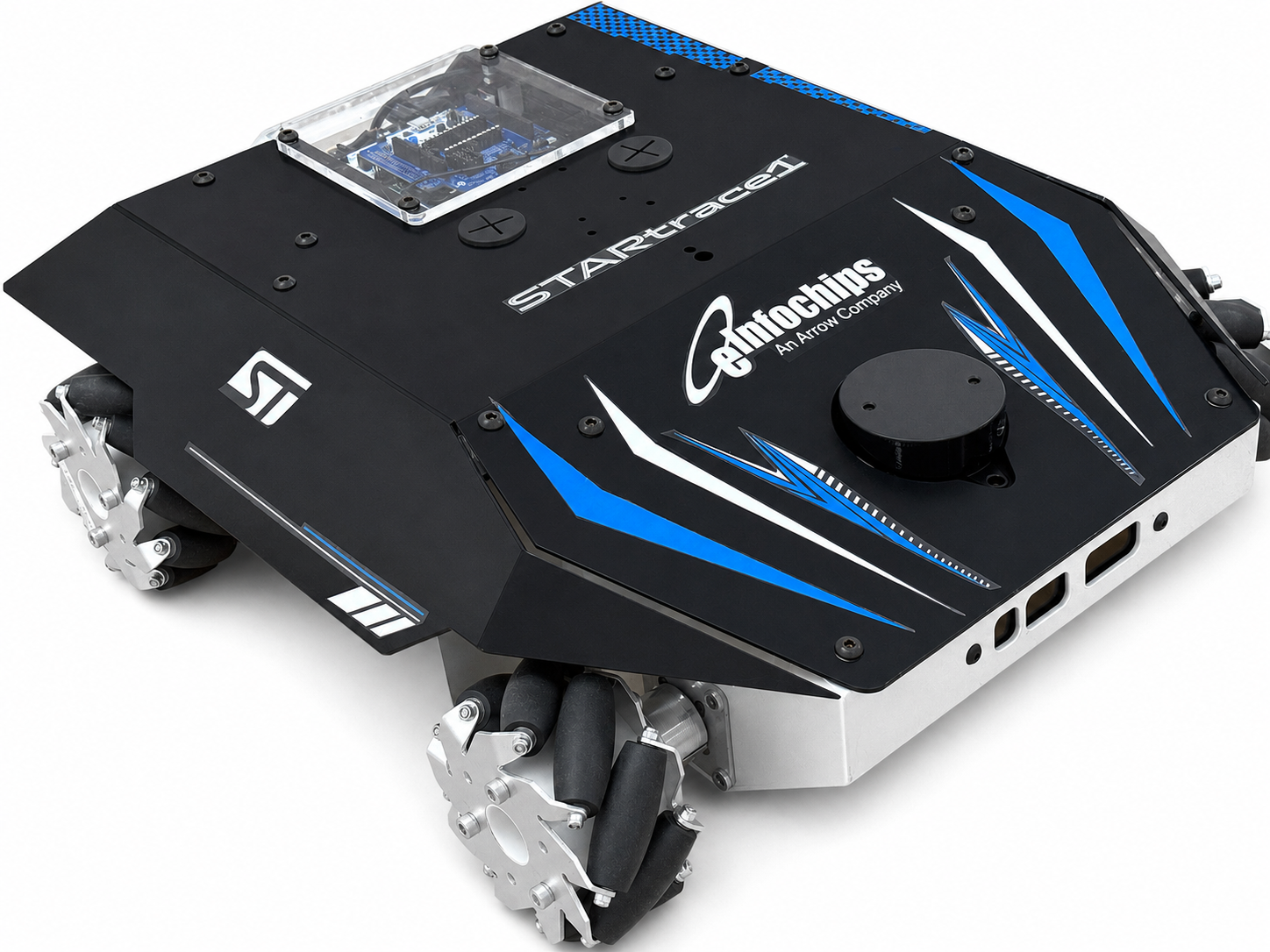
Arrow Electronics, its engineering services subsidiary eInfochips, and STMicroelectronics have introduced an industrial autonomous mobile robot reference platform intended to shorten development time for professional service robots.
The platform combines a complete ST bill of materials with an NVIDIA Jetson Orin Nano compute platform and ROS 2 software stack. It is built around Arrow and eInfochips’ Rover mechanical platform and integrates industrial-grade electronics for power management, real-time control, motion control, sensing, localisation, and autonomous navigation.
The kit includes robust power and battery management for 24V operation, with a pre-validated path to 48V architectures. An STM32-based real-time controller board acts as the interface between the NVIDIA compute layer and the robot’s sensors and actuators.
Motion control is handled through dual BLDC motor drives based on STSPIN32 and STDRIVE devices. The sensing stack uses ST MEMS inertial measurement units, magnetometers, and environmental sensors, supplemented by lidar and vision inputs for SLAM-based mapping and navigation. ROS 2 tools including Cartographer, NAV2, and RViz support mapping, localisation, and autonomous movement.
AMR development brings together mechanical design, motor control, battery management, perception, safety, real-time control, embedded AI, communications, and software integration. Subsystems that work independently during prototype development can still create timing, power, thermal, or reliability problems once combined into a production robot.
Pre-validated platforms reduce some of that early integration burden. They provide a working baseline that can be adapted to different payloads, cost targets, battery sizes, sensor configurations, and industrial use cases, while leaving room for product-specific differentiation around mechanics, autonomy, safety architecture, and fleet software.
Factories, laboratories, warehouses, and logistics centres create difficult operating conditions for autonomous robots. People, shelving, floor changes, lighting variation, wireless coverage limits, reflective surfaces, and unpredictable obstacles all affect the electronics stack. Perception and control have to operate alongside deterministic behaviour where motion safety is involved.
Scaling uncrewed systems from prototype into repeatable production creates many of the same problems seen in UAV manufacturing. Robust testability, traceable electronics, supply-chain control, and production-ready architecture become more important as development moves from demonstration units to deployed fleets.
The platform also reflects the convergence of embedded control and edge AI. NVIDIA Jetson hardware supports perception and AI compute, while STM32 real-time control and ST motion devices keep time-sensitive functions close to the hardware. That separation is becoming common in mobile robots, where high-level autonomy and low-level motor control have different timing, safety, and reliability requirements.
Reuse across product ranges is another pressure point. A platform that can support 24V and 48V designs gives manufacturers room to create different payload and performance tiers from a common control base. Reuse affects certification, software maintenance, spare parts, field service, and lifetime support once robots are deployed in volume.
The Arrow, eInfochips, and ST platform gives AMR developers an integrated starting point for industrial robot hardware, combining power, control, sensing, compute, and software early enough to reduce risk before production engineering begins.