IN Brief:
- Code Metal has acquired Signal Processing Technologies and created an Advanced RF Group.
- The acquisition adds SDR, spectrum sensing, RF machine learning, PNT, and DSP expertise.
- AI-assisted engineering is moving closer to RF, defence, autonomy, communications, and semiconductor implementation.
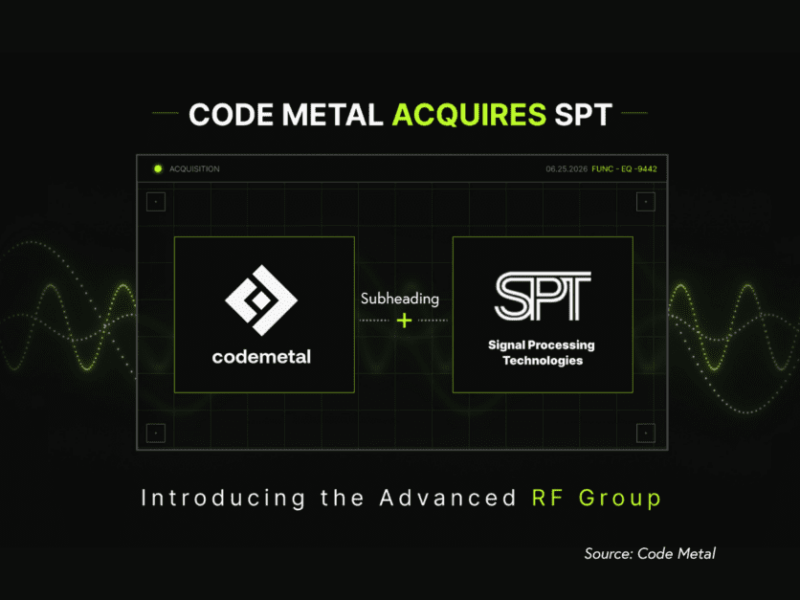
Code Metal has acquired Signal Processing Technologies and launched an Advanced RF Group, expanding its engineering platform into radio-frequency systems, spectrum awareness, and digital signal processing.
The acquisition adds expertise in software-defined radio, advanced communications, spectrum sensing, RF machine learning, positioning, navigation, and timing, and autonomous sensing systems. SPT founders Joe Farkas and Dr Brandon Hombs are joining Code Metal to lead the Advanced RF Group.
Code Metal already works across defence, aerospace, automotive, semiconductor, and communications markets. The acquisition follows its $125m Series B financing earlier this year, which valued the company at $1.25bn.
RF engineering is becoming a more difficult systems problem as spectrum environments become more congested and contested. Communications infrastructure, vehicles, satellites, industrial IoT, defence platforms, robotics, and autonomous systems all rely on the ability to sense, transmit, navigate, and coordinate reliably across complex electromagnetic conditions.
The acquisition gives Code Metal deeper capability in the part of the stack where algorithms must become deployable hardware. Signal-processing software may begin in models, but operational systems have to run on CPUs, GPUs, DSPs, FPGAs, ASICs, RF front ends, and embedded processors under power, latency, thermal, and reliability constraints.
That translation step is one of the harder areas in modern electronics. An RF algorithm that performs well in simulation can fail when exposed to limited precision, hardware timing, interference, antenna behaviour, temperature change, clock stability, data-movement bottlenecks, or edge-case operating conditions. Verification, optimisation, and hardware mapping shape the difference between a working model and a fielded system.
The defence dimension is clear, although the industrial reach is broader. Private wireless networks, resilient positioning, autonomous mobile robots, satellite connectivity, smart infrastructure, and machine-to-machine communications all need stronger RF awareness. Spectrum sensing and adaptive communications are moving beyond specialist military systems into wider operational technology.
Production of Infineon’s RASIC CTRX8188F radar MMIC shows how RF electronics are moving into more centralised, data-heavy architectures where sensing output becomes part of a wider software-defined system. RF hardware increasingly supplies structured data to perception, autonomy, monitoring, and decision layers.
Aerospace and defence timing architecture creates another adjacent constraint. Radiation-tolerant spacecraft clock generation underlines how sensing, navigation, RF performance, and communications depend on stable timing and resilient hardware design. Code Metal’s RF work sits higher in the software and system-design chain, but deployment remains tied to the physical limits of electronics.
AI-assisted engineering may accelerate code generation, optimisation, and hardware mapping, but mission-critical RF systems still need formal verification, test evidence, hardware-specific performance modelling, and repeatable deployment routes. Defence, aerospace, and critical infrastructure systems leave little room for unpredictable behaviour once algorithms meet live spectrum conditions.
The acquisition of SPT gives Code Metal stronger domain depth in a market where software, RF hardware, and semiconductor implementation are converging. The next phase will depend on how effectively that expertise can be turned into repeatable workflows for spectrum-aware systems moving from development into operational deployment.