IN Brief:
- Microchip has introduced the DSA504RT radiation-tolerant six-output programmable clock generator.
- The device can generate multiple clean, phase-aligned frequencies from a single master source.
- Spacecraft timing design is moving towards integrated clock-tree architectures that reduce mass, part count, and synchronisation risk.
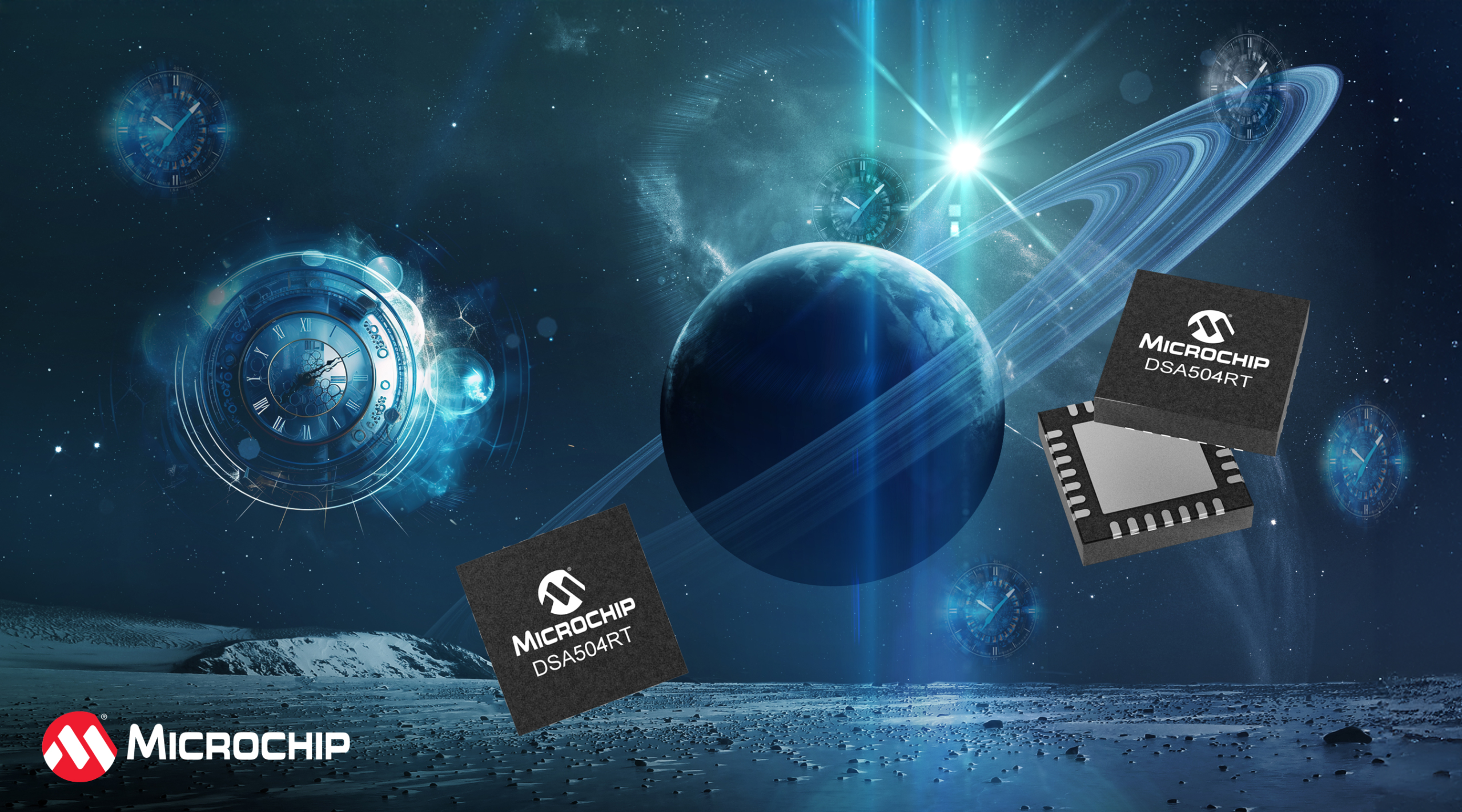
Microchip Technology has introduced the DSA504RT, a radiation-tolerant six-output programmable clock generator developed for aerospace and defence systems that require precise timing across multiple subsystems.
The device is designed to simplify spacecraft timing architectures by generating multiple clean, phase-aligned frequencies from a single master source. It can reduce reliance on multiple discrete oscillators, buffers, and synthesis devices, lowering component count, board area, mass, power consumption, and failure-in-time exposure in high-reliability designs.
Spacecraft timing systems have to support navigation, communications, payload instruments, onboard processing, and control electronics even when GNSS signals are weak, unavailable, disrupted, or deliberately denied. A distributed clock tree built from several separate devices can increase design complexity and synchronisation risk, particularly in systems where power, space, mass, and reliability margins are tight.
The DSA504RT integrates an analogue phase-locked loop with spread-spectrum capability, two fractional dividers, two integer dividers, and six configurable output buffers. Each output can be configured as a differential driver using LVPECL, LVDS, or HCSL, or as a pair of single-ended CMOS outputs.
The device delivers ultra-low jitter performance as low as 200 femtoseconds across the 12kHz to 20MHz range and is compliant with PCIe Gen 1-7 standards. It is offered in QFN28 and CQFP32 packages and is designed to support clock architectures around radiation-tolerant or radiation-hardened FPGAs and microcontrollers.
“This Microchip clock generation device is a game changer for space applications. It can offer a comprehensive clock tree solution, producing three different clock families and up to six different frequencies, each buffered on a variety of selectable output drive types,” said Maamoun Abou Seido, appointed vice president of Microchip’s timing communications group. “Replacing numerous oscillators, buffers and synthesizers, the DSA504RT saves board space and reduces part count to improve the system Failures in Time (FIT) rate in these high reliability applications.”
The introduction extends Microchip’s wider activity in precision timing. Its EX-423 evacuated miniature crystal oscillator targets compact low-power timing in GNSS, military radios, medical devices, seismic systems, and satellite communications, while its expanded hydrogen maser manufacturing in Alabama supports the upper end of high-stability frequency reference production.
The DSA504RT operates at a different point in the timing chain, but the engineering context is the same. Modern systems are more distributed, more synchronised, and more dependent on stable reference signals. In spacecraft, timing errors can propagate into communications performance, sensor alignment, data acquisition, processor interfaces, navigation resilience, and payload accuracy.
Radiation tolerance adds a further layer of design constraint. Space electronics must operate through total ionising dose, single-event effects, temperature extremes, vibration, launch shock, and long mission lifetimes. A more integrated clock generator can reduce part count, provided the device itself satisfies qualification and radiation requirements for the target mission profile.
Replacing multiple discrete timing components can also improve manufacturing and validation. Fewer clock sources reduce the number of interfaces that need to be modelled, routed, tested, screened, and synchronised. A single programmable device can simplify frequency planning and reduce clock-tree complexity, while placing greater importance on configuration control, redundancy strategy, and system-level failure analysis.
The wider space market is increasing demand for timing components that combine heritage with cost control. Large satellites, smallsat constellations, lunar systems, defence spacecraft, and resilient navigation infrastructure all need precise timing, but not every programme can absorb the cost and volume of older bespoke architectures. Radiation-tolerant integrated timing devices help close that gap where mission requirements allow.
GNSS resilience is another driver. Satellite timing is widely used across terrestrial and orbital systems, but jamming, spoofing, outages, and weak-signal environments are pushing designers to improve holdover, local synchronisation, and independent timing paths. Clock generation and distribution therefore sit directly inside the resilience architecture, rather than simply supporting the signal chain.
The DSA504RT gives spacecraft and defence electronics designers a more integrated route to distribute multiple low-jitter timing references from one source. As payloads and onboard processing become denser, timing architecture is becoming a board-level reliability and system-resilience problem rather than a late-stage component choice.