
IN Brief:
- The SX-PCEBE-AP combines 2.4GHz and 5GHz Wi-Fi 7 operation in an embedded access-point module.
- A PCIe 3.0 host interface and Linux support target gateways, machine vision, and edge AI.
- Industrial deployment requires interference testing, secure configuration, roaming control, and measured latency.
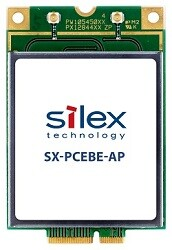
Silex Technology has introduced the SX-PCEBE-AP embedded Wi-Fi 7 access-point module for industrial gateways, machine-vision equipment, factory automation, and edge artificial-intelligence systems.
Built around Qualcomm’s QCN9274-1 platform, the module supports IEEE 802.11be operation across the 2.4GHz and 5GHz bands. Separate 2×2 radio chains allow both bands to operate simultaneously, providing a total of four spatial streams.
Channel widths of 20MHz and 40MHz are available at 2.4GHz, while the 5GHz radio supports 20MHz, 40MHz, 80MHz, and 160MHz operation. A dual-lane PCI Express 3.0 interface connects the module to the host processor.
Two MHF1 antenna connectors are provided, while the power architecture uses a 3.3V main supply and 5V for the radio-frequency front end. The specified operating-temperature range extends from -40°C to +85°C, with relative humidity from 15% to 80% where condensation is avoided.
Silex supports as many as 512 connected clients and provides Linux drivers and integration services for platforms including Nvidia Jetson, Qualcomm, and NXP processors. Certification is planned for the UK, Europe, North America, and Japan.
Wi-Fi 7 introduces multi-link operation, more efficient spectrum use, and higher peak throughput than earlier generations. Where both endpoints provide compatible implementations, multi-link operation can coordinate more than one radio path to reduce latency, improve resilience, or balance traffic.
The SX-PCEBE-AP omits the 6GHz band and concentrates on simultaneous 2.4GHz and 5GHz service. Although that reduces the total spectrum available compared with a tri-band implementation, it can simplify deployment where 6GHz regulations, client support, propagation, or antenna arrangements remain uneven.
Factory networking places greater weight on predictable latency, roaming, and recovery than on peak headline throughput. Machine-vision streams, mobile robots, maintenance terminals, and distributed sensors have different traffic patterns, yet each can be disrupted by interference that would be little more than an inconvenience in an office network.
A 160MHz channel provides substantial capacity but occupies a large proportion of the 5GHz band. Across a site containing several access points, neighbouring networks, radar-avoidance requirements, and reflective metal structures, narrower channels may deliver more stable performance and allow more effective frequency reuse.
Antenna placement will shape the practical link budget. Gateways installed in metal cabinets or close to motors, drives, and switch-mode power supplies may require external antennas, controlled cable runs, and a site survey that measures coverage under operating rather than empty-factory conditions.
Thermal integration also extends beyond the module’s ambient rating because the radio sits beside a host processor, memory, storage, and power conversion. Enclosure airflow, heat spreading, and sustained traffic load determine component temperature more accurately than the nominal environmental range alone.
Security becomes more complex as the number of attached devices grows. Network segmentation, credential provisioning, protected management interfaces, signed firmware, and isolation of untrusted clients have to be built into the gateway and operational procedures rather than left to final installation.
Wi-Fi 7 will operate alongside private cellular networks rather than replacing them outright. A private 5G manufacturing trial led by NMIS has demonstrated the alternative route, using managed cellular coverage for production and automation applications requiring controlled mobility and subscriber identity.
The two technologies overlap but retain different strengths. Wi-Fi uses widely available client hardware and unlicensed spectrum, while private 5G provides centrally managed radio resources and mobility controls. Mixed installations can separate fixed high-bandwidth equipment from wider-area or highly mobile applications.
Long-term software support may prove as important as radio capability in an embedded product. Driver maintenance, host compatibility, regulatory certification, security updates, and recovery after failed firmware changes determine whether a module remains supportable throughout an industrial service life that can extend for a decade.
The SX-PCEBE-AP provides current-generation access-point functionality in a compact embedded form. Reliable deployment will depend on spectrum planning, antennas, thermal design, security, host integration, and measured performance under the interference and traffic conditions found on the working factory floor.

