
IN Brief:
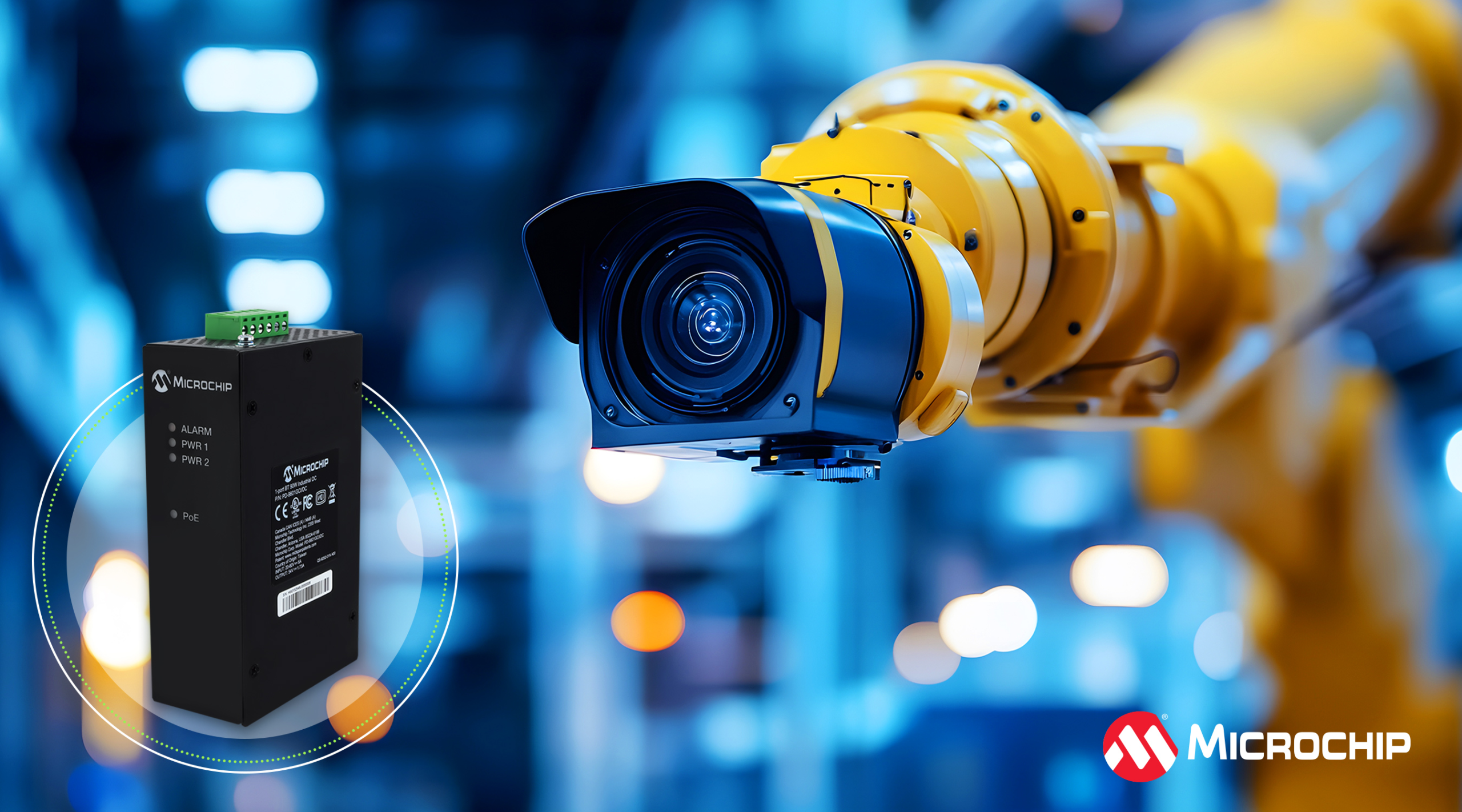
- PD-9601GCI injects up to 90W onto a 10/100/1000Mbps Ethernet connection.
- The IP30 unit operates from −40°C to 75°C with dual 20V to 60V DC inputs.
- Midspan deployment allows industrial PoE equipment to be added without upgrading installed network switches.
Microchip Technology has introduced an industrial Power over Ethernet midspan capable of delivering up to 90W to connected equipment over a Gigabit Ethernet cable.
The PD-9601GCI complies with IEEE 802.3bt and is installed between an existing network switch and the powered device. It injects electrical power onto a 10/100/1000Mbps Ethernet connection, allowing cameras, displays, wireless access points, controllers, sensors, and edge-computing equipment to be deployed without replacing a non-PoE switch.
Two DC inputs accept supplies across a 20V to 60V range, supporting redundant or alternative industrial power arrangements. The sealed metal enclosure carries an IP30 rating and is resistant to vibration, with DIN-rail, wall, and panel mounting options for installation inside cabinets or protected field locations.
Operation is specified from −40°C to 75°C, while enhanced surge protection is intended to withstand electrically demanding installations. Compatibility testing with industrial automation equipment covers power negotiation, cabling, and startup behaviour, reducing the likelihood that an otherwise compliant endpoint will behave unpredictably when connected.
The product extends Microchip’s existing indoor 90W midspan into an industrial package. Production quantities are available, and the device can also be supplied through a private-label arrangement that allows an equipment manufacturer to bundle the injector with its networked product.
PoE reaches higher-power industrial loads
Early Power over Ethernet installations were largely associated with desk telephones, wireless access points, and modest-power cameras. IEEE 802.3bt increased the available power sufficiently to support more capable vision systems, pan-tilt-zoom cameras, displays, lighting controls, access equipment, and edge devices containing processors and local AI accelerators.
Delivering data and power through one cable can reduce electrical installation work, particularly where adding a local mains outlet would require containment, protection, inspection, or production downtime. Centralised DC supplies can also be backed up more readily than numerous distributed AC adaptors, creating a common power-management point for connected equipment.
The cable remains part of the power system, however, and conductor resistance, bundle temperature, connector condition, cable category, length, and installation practice determine how much power reaches the load. High-power PoE requires more careful cable derating than low-power office deployment, especially where many powered links share the same tray or cabinet.
Industrial networks add further constraints because long cable runs may pass near motors and drives, cabinet temperatures can remain elevated, and connectors may be exposed to contamination or vibration. Shielding and grounding intended to improve electromagnetic compatibility must be coordinated with surge protection and building earthing so that additional current paths are not created inadvertently.
The growth of high-power industrial Ethernet for AI-ready networks is pushing the communications layer into machine power architecture. Switch capacity, cable heating, thermal management, equipment placement, and service strategy now have to be considered together when cameras and edge processors draw substantially more power than earlier network endpoints.
A midspan provides a practical migration route because it leaves the installed switch in place. One or several high-power links can be added selectively when the network remains adequate for bandwidth and management but lacks the required PoE class, avoiding premature replacement of a larger multi-port switch.
Additional hardware also creates another powered device and connection point within the network. Cabinet space, DC supply capacity, redundancy, diagnostics, and maintenance access must be planned, particularly when several single-port injectors are installed together; larger projects may still favour managed PoE switches once endpoint count increases.
PD-9601GCI addresses installations where one high-power endpoint must be added quickly or shipped as part of a complete equipment package. Its wide-range DC input, industrial mounting, environmental tolerance, and 90W output turn an existing Ethernet link into a higher-power deployment route without altering the network core.

