IN Brief:
- WhisperExtractor performs audio-feature extraction in the analogue domain before neuromorphic inference.
- INTERA’s event-driven architecture minimises processing activity when relevant sensor events are absent.
- Applications include hearing products, digital health, smart glasses, industrial monitoring, and battery-powered IoT equipment.
Dolphin Semiconductor and INTERA Group have developed a reference platform combining analogue audio-feature extraction with event-driven neuromorphic processing for continuously active edge sensors.
The platform pairs Dolphin’s WhisperExtractor IP with INTERA’s spiking-neural-network architecture. WhisperExtractor calculates mel-frequency cepstral coefficient features in the analogue domain, reducing the volume of raw audio that must be digitised, moved through memory, and processed continuously.
INTERA’s processor evaluates those extracted features using networks in which computational elements communicate through discrete events. When relevant patterns are absent, much of the architecture can remain inactive instead of executing a constant sequence of digital operations.
Applications include true wireless earbuds, hearing aids, smart glasses, digital-health equipment, industrial monitors, and connected sensors whose microphones or transducers must remain operational without imposing the power demand of a fully active digital signal chain.
Dolphin’s voice-interface technology places feature extraction at approximately 7µW under specified always-on conditions using a 32kHz clock. The joint platform extends that analogue front end into a wider inference chain capable of recognising selected acoustic or sensor events locally.
In a conventional always-listening design, an ADC, DSP, memory, and microcontroller may remain active long enough to determine whether an incoming signal deserves further analysis. Analogue preprocessing can reduce that workload before a larger processor or radio is woken.
Narrow classification tasks are well suited to the arrangement because they do not necessarily require an uninterrupted recording. Wake-word detection, alarm recognition, equipment-state classification, respiratory monitoring, and identification of a defined set of acoustic events can operate on extracted features rather than a stored waveform.
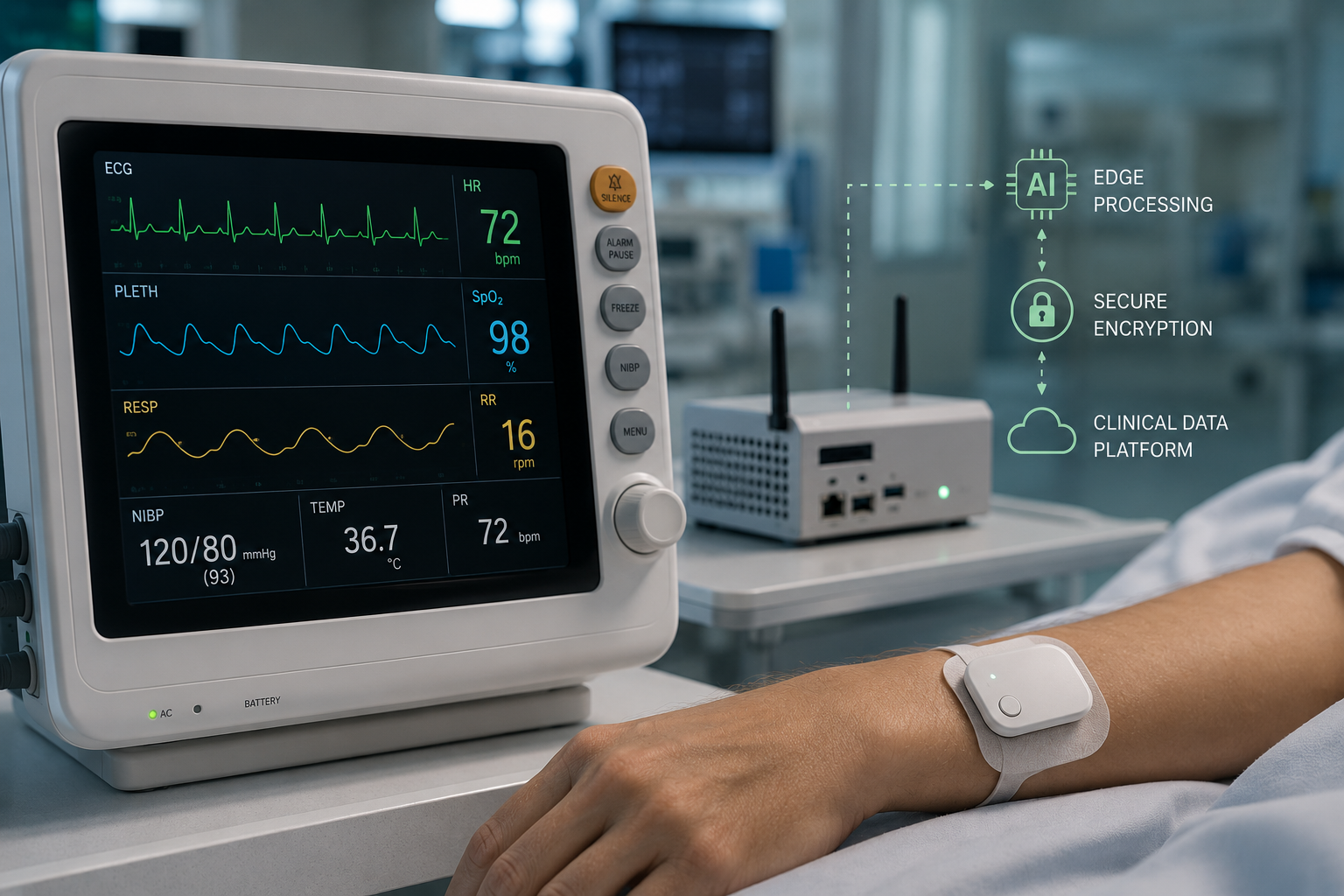
Local classification also limits the quantity of sensitive information leaving the device. A hearing product or health monitor can identify an event without continuously transmitting ambient audio, while an industrial sensor can report a condition instead of sending every sample across the network.
Feature extraction must remain stable across microphone tolerances, temperature, ageing, installation, background noise, and variations between individual users or machines. An analogue representation optimised for one model can discard information needed by another, making the selection of features a central architectural decision.
Spiking neural networks bring a separate set of design constraints. Event-driven execution can lower average power, but development tools, model conversion, verification techniques, and engineering familiarity remain less mature than the ecosystems surrounding conventional neural-network accelerators.
A reference platform can reduce part of that integration burden by defining the interface between analogue extraction and neuromorphic inference. Application-specific training, false-positive analysis, missed-event rates, and wake-up behaviour still need to be characterised using representative acoustic and environmental data.
Medical and hearing products add requirements for repeatability, traceability, and human-factors testing. Placement, user behaviour, background speech, and biological variation can shift signal characteristics, while a low average-power figure cannot compensate for unreliable detection or inconsistent behaviour over the product’s life.
Industrial equipment produces equally difficult data, particularly where several machines, reverberant surfaces, changing speeds, and maintenance activity share one acoustic environment. Models need to distinguish a developing fault from normal process variation without generating enough nuisance alarms to be ignored.
Power-conscious processing is spreading through several device classes, with sparse FPGA inference reducing unnecessary operations through a different architecture. Sparsity, analogue preprocessing, selective wake-up, and event-driven neural networks all restrict computation to information that can alter the result.
The same principle can extend beyond microphones because vibration, pressure, inertial, and biological signals often contain long periods of limited activity interrupted by significant events. A low-power front end can continue monitoring while the main processor sleeps, supporting smaller batteries or energy-harvesting supplies.
Dolphin and INTERA have brought the analogue and neuromorphic stages into one development platform, allowing their combined power and detection behaviour to be assessed as a complete chain. Model portability, manufacturing variation, and long-term reproducibility will determine how readily the design moves into qualified products.