
IN Brief:
- TALQ has become an associated member of LUCI, while LUCI has joined the TALQ Partner Program.
- The partnership connects municipal lighting experience with the vendor-independent TALQ Smart City Protocol.
- Joint guidance and events will address interoperability, procurement risk, energy performance, and long-term system flexibility.
The TALQ Consortium and LUCI have formed a partnership intended to connect municipal lighting strategy with interoperable outdoor-control systems and common technical guidance.
TALQ has become an associated member of LUCI, while LUCI has joined the TALQ Partner Program. The organisations plan to produce city-focused publications, technical material, and joint events, with the first shared formats expected during autumn 2026.
LUCI represents cities and organisations involved in urban lighting, whereas TALQ develops and maintains an open protocol used between central-management systems and outdoor-device networks. The interface supports streetlighting and other connected urban equipment without prescribing the radio or wired technology used between individual devices and their local gateways.
Municipal lighting estates combine luminaires, local controllers, cabinets, gateways, communications links, sensors, and management software, often purchased through separate contracts and replaced on different schedules. A luminaire may remain mechanically serviceable after its communications module becomes obsolete, while a management platform may require replacement long before the underlying electrical infrastructure reaches end of life.
Interoperability allows those layers to be upgraded independently, provided products implement the relevant functions consistently. It also reduces dependence on one supplier across the entire operating life of an installation, which can extend for decades and include several technology generations.
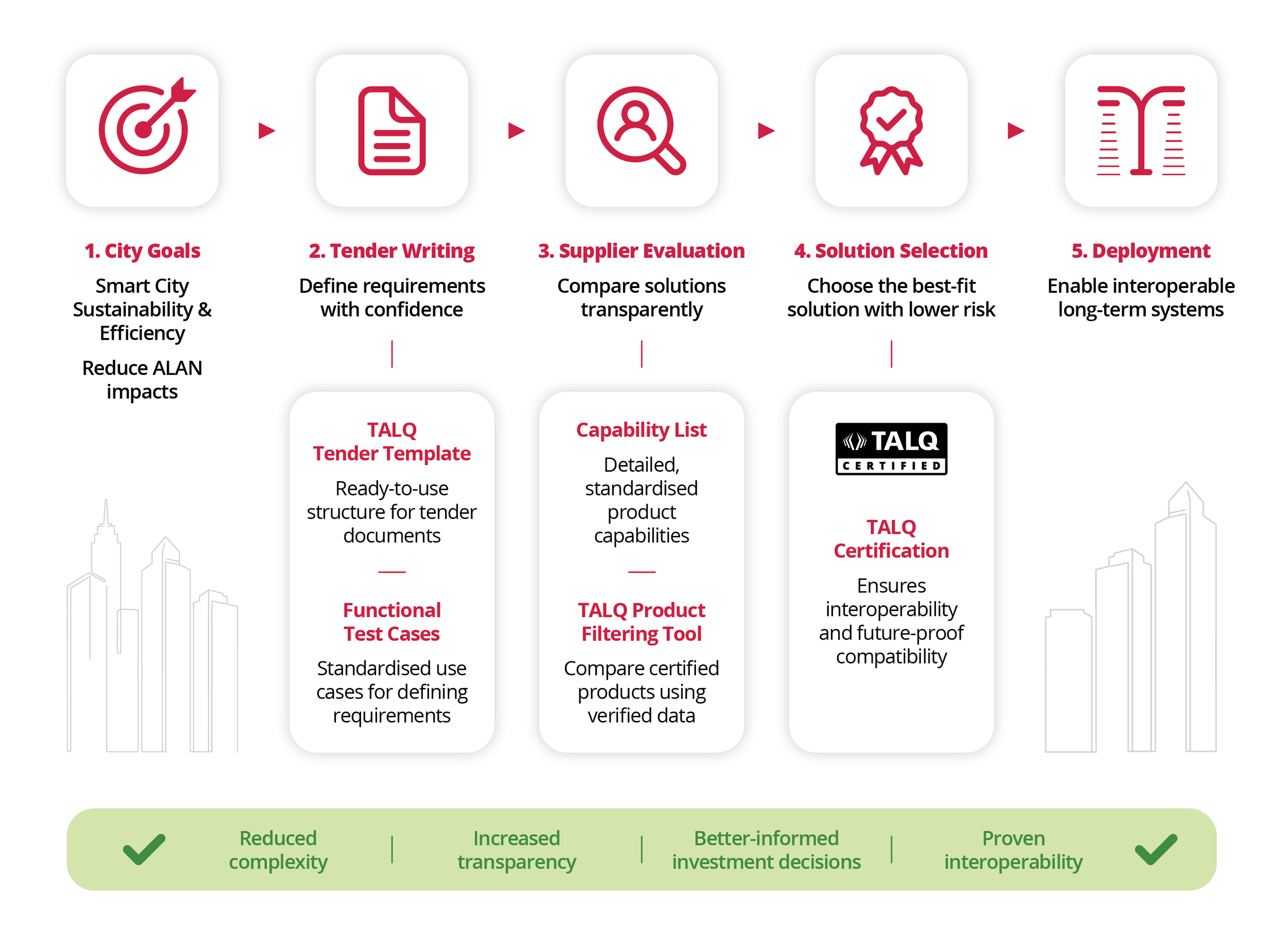
Common protocol support does not guarantee identical behaviour, since optional features, data models, device profiles, and error handling can vary between products. Certification and conformance testing therefore remain central to multi-vendor procurement, particularly where one central-management system must supervise networks supplied by several manufacturers.
Modern streetlighting controls extend well beyond scheduled switching. Management platforms can set dimming profiles, monitor energy use, detect failed luminaires, track cabinet conditions, manage astronomical clocks, and alter output in response to traffic, weather, events, or local operating policies.
As lighting columns acquire environmental monitors, parking sensors, traffic counters, cameras, wireless access points, and other urban devices, the electrical and communications architecture becomes more demanding. Bandwidth, device identity, power availability, cybersecurity, data ownership, and maintenance responsibility all have to be resolved across equipment that may have different suppliers and service lives.
LED conversion lowers connected load, while adaptive dimming can reduce consumption further during periods when full output is unnecessary. The final saving depends on luminaire efficacy, road classification, operating hours, traffic patterns, safety requirements, and the extent to which control profiles are maintained after commissioning rather than left at conservative defaults.
Environmental performance introduces another set of control decisions. Dimming schedules, optical distribution, spectral selection, and curfews can reduce spill light and ecological disturbance, but the management platform cannot decide the acceptable balance between visibility, safety, amenity, and night-time darkness.
Cybersecurity now sits inside the lighting specification because central platforms and field devices are remotely accessible and widely distributed. Device authentication, encrypted communications, signed firmware, role-based access, event logging, vulnerability handling, and secure decommissioning must remain usable after the original system integrator has left the project.
Operational data also has to survive a change of supplier. Energy records, fault histories, repair activity, dimming schedules, asset locations, and device configurations support maintenance planning and investment decisions, yet they lose much of their value when export formats are incomplete or tied to proprietary software.
Procurement documents consequently need to describe testable functions rather than broad aspirations for openness. Interface versions, required profiles, certification status, data-retention rules, cybersecurity obligations, update periods, and procedures for replacing one system layer should be specified before bids are compared.
The partnership gives municipal users a route to feed operational experience into the protocol community, while TALQ can expose where procurement language or product interpretation has produced inconsistent field results. Shared guidance could also help cities distinguish genuine interoperability from arrangements that remain dependent on vendor-specific adaptors or licensing.
Initial outputs will take the form of publications and events rather than new hardware, and their value will depend on the detail carried into tenders, certification programmes, and maintenance contracts. If municipal requirements are converted into measurable interface and lifecycle obligations, lighting estates can evolve without requiring a complete system replacement whenever one technology layer changes.

