IN Brief:
- Five engineers will receive hardware kits to develop healthcare or smart home prototypes.
- Suggested projects include health monitors, medication systems, safety devices, and therapeutic platforms.
- Entries will be judged on technical execution, component integration, documentation, and the completed outcome.
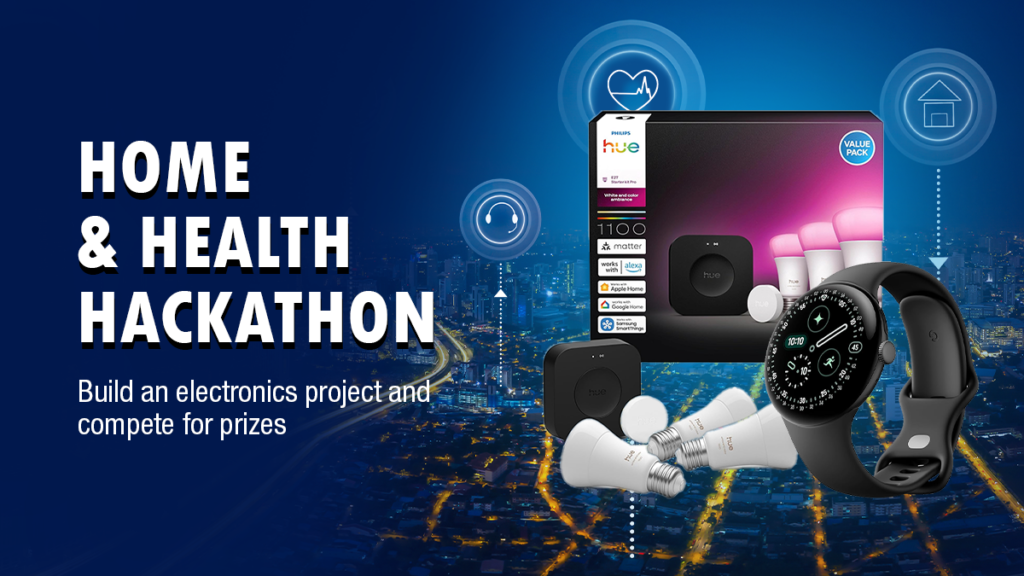
Element14 Community has opened a design challenge centred on smart home and healthcare prototypes addressing safety, wellbeing, independence, monitoring, and daily care. Five selected participants will receive component kits and document their development before submitting a completed working system.
Applications remain open until 16 August, with the chosen challengers expected to finish their projects by 18 October. Entries will be judged on creativity, technical execution, use of the supplied components, the quality of the project record, and the performance of the final prototype.
Suggested applications include open source health monitors, medication management systems, elderly safety devices, sports performance equipment, mental health tools, and technologies intended to support children or people living independently. Smart home proposals may combine environmental sensing, occupancy detection, access control, alerts, and automated responses.
Publishing progress throughout the challenge creates a record of architecture selection, circuit development, embedded software, enclosure work, test results, and revisions. Those stages often reveal more about a design than the finished demonstration, particularly when sensors, wireless links, power systems, and user interfaces have to operate together.
Healthcare prototypes may bring physiological sensors, microcontrollers, displays, connectivity, and local or cloud based analysis into one device. Smart home systems add their own requirements around installation, interoperability, domestic radio conditions, power consumption, and the behaviour of users who may not have any technical training.
Within the limited development period, a convincing entry will need stable power, defined sensor behaviour, reliable communications, understandable controls, and a predictable response when readings are absent, contradictory, or outside their expected range. Documentation will also have to distinguish measured capability from assumptions that have not yet been tested.
Prototype performance depends on real conditions
Development boards make sensing and connectivity accessible, but health and safety applications quickly expose the distance between an experiment and dependable equipment. Placement, calibration, motion artefacts, temperature, lighting, battery condition, clothing, skin contact, and ordinary human behaviour can all produce results that differ from controlled bench tests.
A useful prototype therefore reports uncertainty and test conditions rather than presenting every measurement as equally reliable. False alarms can make a monitoring system unusable, while missed events create a more serious risk, so threshold selection and error handling deserve as much attention as the nominal sensor accuracy.
Once personal information enters the design, data handling adds another layer of engineering. Health and home monitoring can reveal physical condition, routines, location, medication, and periods when a property is unoccupied; the design must establish what remains local, what is transmitted, how long information is retained, and who can retrieve it.
Local processing reduces network dependence and the movement of sensitive raw data, although it introduces firmware management, model validation, and recovery requirements. Cloud analysis can simplify remote access and heavier computation, but it also creates reliance on accounts, connectivity, service availability, and continuing operating costs.
Configurable human machine interfaces developed by SECO demonstrate how display clarity, input method, response time, and predictable behaviour become part of the engineering rather than a decorative layer. The same discipline applies to a healthcare prototype, where confusing alerts or controls can erase the value of accurate sensing.
Where a prototype touches health monitoring, medical claims require particular restraint. A prototype can monitor a signal or demonstrate an alert without becoming a diagnostic or therapeutic device; progress towards a commercial product introduces risk management, usability engineering, electrical safety, cybersecurity, software lifecycle controls, manufacturing quality, clinical evidence, and regulatory approval.
Smart home equipment faces a different but related lifecycle problem because installed products may outlast the phone, router, or cloud service used during development. Documented interfaces, replaceable batteries, a defined offline mode, and recoverable configuration can determine whether the system continues to function after its original software environment changes.
The strongest challenge entries will therefore expose failures, trade offs, and measurements alongside the completed prototype. A short development cycle cannot resolve every certification or lifecycle question, but it can establish which assumptions survive real hardware, imperfect users, and inconsistent surroundings before a design proceeds to a more demanding stage.