IN Brief:
- Space CSAC-SA65 is rated for at least 30 kRad and operation from -40°C to +80°C.
- The atomic clock consumes less than 120mW and occupies less than 17cc.
- Integrated 1PPS input and output support satellite synchronisation without continuous dependence on GNSS timing.
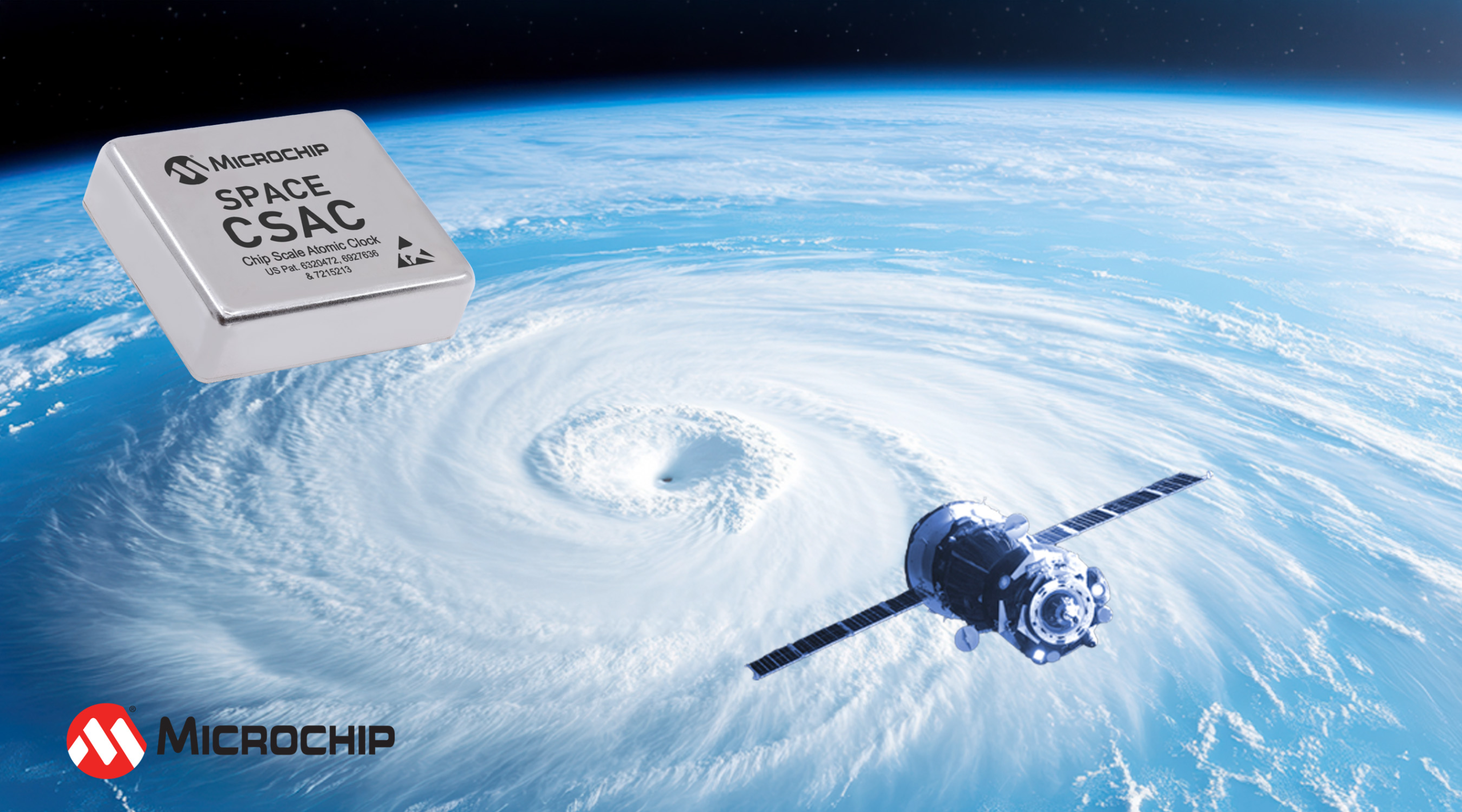
Microchip Technology has extended its chip-scale atomic clock range with a radiation-tolerant timing device designed for satellites where frequency stability has to fit within tight power, volume, and environmental limits.
The Space CSAC-SA65 is rated for radiation tolerance of at least 30 kRad and operation from -40°C to +80°C. Microchip specifies power consumption below 120mW and a package volume of less than 17cc, positioning the device for low-Earth-orbit spacecraft and other systems where larger precision timing assemblies would impose a significant electrical or mechanical penalty.
The clock includes one-pulse-per-second input and output interfaces for synchronisation and is intended to maintain an accurate local timing reference when an external source such as a Global Navigation Satellite System signal is unavailable. Satellite electronics normally use several layers of timing, with external references disciplining local oscillators that then distribute clocks through communications, processing, sensing, and control systems.
If the external reference disappears, the stability of the onboard clock determines how rapidly timing error accumulates. An atomic clock derives its longer-term stability from an atomic transition rather than depending solely on the characteristics of a conventional crystal oscillator, while chip-scale implementations reduce the physics package and electronics sufficiently for tighter spacecraft architectures.
Miniaturising the clock does not remove the conditions imposed by space. Timing electronics have to operate through launch vibration, radiation exposure, temperature variation, and a power budget shared with radios, processors, sensors, payloads, and attitude-control equipment. The useful engineering trade therefore depends on whether the clock retains adequate performance within the actual radiation dose, shielding, orbit, and lifetime of the mission.
Microchip describes the SA65 as a commercial off-the-shelf product built with radiation-tolerant commercial electronic components rather than a traditional fully radiation-hardened timing assembly. That positions it between conventional commercial timing devices and larger specialised space references, giving designers another option where mission requirements do not justify the size, power, or cost of the latter.
Low-Earth-orbit platforms are a principal target. LEO constellations can involve large numbers of comparatively compact satellites with different radiation and service-life assumptions from spacecraft designed for much longer operation or harsher environments, making component selection dependent on the complete system architecture rather than the largest radiation number available on a data sheet.
The SA65 follows Microchip’s earlier Space CSAC-SA45 and extends the specified radiation tolerance and operating-temperature range while retaining chip-scale dimensions and low power consumption. Applications identified by the company include satellite timing and frequency control, assured positioning, navigation and timing, and inter-satellite links.
Those functions all depend on maintaining a common sense of time or frequency across electronic subsystems. Communications equipment uses precise references to manage modulation and channel timing, processors timestamp data, navigation algorithms depend on time measurements, and cross-linked spacecraft may need to coordinate traffic or ranging across several nodes.
Cross-links make clock stability particularly visible at system level because timing errors can affect scheduling, synchronisation, and measurement between satellites. The same principle applies within a spacecraft, where distributed radios, sensors, and processors may derive timing from a shared reference before generating local clocks appropriate to each subsystem.
The integrated 1PPS interfaces provide a conventional route for connecting the atomic reference into that hierarchy. An external signal can discipline the clock when available, while the atomic reference provides holdover between updates; interface delay, downstream clock generation, oscillator noise, and distribution circuitry still determine the quality of timing delivered to the final load.
Continuous power below 120mW is similarly relevant because a clock is an always-on load. Saving a fraction of a watt does not transform the spacecraft power system by itself, but repeated savings across timing, sensing, processing, and communications electronics can reduce battery, solar-array, and thermal requirements.
The sub-17cc volume addresses the same integration pressure from the mechanical side. Small satellites have limited board and enclosure space, and a precision timing reference has to compete with compute modules, radios, power converters, sensors, and harnessing.
The SA65 therefore does not make atomic timing necessary for every satellite. It reduces the size and power cost of choosing it, giving LEO and other compact spacecraft a local timing source with specified radiation and temperature performance where longer holdover or more stable synchronisation justifies the additional component.