IN Brief:
- Philips has received an ARPA-H award worth up to $33.7 million for its A-RISE programme.
- The development combines Azurion imaging, robotic control, autonomous navigation, and steerable catheter technology.
- Future clinical use remains subject to development evidence, clinical oversight, and applicable regulatory requirements.
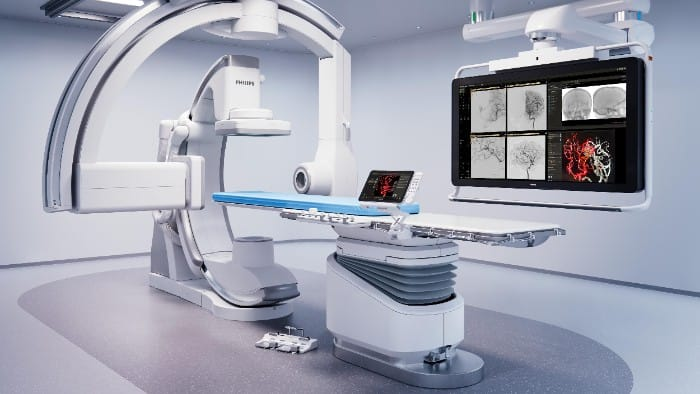
Philips has secured an award worth up to $33.7 million from the US Advanced Research Projects Agency for Health to develop AI-enabled robotic systems for stroke intervention. The A-RISE programme will combine image-guided therapy, robotics, automated navigation, and smart interventional devices around the company’s Azurion platform.
Philips North America is leading the project with Johns Hopkins University and Boston University, with Dr J Mocco of Weill Cornell Medicine participating as a clinical collaborator. The work is aimed at remote-assisted and increasingly automated endovascular procedures, with supervised autonomy under expert clinical oversight rather than unsupervised intervention.
Mechanical thrombectomy requires an interventional team to navigate devices through the vascular system to a clot in the brain while imaging guides the procedure in real time. Philips plans to develop endovascular navigation, robotic device control, image-based guidance, workflow automation, and remote intervention as connected parts of the same system. Johns Hopkins will work on autonomous device navigation, while Boston University will develop steerable catheter technology.
Combining those functions creates a demanding control problem. Imaging has to provide timely information, robotic motion has to remain predictable, steerable devices must respond within the constraints of the vasculature, and software decisions have to be presented in a form that allows clinicians to supervise and intervene. The system also has to preserve the safety and traceability expected of regulated medical equipment.
Bert van Meurs, chief business leader for Image-Guided Therapy at Philips, said: “The goal is not to replace expertise, but to make expertise scalable and accessible.” The development programme consequently centres on extending specialist capability rather than removing the specialist from the clinical loop.
The access problem is substantial. Philips cites around 335,000 US patients each year as eligible for thrombectomy, while only about 12% receive the treatment. More than half of Americans live over an hour from a hospital capable of performing it, and globally fewer than 3% of eligible patients with large-vessel occlusion receive mechanical thrombectomy.
Robotics cannot remove all of those constraints. A thrombectomy service still depends on suitable imaging infrastructure, trained clinical staff, emergency pathways, appropriate facilities, and rapid diagnosis. Remote assistance or greater automation could, however, change where some specialist skills have to be physically located if the technology can demonstrate reliable performance and fit within clinical and regulatory controls.
Philips already has more than 20,000 image-guided therapy systems installed across more than 80 countries, giving the programme an established imaging platform rather than a clean-sheet hardware environment. That brings advantages in clinical workflow and installed infrastructure, but it also means new robotic and AI functions have to integrate with interfaces, procedures, service arrangements, and safety controls that hospitals already use.
The electronics challenge extends from imaging detectors and high-performance processing to motor control, sensing, communications, user interfaces, and the embedded software that coordinates them. Latency and reliability become especially important when image interpretation and physical device movement are coupled, because delayed or inconsistent data can affect how a robotic action is planned and supervised.
The technologies remain under development, and Philips states that future clinical use or commercial availability will depend on applicable regulatory requirements. The immediate programme therefore has to establish engineering evidence before commercial scale becomes relevant: repeatable navigation, controllable robotic motion, dependable imaging integration, and a workflow in which automation remains transparent enough for clinical oversight.
A-RISE brings several established technology domains into a less mature system architecture. Image-guided intervention, robotic actuation, and machine-learning methods each have their own development history, but combining them inside a time-critical endovascular procedure raises a different standard of evidence. Progress will depend on whether the technologies behave as one controlled medical system rather than on the sophistication of any single component.