IN Brief:
- A new uEye Vision architecture will underpin future 2D industrial camera series with revised electronics and platform scalability.
- IDS is expanding event-based imaging, uEye 3D Nion, Ensenso stereo vision, and AI-enabled uEye Live cameras.
- Embedded projects include GMSL multicamera processing, integrated active-focus control, and multispectral NDVI imaging.
IDS Imaging Development Systems is broadening its industrial vision platform across conventional cameras, event-based sensors, 3D imaging, edge AI, and embedded multicamera processing, with the company preparing to demonstrate the technologies at VISION 2026 in Stuttgart. The programme places increasing emphasis on the electronics and processing architecture behind the camera, reflecting machine vision’s movement from simple frame capture towards more distributed interpretation of image data.
At the centre of the portfolio is a new uEye Vision camera platform intended to form the technological basis for future 2D industrial camera series. IDS describes a revised electronics architecture alongside a redesigned mechanical concept, with current-generation sensors and higher-performance components intended to provide a scalable base for subsequent products rather than another isolated camera family.
That platform approach matters in industrial imaging because cameras frequently remain inside machinery for much longer than consumer imaging products. Sensor availability, interface continuity, software support, mechanical compatibility, and replacement strategy can therefore carry as much weight as a short-term improvement in resolution or frame rate. A common camera architecture can simplify that lifecycle if subsequent models retain enough electrical and software continuity to reduce requalification work.
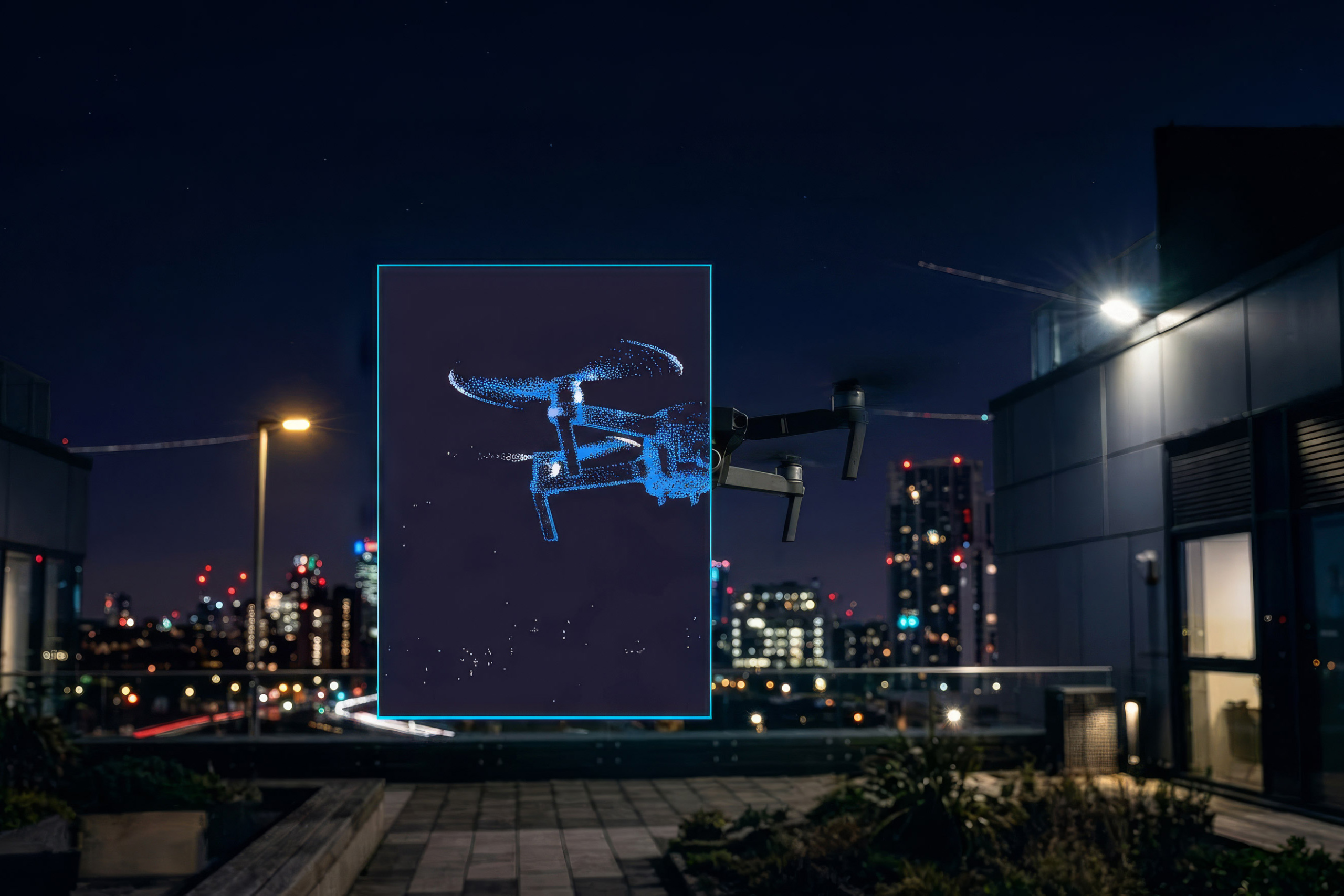
Event-based imaging provides a more fundamental change. IDS is working with Prophesee on systems in which pixels report changes in a scene rather than repeatedly transmitting complete image frames. Static information can be ignored while movement produces asynchronous events, reducing redundant data and latency in applications where objects or cameras are moving quickly.
IDS is positioning event-based vision for drones, UAVs, AGVs, object detection, tracking, and navigation. The sensing method changes the downstream processing problem as well as the camera itself: algorithms receive a temporal stream of changing pixels instead of a sequence of complete conventional images. That can reduce the amount of data that has to be transferred and analysed, but it also requires software and processing pipelines designed specifically around event streams.
The company’s 3D work is developing in parallel. Its uEye 3D Nion time-of-flight range is gaining an RGB configuration for synchronised colour and depth acquisition, while IDS is also introducing another model in the Ensenso N active-stereo family. Time-of-flight and stereo systems solve the depth problem differently, giving machine builders options according to range, scene geometry, precision, ambient conditions, and processing requirements.
AI processing is also moving closer to the sensor. IDS is extending the uEye Live monitoring range with AI-capable models intended to perform image-processing tasks at the edge. Neural networks from DENKweit are being applied to functions including object and orientation detection, parcel handling, and code reading, reducing the need to send every image to a separate host before useful information can be extracted.
Local inference changes the electronics specification around the camera. Processing performance, memory, thermal limits, model deployment, and update management become part of the imaging system rather than separate server-side concerns. The benefit is potentially lower data traffic and shorter decision latency, but those gains depend on how effectively the selected neural network maps onto the available embedded processing resources.
A GMSL Multi-Camera Vision System pushes that architecture into distributed imaging. IDS is demonstrating a design in which images from several cameras are processed and combined through integrated image-signal processors and system-on-chip hardware before the resulting data is transmitted over a single Gigabit Multimedia Serial Link cable. The company says this reduces latency and aggregate data load while leaving more host processing capacity available for the application.
Other projects address narrower integration problems. An active-focus concept places focus control and feedback directly inside the camera and exposes it through software, while an NDVI camera combines multispectral vegetation analysis with conventional colour imaging. The latter is aimed at applications where machine vision has to measure characteristics beyond visible appearance rather than merely increase conventional RGB resolution.
The technologies cover markedly different tasks, but they converge on the same system-design question: where should image information be captured, processed, combined, and discarded? Increasing sensor resolution alone can make the data burden worse. Event sensors, depth processing, local AI, and embedded multicamera aggregation instead move more decisions towards the edge, making interfaces, SoCs, processing resources, software architecture, and long-term component support increasingly important parts of camera selection.
IDS will show the portfolio at VISION 2026 in Stuttgart from 6 to 8 October. Several elements remain development projects rather than fully specified production products, so the engineering value will become clearer as interfaces, performance figures, supported sensors, processing specifications, and production availability are published. The broader direction is already evident: industrial cameras are becoming computing nodes in their own right, and the electronics around the image sensor increasingly determines what information reaches the rest of the machine.