IN Brief:
- The Bangkok facility starts with around 350 employees and can expand to five manufacturing modules.
- Automated assembly, test, and wafer test operations broaden Infineon’s backend production footprint.
- Module A is expected to support around 1,000 employees as production scales.
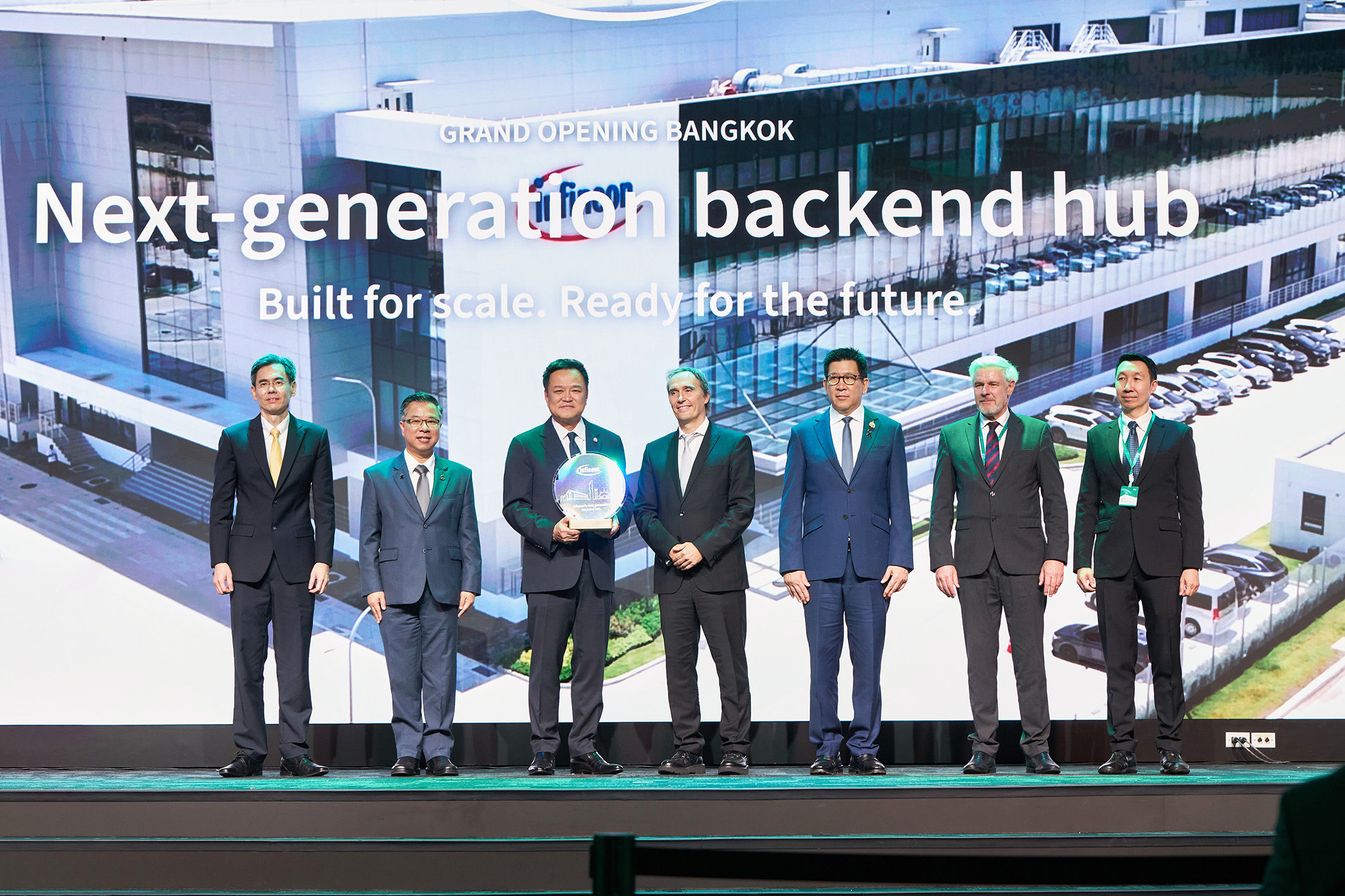
Infineon Technologies has opened a new semiconductor backend manufacturing site in Bangkok, Thailand, adding assembly, test, and wafer test capacity to its global production network.
The greenfield facility in Samut Prakan has started with around 350 employees and is expected to support approximately 1,000 as its first manufacturing building, Module A, ramps. Infineon has designed the site for phased expansion to five modules, leaving scope for substantially more backend capacity as product volumes increase.
Backend manufacturing covers the stages required to turn processed semiconductor wafers into tested products ready for qualification and shipment. Assembly, packaging, wafer test, and final electrical test have to accommodate different device families while maintaining throughput, traceability, and process control across high-volume production.
Infineon says the Bangkok operation combines cleanroom space, assembly and test equipment, wafer test capability, digital manufacturing systems, and extensive automation. The site will support products serving automotive, industrial, and energy applications, where long qualification cycles and continuity of supply put additional demands on manufacturing consistency.
Bringing wafer test and later backend operations into the same location creates a broader manufacturing role than final assembly alone. Processed wafers can be electrically characterised before devices continue through assembly and final testing, while production data from each stage can feed into planning, quality control, and equipment management across the site.
The modular layout gives Infineon more control over the pace of capacity expansion. Semiconductor demand rarely follows a steady curve, and committing an entire large factory to equipment before volumes materialise can leave expensive cleanroom space underused. A site built around successive modules allows manufacturing capacity and supporting infrastructure to be introduced in stages.
Geographic diversification is also part of the investment. Wafers that have completed frontend processing still depend on backend assembly and test before they can enter customer supply chains, making disruption at those later production stages commercially significant even when wafer fabrication remains unaffected.
The Bangkok site adds another production location to a network spanning multiple countries and manufacturing disciplines. Replicating qualified processes between plants is not trivial, particularly where automotive and industrial devices require long production lifetimes, controlled change procedures, and detailed traceability, but a broader footprint can reduce dependence on individual backend locations.
Infineon is working with universities, educational institutions, and industry partners in Thailand to develop the workforce required by the site. Automation reduces repetitive handling but increases demand for process engineering, equipment maintenance, test development, quality, manufacturing software, and other specialist skills needed to keep production lines stable.
The facility also incorporates water recycling, rainwater collection, onsite solar generation, and electricity that Infineon describes as coming from green sources. Semiconductor backend operations are less resource intensive than many frontend wafer processes, but cleanrooms, automated equipment, environmental control, and electrical test still create substantial utility demand as a factory expands.
The new operation follows Infineon’s sale of its older Bangkok and Nonthaburi backend site to Malaysian Pacific Industries earlier in 2026, accompanied by a long-term supply agreement. The Samut Prakan plant represents a different production model, built from the outset around automation, digital manufacturing, and modular expansion.
Module A now has to progress through production ramp, equipment qualification, staffing growth, and transfer of additional product volumes. Further expansion towards the five-module layout will depend on how quickly demand justifies additional equipment and cleanroom capacity, giving Infineon room to increase its Thai backend footprint without committing every planned phase at once.