IN Brief:
- Four second-generation Osprey converters provide 1.3kW to 2.6kW regulated 48/54V-to-12V conversion.
- Peak efficiency reaches up to 98.5% while the family retains the modified DOSA quarter-brick footprint.
- PMBus, remote sensing, fault logging, current sharing, and protection functions support managed high-density power architectures.
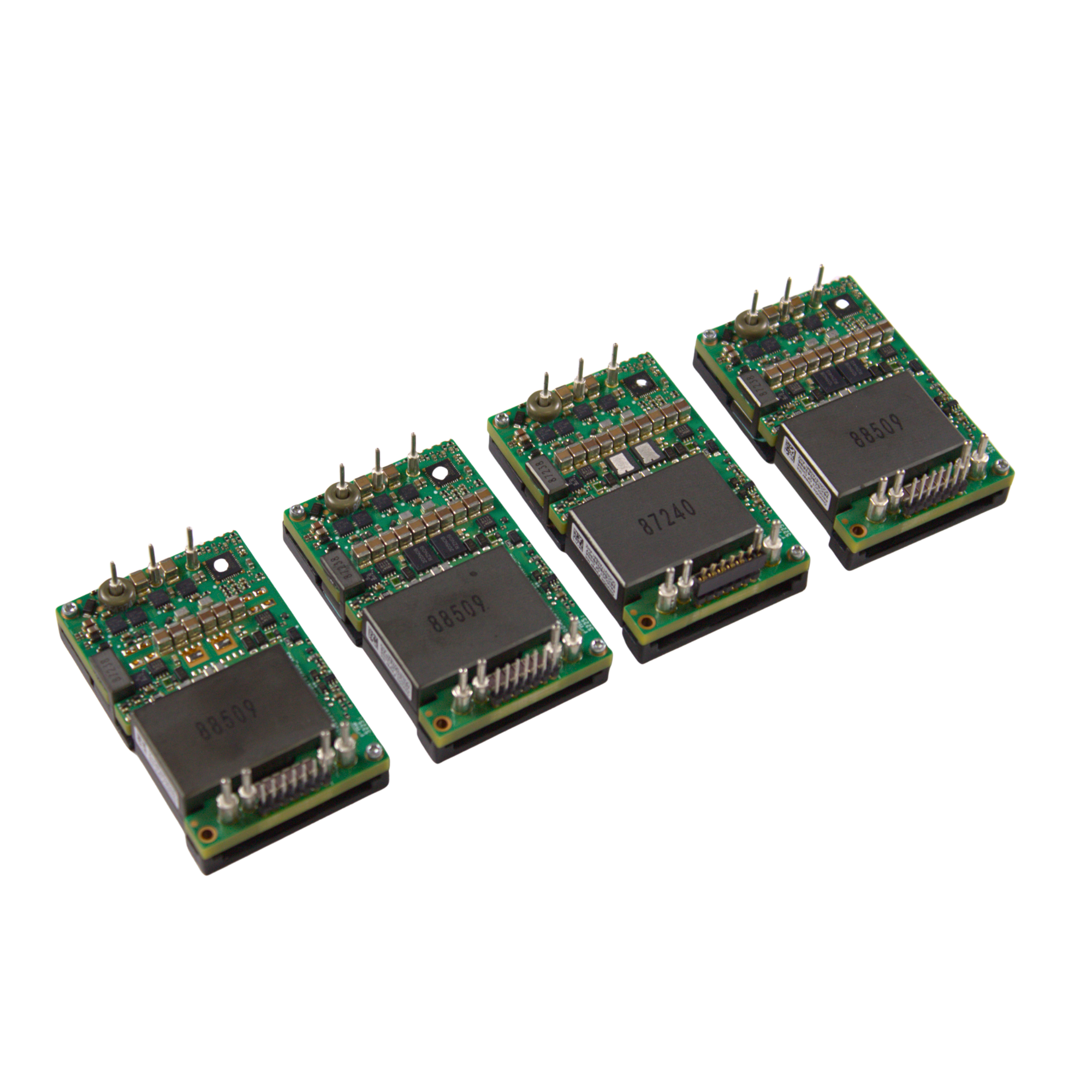
OmniOn Power has expanded its Osprey bus converter family with four second-generation modules delivering between 1.3kW and 2.6kW from 48V and 54V distribution rails to a regulated 12V intermediate bus, while retaining the modified DOSA quarter-brick footprint used by the previous generation. The QODN family is aimed at AI servers, high-density computing, and distributed power architectures where board area, thermal margin, and conversion loss are being squeezed simultaneously by rising processor power.
The range comprises the 2.6kW QODN217, 2kW QODN167, 1.6kW QODN136, and 1.3kW QODN108, corresponding to output currents of approximately 217A, 167A, 136A, and 108A at 12V. All four operate across a 40V to 60V input range, giving system designers margin around the 48V and 54V rails widely used in server and communications equipment while preserving a common mechanical format across the product family.
OmniOn specifies peak efficiency of up to 98.5%, with the 2kW QODN167 rated at 98% full-load efficiency from a 54V input and the 1.6kW QODN136 and 1.3kW QODN108 reaching 98.1% under the same condition. Those differences appear modest in percentage terms, but at multi-kilowatt power levels every fraction of a percentage point represents heat that no longer has to be removed from a densely populated server board or returned to the rack cooling system.
The company is consequently emphasising the flatness of the efficiency curve across the operating range as much as the highest headline figure. AI accelerators can move rapidly between power states as workloads start, stop, or shift phase, so a converter optimised around one narrow load point may deliver less useful system performance than one that maintains high efficiency across the wider band encountered during normal operation.
Philip Zuk, senior vice president and general manager of OmniOn Power’s AI and Data Center business, said incremental efficiency gains can produce significant cost benefits when repeated across large numbers of servers, with the new Osprey generation intended to increase power capability without consuming more board area than the QODE modules it replaces.
The electrical architecture uses regulated 48/54V-to-12V conversion rather than a fixed-ratio stage, leaving the 12V rail to feed point-of-load regulators closer to CPUs, GPUs, memory, networking silicon, and other devices. Splitting conversion into those stages allows the bus converter to handle the large drop from the rack or board distribution voltage while local regulators manage the final transition to the much lower voltages required by advanced processors.
Keeping the modified DOSA quarter-brick footprint gives designers a potential migration path from earlier Osprey modules without rearranging mounting positions and surrounding power hardware simply to accommodate a higher-rated converter. The mechanical continuity becomes increasingly valuable as output rises because the electrical path around the module, including copper distribution, connectors, sensing, and cooling hardware, can be as difficult to redesign as the converter itself.
Current density illustrates that constraint clearly. A 2.6kW output at 12V corresponds to roughly 217A, placing substantial demands on PCB copper, bus structures, connectors, current sharing, and thermal interfaces even when the conversion stage itself remains physically compact. Increasing the converter’s power rating therefore concentrates more electrical and thermal stress around the same board area, making layout resistance and heat spreading increasingly important parts of the system design.
OmniOn has equipped the QODN family with active current sharing for parallel operation, allowing several modules to contribute to a larger power rail while balancing load between converters. PMBus support adds remote on/off control, remote sensing, power-good signalling, firmware updates over I2C, and black-box fault logging, giving operators and system controllers greater visibility into a component that has traditionally been treated as a largely self-contained part of the power chain.
Those monitoring functions become more useful as power conversion is managed alongside the rest of the server rather than inspected only after a failure. Fault histories, temperature events, output behaviour, and operating status can help distinguish a gradual degradation from a sudden upstream or downstream event, particularly in installations where hundreds or thousands of similar modules are operating across one facility.
Protection functions include output overcurrent and overvoltage, overtemperature shutdown, and input under- and overvoltage protection, while the family is specified for operation from -40°C to +85°C. Available output will still depend on airflow, baseplate configuration, input conditions, and the thermal environment around the module, because a high conversion efficiency does not eliminate several tens of watts of dissipation once output reaches the upper end of the range.
OmniOn offers heat-plate configurations intended to couple the converter into external thermal structures, reflecting the growing difficulty of treating board-mounted power as a secondary cooling problem. As accelerator power increases, the conversion stage and its associated conductors occupy the same thermal budget as memory, networking, and compute hardware, so improvements in converter efficiency directly affect how much cooling capacity remains available elsewhere in the server.
The new Osprey family sits within the established 48V and 54V power architecture used by current high-density servers rather than the emerging 800V rack systems being developed for future AI installations. That gives the QODN modules a more immediate application path, particularly where equipment makers want to increase board power without replacing the entire upstream distribution system, while still leaving the final low-voltage conversion close to the processor.
For designers, the useful measure will be how the efficiency and thermal figures hold across real workload profiles, parallel configurations, and high-current board layouts rather than at a single laboratory operating point. A quarter-brick capable of 2.6kW removes one packaging constraint, but it leaves no room for weak current distribution or inadequate cooling around it; at this power level, the converter, PCB, connectors, and thermal hardware increasingly have to be engineered as one system.