IN Brief:
- Summation averaging is available for 52 PCIe and Ethernet-connected digitizer variants in the 59xx series.
- Spectrum specifies processing of up to two million repetitive events per second under suitable acquisition conditions.
- Onboard accumulation reduces host data transfer when individual raw captures are not required.
Spectrum Instrumentation has introduced a firmware option allowing 59xx series digitizers to carry out summation averaging in the onboard field-programmable gate array. The function is designed for measurements in which substantially the same electrical waveform is captured repeatedly, but individual acquisitions contain unwanted noise. Spectrum specifies processing rates of up to two million events per second under suitable conditions and says the option is available across 52 versions of the 59xx family.
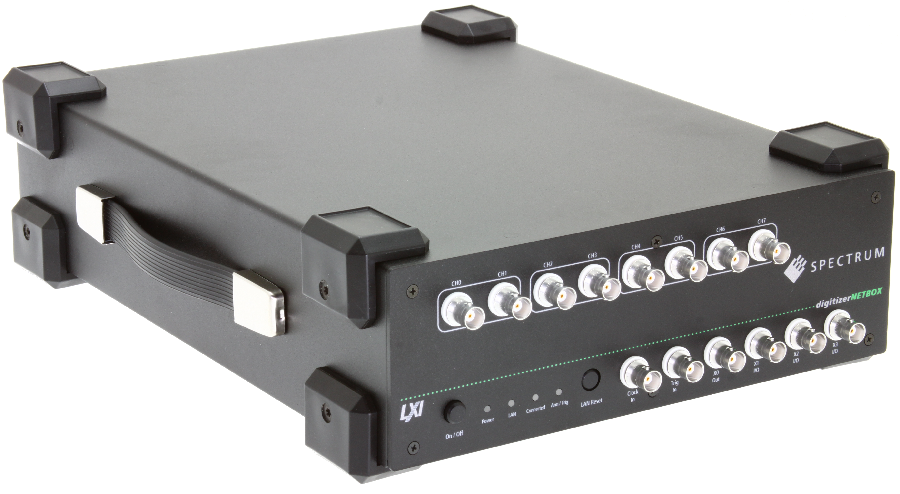
The range includes 16-bit digitizers supplied as PCI Express cards and Ethernet-connected LXI instruments, with model-dependent sampling characteristics and channel arrangements. The averaging function is a processing addition to these existing instruments. It does not change the analogue-to-digital converter, increase its nominal bit depth or extend the analogue input bandwidth. Those characteristics remain determined by the model selected for the application.
Summation averaging aligns successive acquisitions to a trigger and accumulates corresponding sample values. When the wanted waveform is repeatable and the noise contribution varies independently between captures, the underlying signal is reinforced relative to the noise. The resulting average can reveal small features that are difficult to distinguish in a single record. The achievable improvement depends on the number of acquisitions, the stability of the waveform and the properties of the noise; it is not guaranteed for signals that change substantially from one event to the next.
Performing that calculation within the FPGA changes the data-handling requirements. In a host-based arrangement, every acquired record may have to cross the PCIe or Ethernet interface and be stored before software accumulates the samples. With onboard processing, intermediate captures can be combined inside the instrument. The host can receive the resulting accumulated or averaged waveform rather than every contributing record, reducing transfer and storage demands when individual captures are not required for subsequent analysis.
This can be useful in laser diagnostics, spectroscopy, electronics characterisation and other tests where a stable response is generated repeatedly. The measurement chain must nevertheless remain sufficiently consistent from one capture to the next. Trigger jitter can blur rapidly changing waveform features, and an intermittent fault may disappear in the average because it is not present in most events. Engineers investigating occasional transients should retain access to individual acquisition records or use a different capture mode.
The manufacturer’s two-million-events-per-second figure describes the capability of the averaging process in appropriate operating conditions, rather than a universal rate for every record length, channel configuration and connection method. Capture timing, trigger conditions, memory management and subsequent calculations can determine the throughput of a complete measurement. There is therefore no basis for converting the stated event-processing figure into a fixed speed improvement for all automated test systems.
Signal-to-noise ratio and effective measurement precision may improve through averaging, but the 16-bit converter remains a 16-bit converter. Random noise can be reduced statistically, whereas systematic errors, non-linearity and repeatable interference may remain in the averaged result. Calibration, signal integrity and suitable acquisition settings are still required to establish the measurement uncertainty.
Spectrum has previously implemented onboard averaging on other digitizer platforms. Extending the approach to the 59xx series provides another processing option within a lower-speed, high-resolution product family. Users selecting between PCIe cards and remote Ethernet instruments can therefore evaluate the same underlying measurement method against their channel, bandwidth and installation requirements, without treating it as a replacement for conventional single-shot capture.
Calibration remains particularly important when an averaged trace is used to make a pass-or-fail decision. An apparently smoother waveform can conceal a consistent offset, repeated pickup or gain error if the acquisition chain has not been characterised. Engineers should establish the trigger reference, number of records and averaging method alongside the test result, so measurements collected on different instruments or at different times can be compared on a common basis. Results generated through FPGA accumulation should be reproducible under those defined settings before they are used for component qualification.