IN Brief:
- Dorset electronics manufacturer ETL selected a Promation 9544 CJ Pro after trials arranged with Altus Group.
- The robotic system provides four-axis movement, closed-loop temperature control, automated solder feeding and integrated tip cleaning.
- The 23 October report references installation scheduled for summer 2026, but no completed commissioning or production milestone has been verified.
Electronic Technicians Ltd has selected a Promation 9544 CJ Pro robotic soldering system following equipment trials organised with Altus Group, as the Dorset contract electronics manufacturer seeks to automate part of its through-hole assembly operation. The selection is detailed in trade coverage published on 23 October, which explains the company’s evaluation of different soldering technologies and its reasons for choosing a programmable robotic system.
The account follows ETL’s expansion of its manufacturing facility during 2026, when the company reviewed production activities that continued to depend heavily on skilled manual work. Through-hole assembly was identified as a priority because its products include conventional leaded components requiring soldering after insertion into printed circuit boards. The resulting investment is intended to support additional production capacity and more consistent process execution.
There is an important limitation to the published chronology. The October report describes installation of the selected equipment as scheduled for summer 2026, a period that has already passed. It does not confirm that the machine has been installed, commissioned or brought into production. The equipment selection is established, but no new operational milestone should be inferred from the date of the report.
Altus considered both selective soldering and robotic soldering technologies with ETL before the final selection. The two methods can address similar assembly requirements but use different approaches to applying heat and solder. Selective systems can process suitable boards efficiently through controlled solder application, while robotic equipment directs a soldering tool to individual connections according to programmed movements.
Board geometry and production mix influence which approach is appropriate. A selective soldering installation may provide high throughput when board designs and fixture arrangements suit the process. Robotic soldering offers greater freedom to approach individual joints from different positions, which can be useful where assemblies vary frequently or component placement restricts access.
ETL’s product mix was a central factor in the evaluation. The manufacturer produces electronics assemblies for customers in sectors including industrial equipment, energy, defence and medical technology. Different board layouts and component arrangements require corresponding process settings, and the ability to prepare several programmes for the same equipment can be valuable in manufacturing operations with relatively varied production runs.
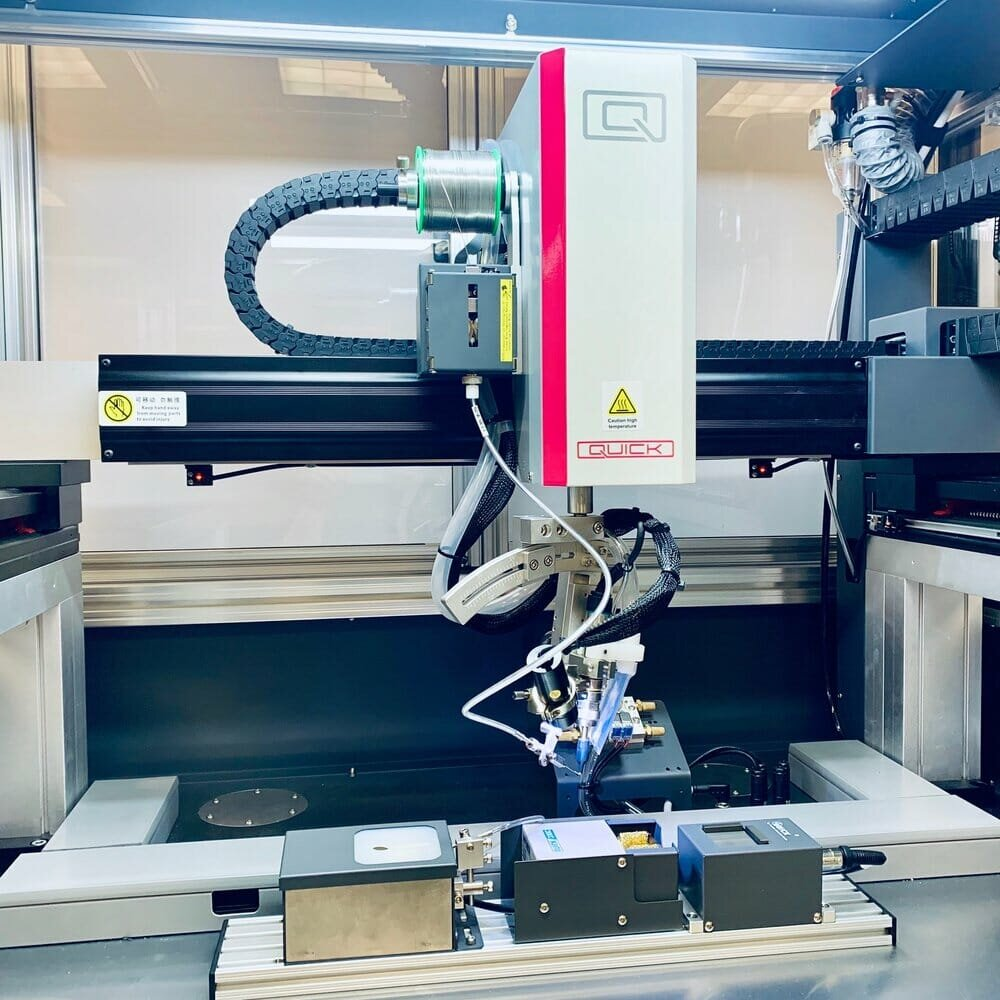
Following demonstrations and application trials, ETL selected the Promation 9544 CJ Pro. The system combines four-axis movement with closed-loop temperature control, automated solder wire feeding and integrated tip cleaning. These functions are intended to automate elements of conventional hand soldering while retaining control over the approach and duration of each operation.
Four-axis movement permits the soldering tool to follow programmed positions and orientations, allowing it to reach joints with different access requirements. The robot’s path must be developed around the board geometry, fixture position and surrounding components. A repeatable programme can reduce variation in tool movement, but accurate board location and process preparation remain necessary for consistent results.
Closed-loop temperature control allows the heating system to respond to measured changes in the tool’s temperature. A solder connection must receive sufficient thermal energy for the solder and surfaces to form an acceptable joint, without exposing components or board materials to excessive heating. The temperature measured at the tool is not necessarily identical to the temperature throughout the joint, making contact conditions, dwell time and thermal mass important variables.
Automatic wire feeding supplies solder according to the programmed sequence, while integrated tip cleaning helps manage residues during repeated operations. These mechanisms can make process execution more consistent, although final joint quality also depends on solder materials, surface condition and maintenance of the equipment. The October report does not provide measured improvements in defect rates or production yield from ETL’s selected machine.
The Promation system includes dedicated application tooling, which may be needed to hold assemblies in a consistent position and maintain access to the intended soldering points. The operator or process engineer must establish suitable joint sequences, heating conditions and solder delivery parameters for each product. Finished assemblies will continue to require inspection against the relevant acceptance criteria.
ETL managing director Stuart Crook identified additional capacity, repeatable quality and reduced dependence on manual soldering as the intended benefits of the investment. The company expects robotic equipment to support a process that has traditionally relied on skilled operators, while retaining the flexibility required for its varied assemblies. These remain anticipated benefits; the published material does not supply operating data establishing how much throughput or labour productivity has changed.
Altus chief executive Joe Booth explained that the supplier’s role was to compare available technologies against ETL’s manufacturing requirements before recommending a particular solution. Altus was also identified as the provider of commissioning support and assistance with the first production programmes. Whether those activities have taken place since the originally scheduled summer installation has not been confirmed.
Introducing robotic soldering may reduce some repetitive handling and tool movements, but it also requires programming, fixture development, process validation and equipment maintenance. The return on investment will depend on the frequency of product changes, the number of joints processed and the time required to prepare or modify programmes. Without measured operating results, those factors cannot be translated into a reliable productivity improvement for ETL.
The 23 October coverage establishes the company’s investment decision and explains the engineering requirements that led to the equipment selection. The current status of installation and commissioning remains unverified because the stated summer 2026 schedule has passed without a confirmed subsequent milestone. Any evidence of completed installation, production qualification or improved manufacturing performance would constitute a separate development.