IN Brief:
- All five LanoSync Q-Series switches support IEEE 1588 PTPv2 Boundary Clock and Transparent Clock modes.
- G.8032 ring protection provides a stated recovery time below 50 milliseconds following supported network failures.
- Selected models offer 90W PoE++ ports, while the flagship combines four 10G-capable SFP+ uplinks with a 500W PoE budget.
Antaira Technologies has launched five LanoSync Q-Series managed Ethernet switches combining IEEE 1588 precision time synchronisation with resilient industrial networking. The range supports applications in factory automation, electrical substations, robotics and distributed machine vision, where equipment must exchange data while maintaining a consistent timing reference. Selected configurations also provide IEEE 802.3bt power delivery and higher capacity fibre connections.
All five switches support version two of the Precision Time Protocol, or PTPv2, in both Boundary Clock and Transparent Clock modes. These functions allow the network switch to participate in maintaining time alignment between connected devices. Without a shared reference, internal clocks in sensors, programmable logic controllers and other electronic equipment can drift apart, complicating the comparison of measurements or coordination of scheduled operations.
In Boundary Clock mode, a switch receives time from an upstream grandmaster clock and distributes a synchronised reference to downstream devices. This establishes separate timing segments and can limit the propagation of some timing variations. Transparent Clock mode instead measures the residence time of timing messages inside the switch and provides correction information, allowing receiving devices to account for that delay.
Antaira states that the equipment can support sub-microsecond timing accuracy. Achieving such performance in an installed network depends on the clock source, network topology, endpoint support and configuration. The switches provide timing functions suitable for system design, but their inclusion does not establish a measured synchronisation result across every possible industrial installation.
Network resilience is addressed through ITU-T G.8032 Ethernet Ring Protection Switching. A configured ring can use an alternate path following a supported link or node failure, with Antaira specifying recovery in less than 50 milliseconds. This concerns restoration of communications on the ring; whether a control process remains unaffected also depends on application timeouts, buffering and the behaviour of the connected equipment.
The two timing functions address different requirements. PTP aligns the clocks used to record and coordinate events, whereas Ethernet Ring Protection Switching is intended to restore traffic when the preferred network path is interrupted. In a multi-camera inspection system, for example, common timestamps may help correlate images, while resilient connectivity helps maintain the transport of images and control messages.
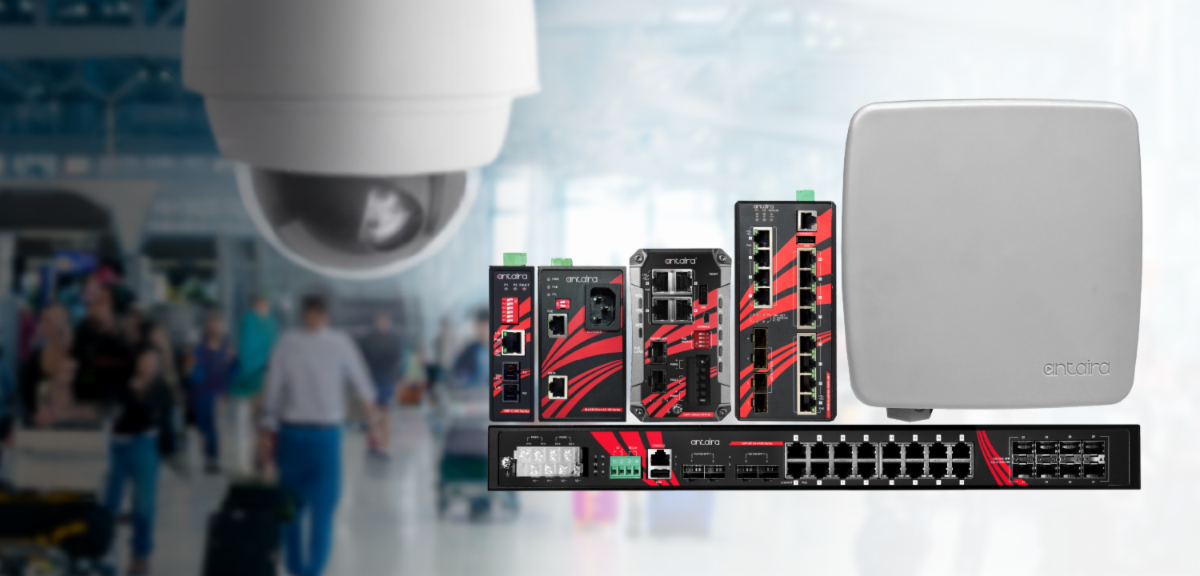
Antaira offers two models without PoE and three with powered Ethernet ports. The QMX-0804G-2Q2S-T has four Gigabit copper ports and four SFP slots, including two that accept interfaces up to 2.5G. The QMX-1204G-2Q2S-T increases the copper count to eight and adds two digital inputs, four relay outputs, a 1-Wire interface and three RS-232/485 serial ports for connection to field equipment.
The QMP-0804G-2Q2S-bt-T provides four Gigabit IEEE 802.3bt PoE++ ports with a maximum rating of 90W per port, while the QMP-1204G-2Q2S-bt-T increases that count to eight. Each has a total power budget of 240W. Consequently, its full 90W per-port capability cannot be used simultaneously on every port if aggregate demand exceeds the total available budget.
For larger network installations, the QMP-2820G-4X16S-bt-T supplies eight powered Gigabit copper ports, sixteen 100M/1G SFP slots and four SFP+ ports capable of 1G, 2.5G or 10G operation. It also supports static routing and provides a 500W aggregate PoE budget. The 10G uplinks belong to this flagship configuration, not to all five models in the range.
Power requirements differ across the configurations. The smaller switches accept 20–60V DC input, while the flagship operates with 36–60V DC input. Antaira specifies a 55–57V DC supply for the higher powered PoE++ operation. The external power supply therefore needs to meet both the switch’s own requirements and the maximum combined load of cameras, access points or other attached devices.
Fibre ports provide an option for extending network connections across industrial sites without running electrically conductive links between equipment locations. They can also reduce susceptibility to electromagnetic interference on the data connection, although the reach and data rate depend on the optical transceivers installed. Those choices remain part of the system architecture, alongside redundancy settings and the selected timing hierarchy.
The Q-Series is specified for operation between -40°C and +85°C and includes ITU-T K.44 surge protection. The switches are available in five configurations, allowing the same timing and ring protection functions to be deployed at relatively small network edges or more densely connected aggregation points. Equipment selection will depend on port count, optical speed, field interfaces and available power rather than a single common specification across the family.