IN Brief:
- Valeo and Anritsu will demonstrate an extended digital twin validation system at the 5GAA meeting in New Delhi on 26–29 October.
- The architecture combines a virtual telematics ECU with Anritsu software-based cellular network simulation.
- The new eCall scenario extends earlier network handover and V2N/V2X work; no completed vehicle certification is claimed.
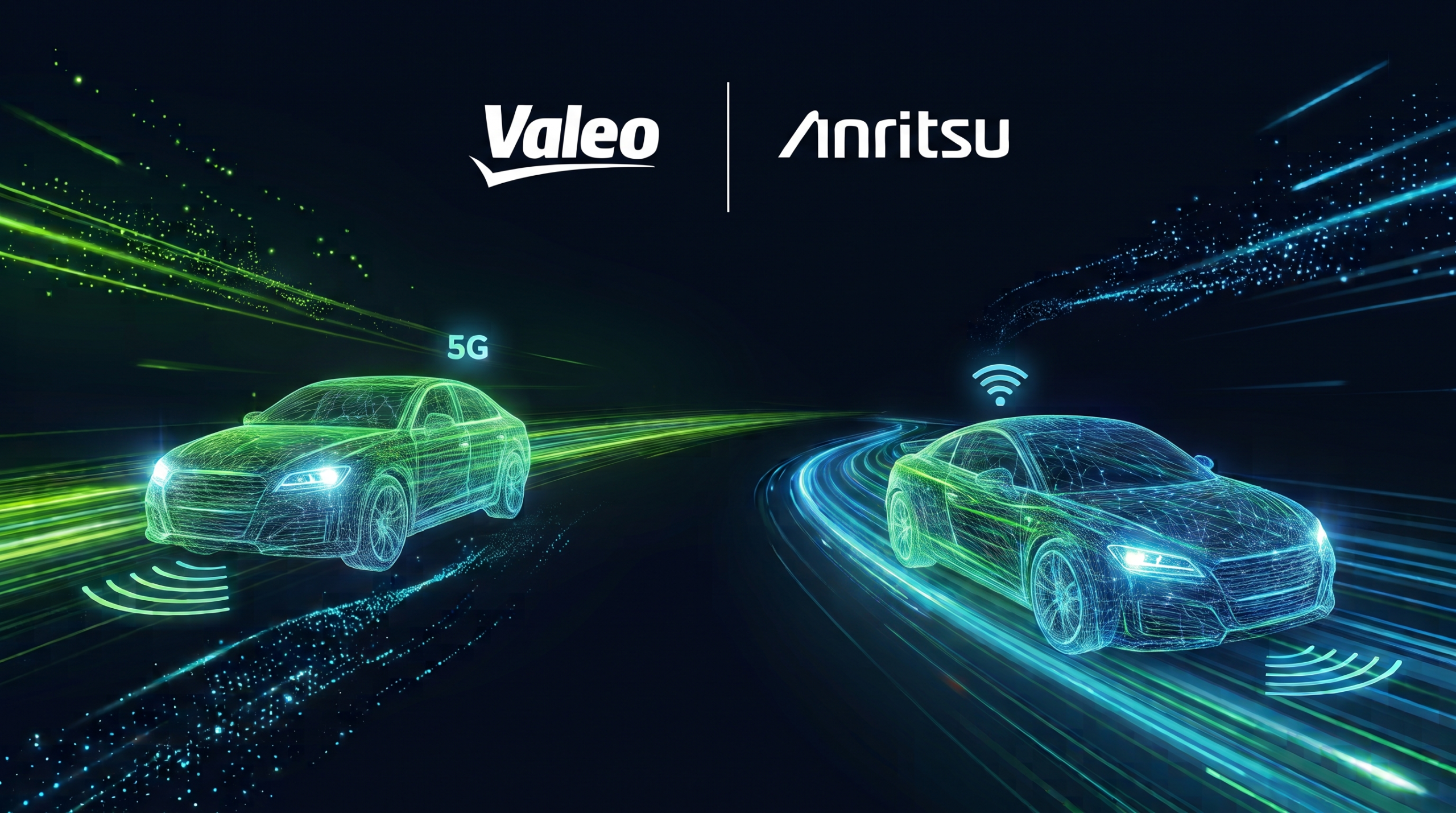
Valeo and Anritsu are expanding their digital twin validation system for software-defined vehicles, adding emergency calling to a virtual test environment that combines vehicle electronic control unit simulation with mobile network modelling.
The companies are demonstrating the expanded system at the 39th meeting of the 5G Automotive Association in New Delhi, India, from 26 to 29 October. It builds on a collaboration established earlier in 2026 and a joint presentation at Mobile World Congress in March.
The new use case concerns eCall, which provides a means for a vehicle to contact emergency services after a serious incident. Adding this function moves the demonstration beyond general connectivity testing into a scenario where communication availability and the handling of failures have particular significance.
Valeo contributes its virtualised telematics electronic control unit environment, while Anritsu provides software-based cellular test technology. The integrated system is intended to reproduce selected vehicle and network conditions without requiring every software test to be undertaken in a complete physical vehicle.
Mobile connectivity is difficult to validate solely through driving because the communications environment changes between journeys. Signal strength, congestion, network configuration, and transitions between cells or operators can alter how an application behaves, even along a route that has already been tested.
A software-in-the-loop environment allows engineers to define some of those conditions and repeat the same sequence after modifying an application. A failure that appears only during a particular network transition can then be investigated under more consistent conditions than an uncontrolled road test would provide.
Valeo’s virtual ECU represents selected telematics functions and their software interfaces, while Anritsu’s cellular simulator and associated virtual engine model conditions encountered on real networks. Whether the combined environment operates locally or in the cloud, its usefulness depends on reproducing relevant communication delays, failed connections, and recovery behaviour. A successful virtual eCall test may not predict the response of a physical telematics unit if a processor delay or network interruption has been omitted from the model.
As a moving vehicle passes between mobile cells or telecommunications operators, its active connection may change while an application is exchanging data. Valeo and Anritsu’s inter-operator handover simulations allow developers to examine delayed or interrupted transfers and the handling of session state and recovery under defined conditions. Their multi-vehicle vehicle-to-network and vehicle-to-everything scenarios add interactions between endpoints that can be difficult to reproduce in coordinated physical road tests.
The new eCall work introduces fault conditions affecting a safety-related communication function. Software may need to respond to an unavailable connection, a failed attempt to establish contact, or a network transition during an emergency call, rather than treating every interruption as a routine loss of service.
Controlled testing can examine whether the virtualised function attempts to recover as designed and how it handles information that cannot be sent immediately. The available statement does not specify the full range of eCall standards, telecommunications variants, or regulatory approval tests covered by the demonstration.
Recorded driving data can supply representative vehicle behaviour and environmental inputs, which can then be combined with defined network conditions. The companies identify repeatability as a benefit because engineers can compare the same scenario before and after a software change without relying on identical physical road conditions.
Repeating an eCall test can show whether the modelled function handles a specified failed connection or handover consistently, but it cannot demonstrate how the physical system will respond to unmodelled antenna effects, radio propagation, or electrical disturbances. Laboratory measurements, hardware-in-the-loop testing, and road trials are still required to assess failure conditions that the virtual environment cannot reproduce reliably.
The companies expect their approach to reduce reliance on physical track testing and expose connectivity faults earlier in development. They have not published independently verified figures for cost savings, reductions in test kilometres, or shorter development cycles resulting from the latest eCall extension.
Certification of a finished eCall system requires evidence from defined tests covering its specific telematics hardware, software, communications interfaces, and the requirements of the target market. Valeo and Anritsu have not reported completing that assessment through this demonstration.
The New Delhi presentation will show how the companies have extended their earlier virtual connectivity work to an additional application. Subsequent customer programmes will determine how extensively the digital twin can supplement physical validation while retaining the evidence needed for safety-related communication systems.