IN Brief:
- Clea 2.0 provides a common application deployment workflow across supported SECO and third-party edge devices.
- Its native Model Context Protocol server allows natural-language instructions to initiate permission-controlled fleet operations.
- The framework includes sandbox testing campaigns, multi-tenant isolation, and role- and attribute-based access controls.
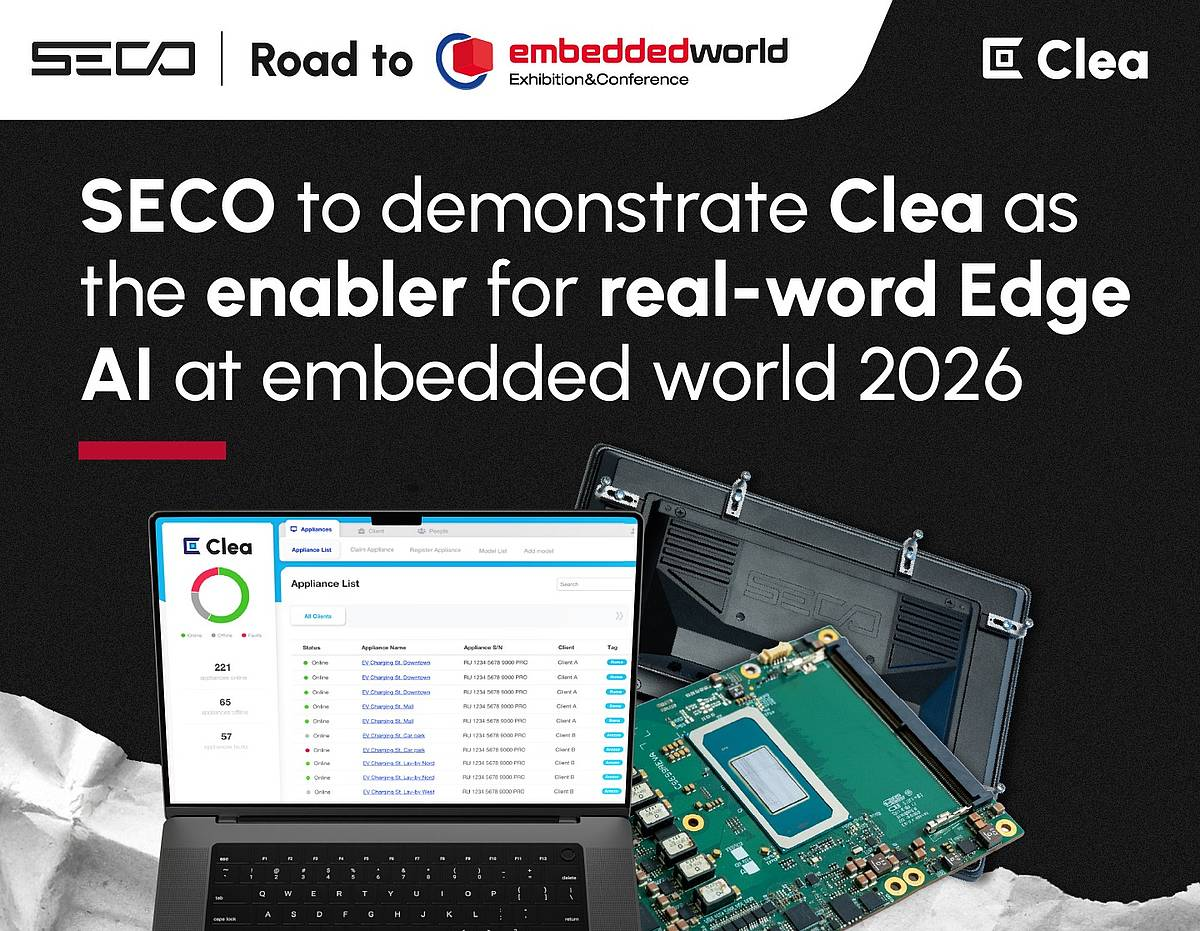
Italian embedded systems manufacturer SECO has introduced Clea 2.0, a software framework for deploying and managing artificial intelligence applications across distributed industrial edge devices. The platform combines application deployment, device orchestration and permission-controlled operations within a common environment designed to support compatible SECO and third-party hardware.
The framework addresses the software integration required when industrial equipment contains different processors, operating systems and computing platforms. A fleet of machines may use several generations of embedded hardware, each with its own operating constraints, software dependencies and configuration requirements. Deploying a common application across those devices can therefore involve separate installation, testing and maintenance procedures.
Clea 2.0 provides a unified deployment workflow intended to reduce this fragmentation. The system allows supported AI applications and models to be distributed through a common management interface rather than requiring independent processes for each hardware platform.
SECO describes the deployment process as one-click operation. That refers to application distribution through the configured framework, not the elimination of device preparation, compatibility checks or qualification of the software on its intended hardware. Application performance will continue to depend on processor capability, memory capacity, acceleration resources and the operating environment.
The framework separates the management workflow from the underlying device hardware. This approach can accommodate equipment from different suppliers, provided the necessary software components and supported operating configurations are available. The company has not published a definitive compatibility list establishing support for every industrial processor or operating system.
Fleet management functions are extended through a native Model Context Protocol server. MCP provides an interface through which software agents can access defined tools and services, allowing requests expressed in natural language to be translated into operations supported by the connected management system.
In Clea 2.0, those operations may involve coordinated actions across multiple devices. A requested software change can be associated with the relevant fleet or deployment group, although the system must still determine which operations are permitted and which devices fall within the authorised scope.
SECO says agent operations are constrained by user identity and access permissions, with actions recorded for traceability. The framework includes role-based access control, which assigns privileges according to defined responsibilities, alongside attribute-based access control, which can apply additional conditions associated with users, resources or operational circumstances.
Permission controls are important because software deployment can alter the behaviour of industrial equipment. An incorrectly configured application may consume excessive computing resources, interrupt communication with other systems or interfere with functions that depend on predictable processing performance.
The availability of an AI-controlled management interface does not remove these risks. Access policies determine which operations may be initiated, while software validation and operational procedures determine whether an authorised change is suitable for the affected equipment.
Clea 2.0 incorporates sandbox testing campaigns intended to support controlled evaluation before wider deployment. A restricted rollout can expose configuration problems or application incompatibilities before the same change reaches a larger installation, although the scope of a sandbox must reflect the actual devices and operating conditions being tested.
The platform also includes multi-tenant isolation for environments managed on behalf of different customers or operating divisions. Separation of data and administrative privileges allows equipment manufacturers and service providers to support multiple installations without giving each customer access to resources belonging to another organisation.
These functions extend SECO’s existing Clea software environment, which connects industrial hardware, operational data and edge applications. The new release concentrates on distributing and governing AI workloads while retaining the ability to manage devices that have different computing resources and software configurations.
Industrial visual inspection provides one possible application. A camera system can execute inference locally to classify images or identify conditions requiring further examination. The model’s processing demand, camera data rate and required response time determine whether it can operate on the available edge hardware without interrupting other workloads.
Local inference can reduce the amount of image data transmitted to a remote computing service, but it introduces its own demands on memory, processor utilisation and model maintenance. Changes to the model must be tested against the relevant equipment, particularly where detection performance affects production decisions or automated responses.
Similar considerations apply to predictive maintenance systems and robotic applications. Software management can coordinate application versions and deployment status, but it does not establish that a model has been validated against the sensors, mechanical systems or operating conditions of a particular installation.
SECO is opening Clea 2.0 for early access, with registration offered free of charge until 30 April 2027. The initial announcement does not include independently verified performance results from large production fleets or complete hardware compatibility data.
The release brings application distribution and permission-controlled fleet operations into the same framework. Evaluation will depend on whether the supported hardware configurations, deployment controls and integration interfaces meet the requirements of existing industrial installations.