IN Brief:
- Researchers demonstrated optical readout and coherent microwave control of an individual carbene molecule embedded in a crystalline host.
- Measurements at 4.5K included 2.2ms spin coherence under dynamical decoupling and 21ms spin relaxation.
- NVision and HyperLight plan to integrate molecular emitters with thin-film lithium niobate photonic circuits, with initial prototypes targeted for late 2026.
Researchers at NVision have demonstrated coherent control and optical readout of an individual organic molecular spin, establishing a potential component for photonic quantum information systems. The results, published in Nature, concern a specially designed carbene molecule embedded in a crystalline host, with experiments conducted at a temperature of 4.5K.
The Ulm-based company has also entered a partnership with HyperLight to investigate incorporating molecular qubits into thin-film lithium niobate photonic integrated circuits. That programme will attempt to transfer the laboratory result into an integrated optical platform, although no functioning multi-qubit processor or chip-based entanglement system has been demonstrated by the announced work.
The experimental system uses di([1,1′-biphenyl]-4-yl)carbene, a molecule with two unpaired electrons that produce a triplet ground state. Its molecular structure and surrounding crystalline material have been selected to support both a relatively stable electron spin and optical transitions that can be used to interrogate that spin.
The carbene is embedded within a structurally matched ketone crystal. The rigid host constrains the molecule’s geometry and limits disturbances that would otherwise alter its electronic and optical properties. Researchers introduce the molecules through a photoactivatable precursor, allowing active spin centres to be generated within the crystal under controlled conditions.
At low concentrations, the researchers isolated individual optical emitters using cryogenic microscopy. They confirmed single-emitter behaviour through photon correlation measurements, obtaining a zero-delay second-order correlation value of approximately 0.14, below the 0.5 threshold conventionally used to establish single-photon emission from an isolated source.
The spin state was manipulated using resonant microwave pulses, while optical excitation and fluorescence provided a means of initialisation and readout. The team observed coherent spin oscillations, demonstrating that an individual molecule’s electron spin could be controlled rather than merely detecting fluorescence from an ensemble of molecules.
Different measurement sequences produced substantially different spin lifetimes. Ramsey measurements yielded a dephasing time of approximately 5.3µs, while a Hahn-echo sequence extended the measured coherence to 12.2µs. A more extensive XY8 dynamical-decoupling sequence produced a coherence time of 2.2ms, with spin relaxation measured at approximately 21ms.
These values describe the behaviour under the respective experimental pulse sequences. The 2.2ms result should not be presented as an unconditional coherence time available during arbitrary operation, because dynamical decoupling actively suppresses certain environmental disturbances through repeated control pulses.
The molecular emitter also exhibited narrow optical transitions and spectral stability over periods exceeding an hour. Such properties are important for schemes in which photons emitted by separate quantum devices must behave sufficiently alike to support interference and entanglement protocols.
Optical readout of an individual spin provides a possible interface between stationary quantum information stored in a molecule and photons that can carry information between locations. The interface is a necessary component of some distributed quantum architectures, but further development is required to demonstrate efficient spin-photon entanglement and reliable connections between separate qubits.
The Nature study reports a photoluminescence quantum yield of 10.8% and a Debye-Waller factor of approximately 19%, corresponding to a net zero-phonon-line emission efficiency of around 2.1%. These figures indicate that substantial optical losses remain before an integrated device could deliver high rates of useful photons.
Photon collection and indistinguishability are particularly important when linking separate spin qubits. A photonic circuit must collect emitted light, route it through suitable optical structures and preserve the relevant quantum properties. Losses reduce the rate at which successful remote operations can be established, even where the underlying spin remains coherent.
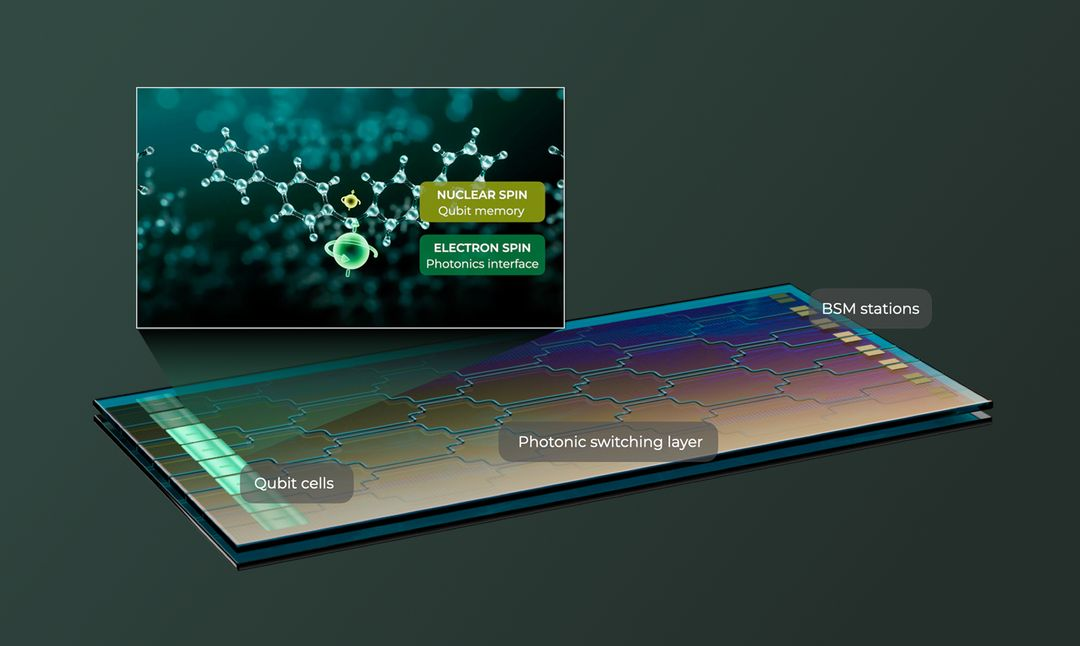
NVision is seeking to improve this interface through collaboration with HyperLight, which develops thin-film lithium niobate photonic technology. The proposed approach places molecular materials onto photonic circuits containing waveguides and electro-optical components, potentially allowing optical control and connectivity to be integrated at chip level.
The integration process introduces additional manufacturing constraints. Depositing or attaching molecular materials must preserve the spin and optical characteristics observed in the crystal experiment, while waveguide geometry, optical coupling and device packaging will influence transmission losses and the performance of the complete system.
The experimental result was obtained at 4.5K, so the architecture continues to require cryogenic operation under the conditions currently demonstrated. NVision’s planned photonic integration has not established equivalent room-temperature performance or removed the need to manage optical and thermal behaviour within a cooled assembly.
The company evaluated more than 150 molecular candidates computationally and synthesised approximately 40 during development of the reported system. This chemical design approach gives researchers a means of modifying molecular electronic properties, although each candidate still requires experimental validation of its optical and spin characteristics.
NVision and HyperLight are targeting initial integrated-chip prototypes in the fourth quarter of 2026, with an on-chip demonstration planned before the end of the year. NVision’s longer-term targets include 1,000 physical qubits and subsequently 1,000 logical fault-tolerant qubits by 2030. Those objectives remain dependent on future progress in integration, entanglement, control and error correction.
The published experiment establishes individual spin manipulation and optical readout in a designed molecular system. The next engineering test is whether those properties can be preserved and connected through manufactured photonic hardware, rather than relying on the standalone cryogenic microscopy arrangement used in the research.