IN Brief:
- MetaEye combines two meta-optical elements, a bandpass filter and a CMOS sensor in a lens assembly without conventional refractive elements.
- The 12.9mg camera operates at a nominal wavelength of 850nm and is specified for object distances of 15–40mm.
- NIL Technology says customers have progressed through qualification builds and are increasing production activity during 2026.
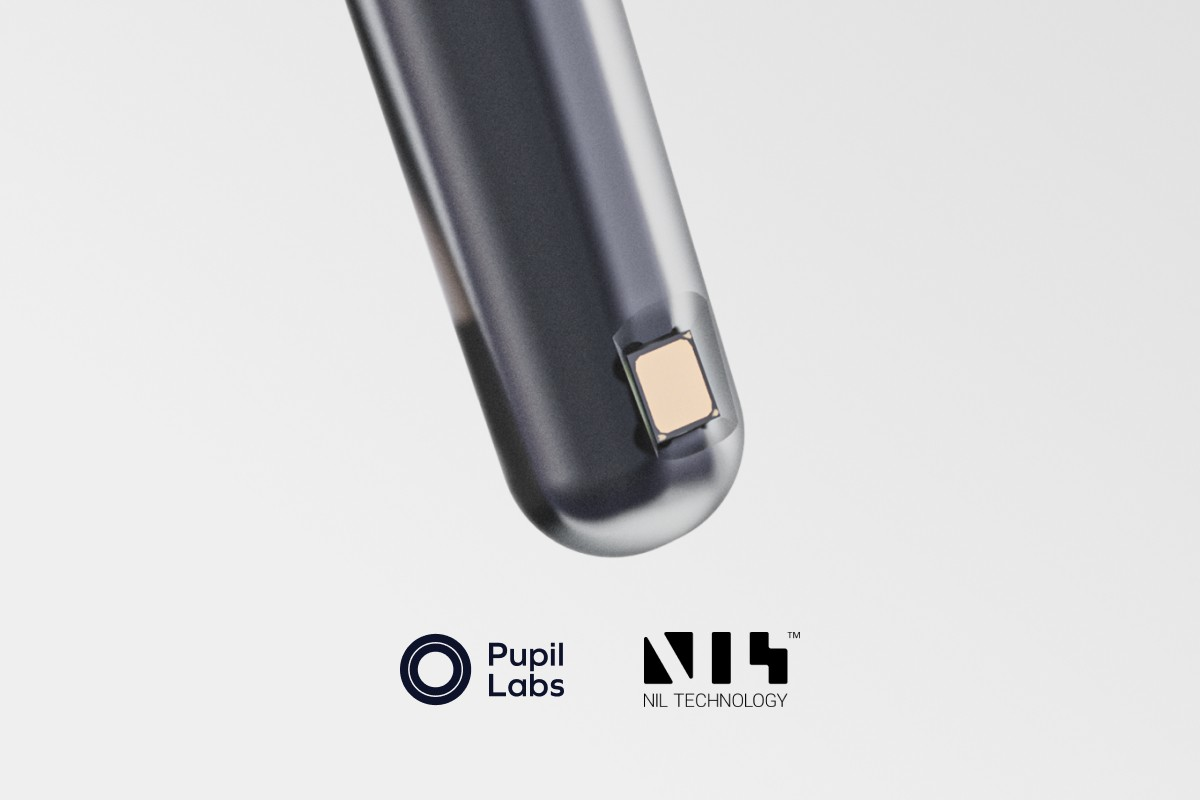
NIL Technology has launched metaEye, a miniature near-infrared camera built around two flat meta-optical elements rather than conventional refractive lenses. The Danish manufacturer’s module measures 1.68 × 1.68 × 2.11mm and is designed for eye-tracking systems in smart glasses and augmented and virtual reality headsets, where camera dimensions influence the layout of the entire optical assembly.
The camera integrates two meta-optical elements, a bandpass filter and multiple apertures into a solid lens cube mounted directly onto the image sensor’s cover glass. Its CMOS sensor provides 400 × 400-pixel resolution with a 2.2µm pixel pitch, while the completed module weighs 12.9mg.
Meta-optical elements use microscopic structures patterned across a surface to control the phase and propagation of incoming light. By engineering the geometry of these structures, designers can produce optical functions normally requiring curved refractive surfaces, allowing some conventional lens elements to be replaced by thin patterned components.
The two elements in metaEye operate together within a compact stacked arrangement. Combining optical functions with filtering and aperture structures removes the air gaps and separate plastic refractive lenses associated with many miniature camera modules. The resulting lens stack is mounted directly against the sensor package rather than assembled around a conventional multi-element lens barrel.
Such construction changes the mechanical constraints of camera integration. In a head-mounted eye-tracking system, the camera must occupy space around the user’s eye while accommodating infrared illumination, mechanical supports, electronic connections and other optical components. Reducing its dimensions allows the camera to be positioned within a smaller available volume, although the complete system still requires suitable illumination and processing hardware.
NIL Technology specifies an operating wavelength of 850nm, with the optical design centred on 850nm within a stated tolerance of ±20nm. The camera is intended for object distances of 15–40mm, corresponding to the short working distances encountered in near-eye imaging rather than general-purpose photography.
Near-infrared eye-tracking systems illuminate the eye and analyse the resulting images to estimate pupil position, eye movement or other relevant features. Operating outside the visible spectrum allows illumination to be provided without introducing visible light into the user’s field of view, although optical safety, illumination geometry and image-processing requirements must still be addressed in the finished equipment.
The image sensor’s 400 × 400-pixel resolution establishes the available sampling grid but does not independently determine eye-tracking accuracy. That depends on the optical field of view, lens distortion, illumination conditions, sensor noise, mechanical alignment and the algorithms used to interpret the recorded images.
The integrated bandpass filter is designed to restrict the wavelengths reaching the sensor, helping the imaging system concentrate on the intended near-infrared illumination. Its effectiveness in rejecting unwanted light depends on the filter’s spectral response and the operating environment, particularly where background illumination contains significant infrared energy.
Temperature behaviour is another consideration in compact camera design. Differences in thermal expansion between optical and mechanical components can change the relative position of lenses and sensors, affecting focus and image geometry. NIL Technology says its solid lens stack, which avoids internal air gaps, provides improved temperature stability compared with conventional miniature optical assemblies.
The company has not published a complete comparative dataset covering image quality or temperature performance across alternative camera designs. Qualification of an individual wearable product will therefore still require evaluation over its expected operating temperatures, mechanical loading and manufacturing tolerances.
NIL Technology designs and manufactures its meta-optical elements using nanoscale patterning processes, drawing on experience in nanoimprint technology. Its production model separates fabrication of the optical elements from final camera assembly, which is undertaken by manufacturing partners.
This arrangement makes alignment and process repeatability important. Small variations in the patterned optical structures, spacing between elements or their position relative to the sensor can affect imaging performance, particularly when the completed optical system occupies only a few cubic millimetres.
The company says it has worked with several major customers on qualification builds for approximately 18 months, with those customers increasing production activity during 2026. MetaEye previously received a SPIE Prism Award in 2025, preceding the current commercial product launch.
The device, designated TM28-901013, is the first marketed configuration of NIL Technology’s wider metaCamera architecture. The manufacturer is also developing configurations for distant subjects and close-range imaging, although these require different optical designs from the initial eye-tracking module.
MetaEye is being offered for evaluation and integration into customer products. Its compact dimensions, defined near-infrared operating range and solid optical construction provide engineers with a specific alternative to conventional miniature refractive camera modules, subject to qualification within the finished imaging system.