IN Brief:
- Four individually controlled 60W RGBL emitters form the main 240W optical engine.
- A 48-emitter RGBW ring adds independently controlled pixel effects around the primary lenses.
- Networked control, compact mechanics, and continuous movement place substantial electronic integration inside a 7kg fixture.
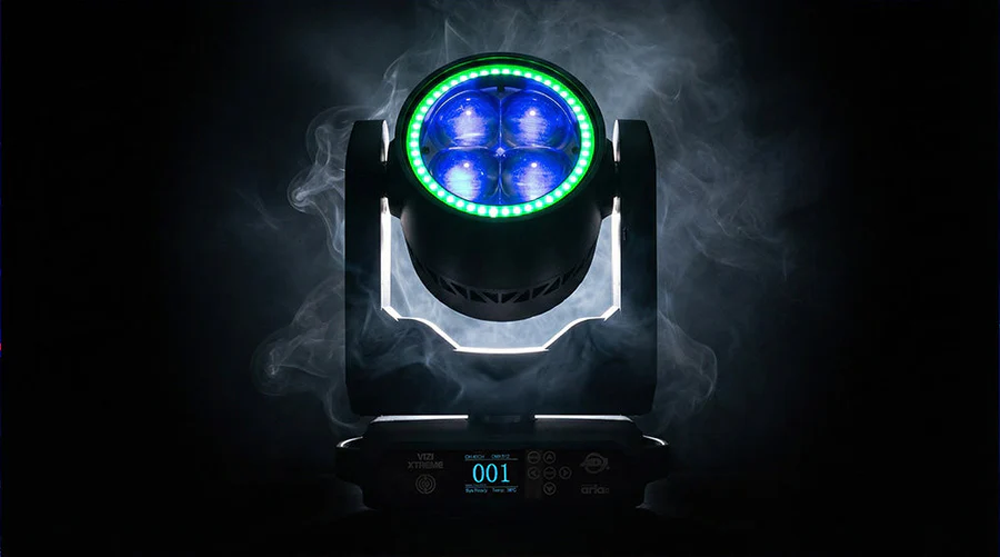
ADJ has begun shipping the Vizi Xtreme, a compact professional moving-head luminaire combining four independently controlled 60W RGBL emitters with a separate ring of 48 RGBW LEDs.
The main 240W optical engine uses red, green, blue, and lime emitters to deliver saturated colours alongside a broader white range. A motorised zoom adjusts the beam from 3° to 45°, allowing the fixture to move between narrow effects and wider wash coverage without a manual optical change.
Around the primary lenses, 48 0.5W RGBW LEDs are divided into six controllable zones. The ring can operate independently from the main engine, creating pixel effects, chases, colour transitions, and visual movement around the four high-power sources.
Colour temperature can be adjusted from 2,700K to 10,000K, extending the system from warm stage illumination to cooler white output. Electronic dimming, strobe functions, and individual RGBL control allow each main lens to act as a separate element rather than part of one common light source.
The mechanical system supports conventional 540° or 630° pan and 270° tilt, together with optional continuous 360° movement on both axes. Three-phase motors provide controlled positioning while the complete fixture weighs approximately 7kg.
DMX and RDM are joined by Art-Net and sACN for Ethernet-based lighting networks, while NFC configuration and wireless control reduce the need for direct physical access during setup. The combination allows addressing, monitoring, parameter changes, and large channel counts to be managed from central control systems.
Integrating optics, thermal management, motor control, networking, processing, and power conversion inside a moving enclosure creates a tightly coupled engineering problem. The four main emitters can draw substantial power while the ring, motors, control electronics, display, and communications remain active, so heat removal must be achieved without adding excessive mass to the head.
Lime emitters are increasingly used in professional RGB systems to improve spectral continuity and white-light quality. Conventional RGB mixing can produce strong saturated colours but leave gaps that affect skin tones, camera response, and the appearance of coloured surfaces. A lime channel gives the control system another variable for balancing colour rendering and luminous output.
Application-specific LED control is developing in other sectors as well. TPL Vision’s pulsed-lighting controller regulates high-current LED output for tightly timed image capture. Professional entertainment lighting pursues a different optical result, but both systems rely on precise current control, predictable switching, and thermal stability.
Materials research continues to expand the performance range available to future products. Vapour-deposited perovskite LEDs have reached 21.9% external quantum efficiency in laboratory devices. Commercial moving heads remain centred on established emitters, yet gains in source efficiency, spectral output, packaging, and heat handling continue to increase the functions that can be concentrated within smaller fixtures.
Continuous pan and tilt place additional demands on cable routing, slip rings, position sensing, and motor control. Repeated rotation must preserve power and data integrity, while faster acceleration increases mechanical load and any imbalance in the optical head affects current draw, positioning accuracy, acoustic noise, and bearing wear.
Thermal behaviour will determine how closely the fixture can sustain maximum output in warm venues or densely installed rigs. LED junction temperature affects efficacy, colour, and lifetime, while fan noise and airflow can become restrictive in theatres, broadcast studios, and other acoustically sensitive spaces.
Networked control also expands the software burden. Large installations may contain hundreds of devices, making manual configuration slow and prone to error. RDM, Art-Net, sACN, and NFC can simplify identification and setup, although firmware stability and interoperability remain essential when fixtures from several manufacturers share one network.
Vizi Xtreme enters a market that increasingly expects one compact unit to deliver beam, wash, pixel, and movement effects previously divided across several products. Consolidation reduces rig weight and cabling, but transfers greater complexity into every fixture’s electronics, software, cooling, and mechanics.
Commercial shipment moves the design into sustained production use, where colour consistency, motor precision, network reliability, and thermal control will be tested across repeated movement and long operating hours. Those characteristics will determine whether the compact architecture can replace several specialised fixtures without imposing a larger maintenance burden.