IN Brief:
- J.P. Morgan and TriplePoint Capital are providing Heron Power with a $60m credit facility.
- Heron is converting a 286,000ft² Morgan Hill building into a factory targeting mass production from late 2027.
- Its 5MW Heron Link platform is intended for medium-voltage power conversion in data-centre, solar, and energy-storage infrastructure.
Heron Power has secured a $60 million credit facility from J.P. Morgan and TriplePoint Capital as it prepares to move its medium-voltage power-conversion hardware from engineering and early production towards large-scale manufacturing.
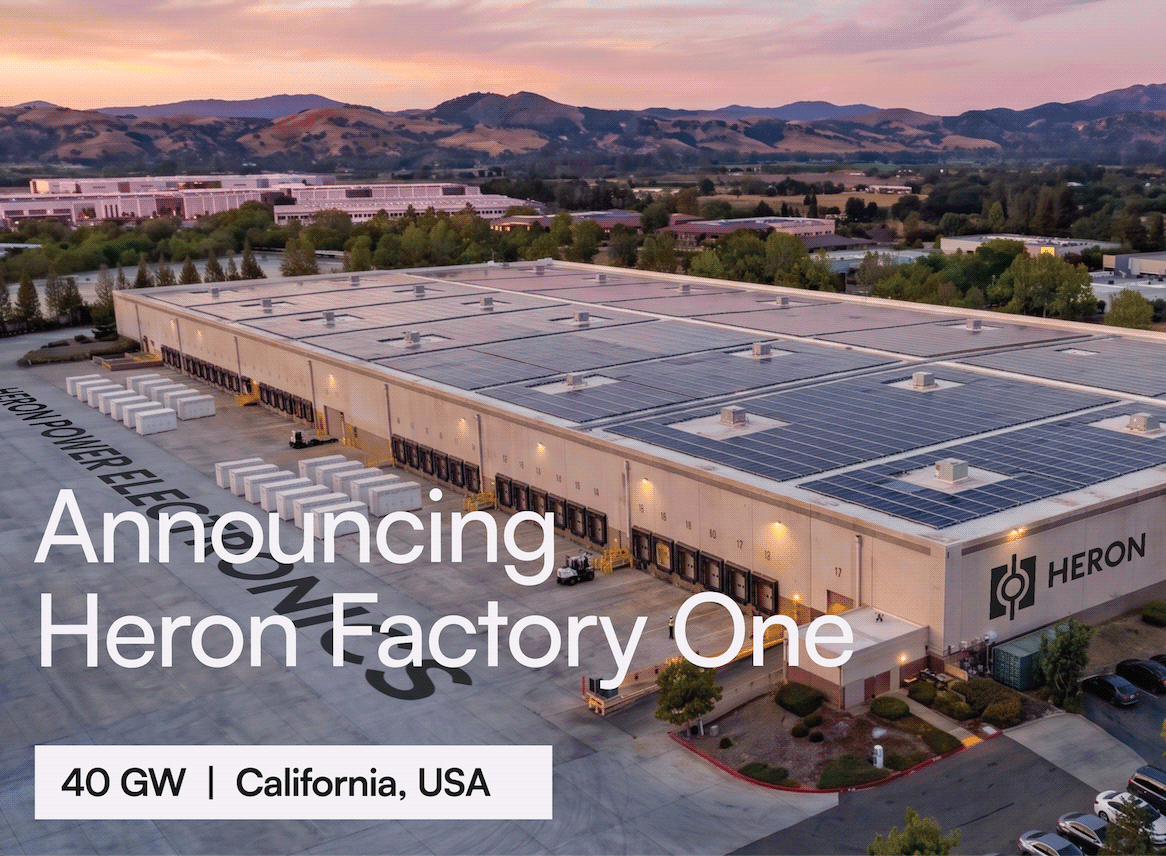
The debt facility follows a $140 million Series B completed in February and adds another source of capital as Heron converts a 286,000ft² building in Morgan Hill, California, into its first large-scale factory. Mass production is scheduled to begin in late 2027.
The company’s first product, Heron Link, is a 5MW medium-voltage power-conversion platform aimed at large energy and data-centre projects. Heron says it has identified more than 40GW of customer interest in the system, placing manufacturing capacity and working capital alongside product engineering as immediate constraints on growth.
The financing announcement is distinct from the factory investment disclosed in August. Heron has not published the draw schedule, interest rate, covenant package, or division of the facility between J.P. Morgan and TriplePoint Capital, so the $60 million should be treated as available credit rather than cash already committed to a particular item of equipment.
That distinction matters for a hardware manufacturer approaching a production ramp. Factory conversion, automated assembly systems, high-power test equipment, inventory, supplier deposits, and staffing all consume capital before completed units generate corresponding customer revenue.
Debt can provide another route for financing that transition without relying solely on additional equity. Heron’s latest facility comes after the February equity round and as the Morgan Hill operation moves from site preparation towards the installation and qualification of production capability.
The factory plan itself is substantial. Heron announced in August that it intends to invest more than $100 million in the Morgan Hill site, create more than 600 manufacturing, engineering, and operations jobs, and build capacity for as many as 10,000 Heron Link units annually.
At the platform’s stated 5MW rating, the company equates that target with more than 40GW of annual manufacturing capacity. That remains a planned output rather than current production, and reaching it will depend on factory commissioning, supply availability, process yield, test throughput, and customer deployment schedules.
Medium-voltage power conversion is a demanding manufacturing problem because the product sits between semiconductor electronics and grid infrastructure. A system has to combine high-power switching devices, gate-drive and control electronics, magnetic components, thermal management, insulation, protection, mechanical packaging, and high-voltage connections while remaining serviceable in the field.
Heron describes Link as a solid-state approach to functions traditionally spread across transformers, inverters, and associated grid equipment. Its solar and storage version is specified at 5MW, while the company is also developing a data-centre architecture intended to convert medium-voltage AC directly towards the high-voltage DC distribution used by accelerator infrastructure.
The manufacturing challenge lies in turning that architecture into repeatable hardware. Prototype and low-volume builds can tolerate comparatively high levels of engineering attention, manual intervention, and component selection. Volume production requires controlled assembly sequences, traceability, automated or standardised test, predictable supplier quality, and repair procedures that can be applied repeatedly.
Heron’s August factory announcement identifies automated assembly and high-volume manufacturing as part of that strategy. The company chose Morgan Hill partly to remain close to its Bay Area engineering base while expanding into a facility far larger than would be required for prototype development alone.
The credit facility arrives as demand for power equipment is being pushed by several markets at once. Data centres are increasing electrical loads rapidly, while utility-scale batteries and solar installations require growing quantities of medium-voltage conversion hardware. Equipment lead times can therefore become as important to developers as the nominal efficiency of the converter itself.
Heron has also appointed former Tesla chief financial officer Zach Kirkhorn to its board. Kirkhorn had already invested in and advised the company, and his appointment adds manufacturing-scale and capital-planning experience as Heron moves towards a more asset-intensive operating model.
The next phase will depend less on another demonstration of the converter concept than on whether the company can industrialise it. The $60 million facility gives Heron additional financial capacity for that transition; the more difficult task is turning a 286,000ft² building and a planned 10,000-unit annual output into qualified, repeatable medium-voltage electronics by late 2027.