IN Brief:
- Fox ESS has reduced switching losses by 70% using Infineon’s 1200 V CoolSiC G2 MOSFETs.
- PQ3-Ultra reaches 98.78% peak PV inverter efficiency and 98.47% peak battery charge and discharge efficiency.
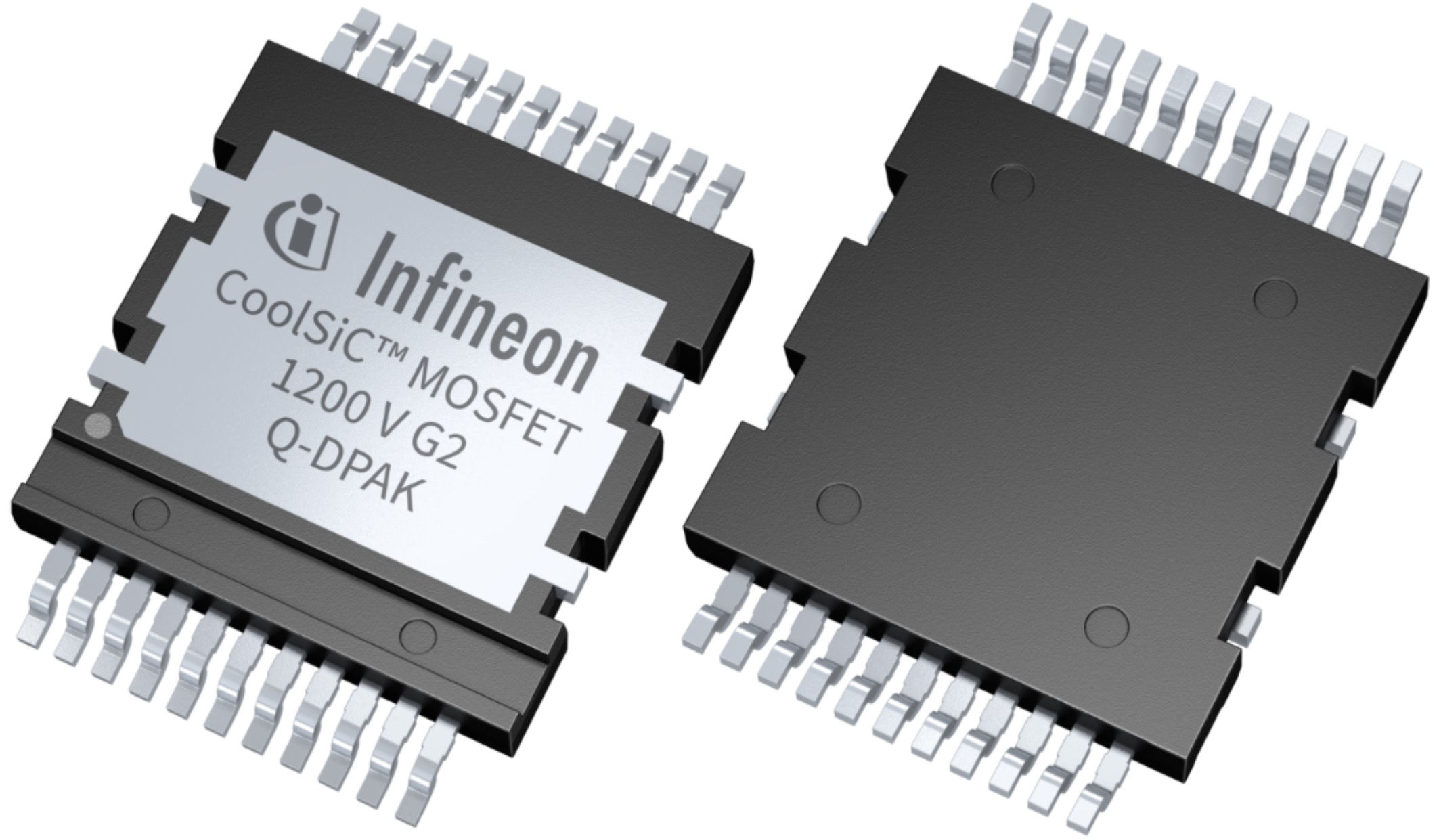
- Top-side-cooled Q-DPAK packaging combines .XT interconnection with a trench-gate architecture to improve thermal and switching performance.
Infineon Technologies is supplying 1200 V CoolSiC MOSFET G2 devices to Fox ESS for residential energy storage systems, with the silicon carbide switches cutting switching losses by 70% in the company’s PQ3-Ultra platform. Fox ESS reports peak photovoltaic inverter efficiency of 98.78% in grid-tied operation and peak battery charge and discharge efficiency of 98.47%.
The devices are used in Infineon’s top-side-cooled Q-DPAK package, which changes both the electrical and thermal design around the power stage. Infineon’s .XT interconnection technology is intended to reduce thermal resistance and junction temperature, while the trench-gate architecture lowers switching losses. The package also allows heat to be removed from the top of the device rather than through the PCB alone.
That arrangement gives designers more freedom in board layout because the principal thermal path is separated from the electrical connection to the PCB. Infineon says the package can help reduce parasitic effects and stray inductance, both of which become increasingly important as switching edges become faster. Its surface-mount format also supports automated assembly, retaining a production route suited to volume inverter manufacture.
Fox ESS is applying the devices in systems that move power between photovoltaic generation, battery storage, household loads, and the grid. Its PQ-H3-Ultra-10.0 hybrid inverter combined with the EQ3300-5 battery achieved a System Performance Index of 97.0% in testing by HTW Berlin University of Applied Sciences and AQUU Research. The result placed the system first in the 10 kW class among the hybrid inverter and storage products tested during 2026.
The same test recorded the highest SPI score since the evaluation began in 2018. SPI measures the economic energy performance of a complete storage system rather than relying on a single component or peak conversion figure, so the result provides a broader view of how the inverter, battery, controls, and losses interact under representative operation.
Residential storage places a wide operating range on the power electronics. The inverter has to handle changing solar generation, battery state of charge, household demand, and grid conditions, with efficiency varying across load points rather than remaining fixed at the headline maximum. Lower switching losses can reduce heat generation across that operating range, easing pressure on heatsinks, airflow, enclosure volume, and component derating.
Silicon carbide MOSFETs are increasingly used in power conversion where their switching behaviour and temperature capability justify a higher device cost than conventional silicon. The system-level benefit depends on more than the die, however. Package inductance, thermal resistance, gate-drive behaviour, PCB geometry, and cooling all influence whether faster switching can be used without creating additional electromagnetic or reliability problems.
Top-side-cooled packages are therefore becoming an important part of power-density improvements. Removing more heat directly from the package can allow smaller thermal interfaces and reduce the amount of PCB area dedicated to spreading heat, while shorter electrical paths can support lower-inductance layouts. Those gains become particularly useful in compact residential equipment, where acoustic limits and installation dimensions leave little room for oversized cooling hardware.
Fox ESS also brings manufacturing scale to the component decision. The company says it has installed more than 890,000 photovoltaic inverters and more than one million batteries in more than 70 countries during the past three years. At that volume, package compatibility, automated placement, thermal-interface assembly, and repeatable production are as relevant as laboratory efficiency.
The CoolSiC deployment gives Fox ESS a measurable reduction in semiconductor switching losses alongside a high complete-system efficiency result. The next constraint is maintaining those figures across production tolerances, thermal cycling, load variation, and long service life while keeping the inverter compact enough for residential installation.