IN Brief:
- Microchip is offering limited samples of its LAN9324x and LAN9322x automotive Ethernet TSN switch families.
- Family configurations scale to 18 external ports and 30Gbps switching capacity, with MACsec and Arm-based control and security hardware.
- VelocityDRIVE provides YANG and CORECONF management; volume pricing and general production availability remain undisclosed.
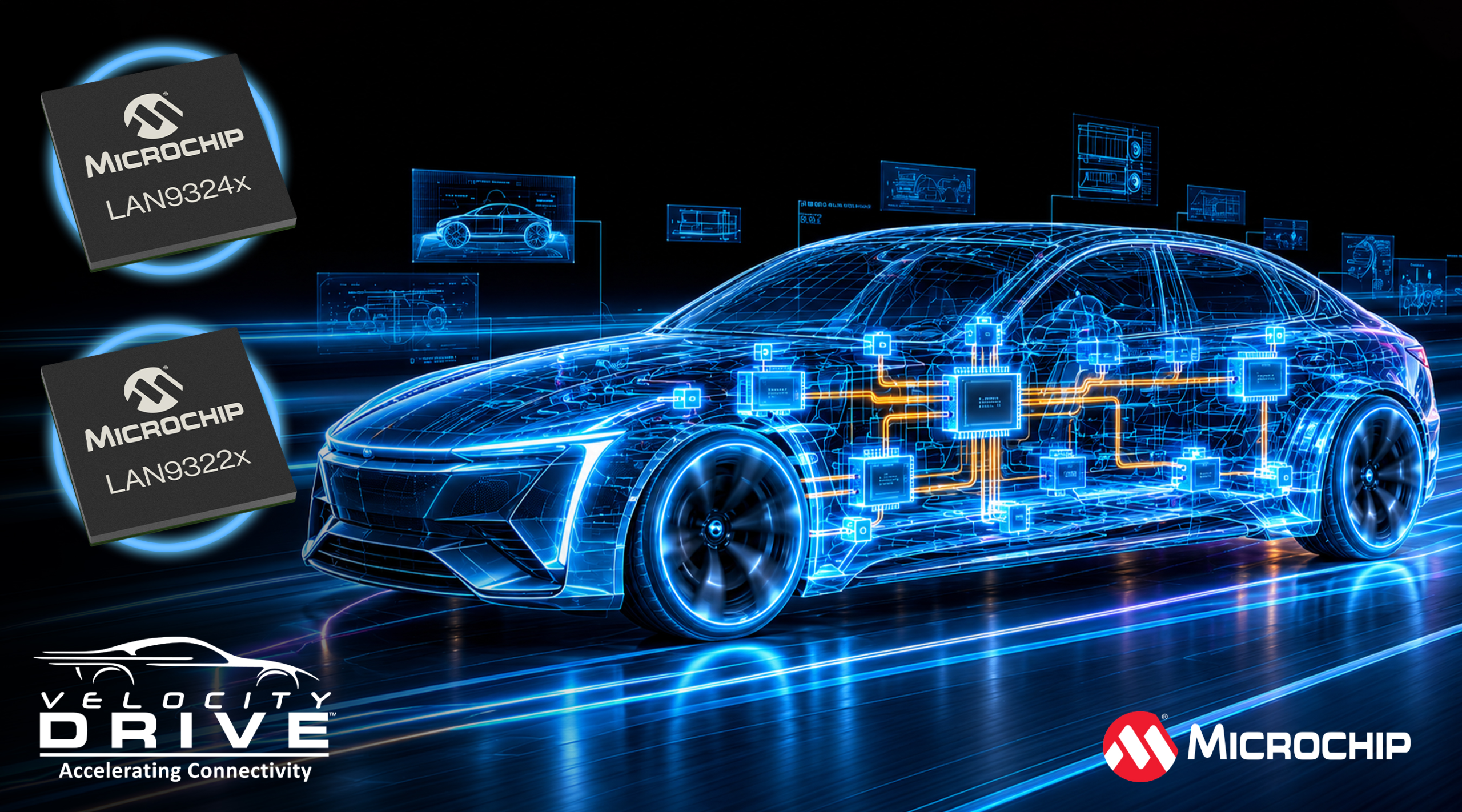
Microchip Technology has begun limited sampling of its LAN9324x and LAN9322x automotive Ethernet Time-Sensitive Networking (TSN) switch families. The devices combine configurable physical interfaces, security hardware and standards-based software management for vehicle networks that connect zonal controllers with central computing systems. The 17 November release establishes sampling availability; Microchip has not given a general production date.
The LAN9322x family is intended for compact edge and zonal applications. LAN9324x devices provide higher port counts and bandwidth for gateways, central computing nodes and more demanding zone controllers. Across the combined portfolio, Microchip specifies up to 18 external ports and 30Gbps switching capacity. These are family maxima, not specifications shared by every device, and the required port mix depends on the number and speed of links in the vehicle architecture.
As more vehicle functions exchange data over Ethernet, a zone controller must carry traffic from different sensors and electronic control units towards other zones or central processors. Camera streams, diagnostic messages and control data may share part of the same switching fabric despite having different latency and loss requirements. The switch design therefore affects how network capacity is allocated and how communication is maintained when traffic demand changes.
The new parts support integrated physical interfaces for 10BASE-T1S, 100BASE-T1 and 1000BASE-T1, with SerDes connectivity options extending from 10Mbps to 10Gbps. The single-pair Ethernet variants serve different link distances, bandwidths and network topologies, and cannot simply be treated as interchangeable connectors. Combining PHY choices within a compatible switch architecture allows hardware developers to select ports for individual sensor, control and backbone requirements instead of fitting an identical high-bandwidth interface throughout a vehicle.
TSN functions are intended to make selected Ethernet traffic more predictable through synchronised timing, traffic scheduling and prioritisation. The switch can help enforce a defined network policy, but deterministic performance is a property of the designed system, including endpoints, link capacities, traffic loading and configuration. A zonal network still needs timing and fault-behaviour validation for each critical function rather than relying solely on the presence of TSN support.
Microchip’s VelocityDRIVE Software Platform uses IETF and IEEE YANG data models with CORECONF to manage compatible switches. A common management model can reduce the need for separate device-specific configuration software as hardware choices change. The company also supports dynamic runtime reconfiguration, allowing a network configuration to be altered after initial setup. In a vehicle, a change affecting reserved traffic or security rules must be tested against the functions that depend on those settings.
MACsec support on every port provides link-layer protection for supported Ethernet connections. Additional hardware includes an Arm Cortex-M33-based embedded hardware security module and a deep packet inspection engine for filtering and intrusion detection. These functions can protect or inspect selected network traffic, but secure operation still depends on provisioned keys, configuration policies and integration with the vehicle’s wider cybersecurity architecture.
The switching families integrate a dual-core Arm Cortex-R52+ processor with lockstep operation and on-chip SRAM. Microchip describes the devices as ISO 26262 ASIL B compliant and AEC-Q100 Grade 2 qualified, with an ambient temperature range of −40°C to +105°C and a maximum junction temperature of 150°C. Those specifications concern the components and their design assurance; they do not establish functional safety compliance for a complete installed network.
Microchip also offers evaluation boards, reference designs and compatible Ethernet PHYs, bridges and endpoints for vehicle network development. The manufacturer points to wafer fabrication, assembly and test operations in several geographical regions as part of its sourcing approach, although it has not provided detailed capacity figures or named alternative production locations for these switches.
The devices remain available through limited sampling, supported by evaluation boards, reference designs and the VelocityDRIVE development environment. Microchip has not provided production pricing or a general shipment timetable. The automotive switching families are distinct from its recent PolarFire industrial networking update: the present devices integrate Ethernet switching, physical interfaces and network-management functions for vehicle architectures.