
IN Brief:
- Pickering will showcase modular switching platforms and Test System Architect at Microelectronics US 2026 in Austin.
- The line-up targets wafer acceptance, high pin-count package validation, RF routing, photonics test, and high-voltage switching requirements.
- Test engineering is shifting from box-level selection to signal-path design, documentation control, and faster replication across increasingly complex programmes.
Pickering Interfaces is set to use Microelectronics US 2026 to reinforce its position in semiconductor test, bringing a mix of modular switching hardware and design software aimed at the increasingly awkward realities of device verification. The company will show its latest signal switching solutions at the Austin event on 22-23 April, alongside the recently launched Test System Architect environment for designing and documenting switching and cabling systems.
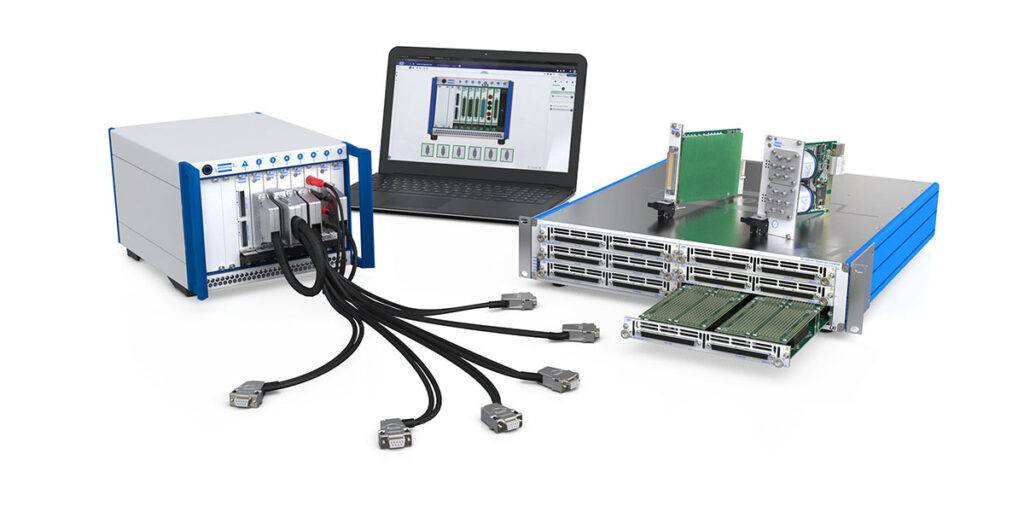
The hardware line-up is pitched at a range of semiconductor test problems rather than a single niche. Pickering says the portfolio on display will cover wafer acceptance testing, high pin-count package validation, photonics work, RF switching, and high-voltage routing. Among the systems being highlighted are a six-slot LXI 2U modular switching platform, a high-density reed relay matrix in a dual 128×4 configuration, an RF multiplexer with automatic termination and remotely mounted relays, and a high-voltage PXI multiplexer rated up to 1000VDC or 1000VAC peak.
On its own, that would be a familiar test-and-measurement story: more switching options, more channel density, more configuration flexibility. The more interesting part is how Pickering is now framing the software layer around the hardware. Test System Architect is designed to let engineers define signal paths, configure instruments and chassis, generate cable designs, and automate a large chunk of the documentation that normally consumes engineering time late in a programme. Pickering is not the first supplier to talk about workflow, but the emphasis is telling. In semiconductor test, the cost and delay often sit less in the switching modules than in the engineering effort required to connect, validate, revise, and replicate the whole system.
That burden has been rising as devices become more heterogeneous. Mixed-signal packages, chiplet-based designs, RF front ends, power semiconductors, and photonic elements all bring different routing, isolation, leakage, bandwidth, and documentation demands. Validation rigs are also expected to last longer and evolve faster, which pushes engineers towards modular architectures that can be reworked without tearing up the whole rack. Hardware flexibility is valuable, but only if teams can see the signal path clearly, manage changes without error, and hand projects from design to production support without losing the plot in spreadsheets and disconnected drawings.
Pickering’s pitch lands neatly in that gap. Test System Architect brings together chassis selection, module choice, schematic design, cable definition, migration support, and project management in one place. That matters because many engineering groups are still managing complex automated test builds with a patchwork of CAD files, part lists, legacy documents, and tribal knowledge. The result is rework, duplicated effort, and avoidable commissioning delays. By making the signal path explicit earlier, suppliers like Pickering are trying to shift automated test development towards something more repeatable and easier to maintain.
There is also a broader market backdrop here. Semiconductor manufacturing and design activity have both become more geographically distributed, while device qualification requirements have become more demanding. Engineers are being asked to support faster development cycles without giving up measurement integrity, traceability, or long-term maintainability. In that environment, scalable switching is not just about adding channels. It is about building test systems that can be reconfigured for new programmes, duplicated across sites, and updated as instruments or standards change.
Pickering’s continuing emphasis on migration is part of the same picture. Many organisations still carry test infrastructure built around older VXI and GPIB-era decisions, even as new projects are standardising around PXI, PXIe hybrid platforms, LXI, and Ethernet-linked architectures. Any tool that reduces the pain of moving between generations of hardware will find a willing audience, especially where teams need continuity rather than a clean-sheet rebuild.
The Austin showcase is therefore less about a single box and more about how semiconductor test systems are being assembled now: modular, signal-path aware, documentation-heavy, and increasingly software-assisted from the outset. That does not eliminate the engineering work. It does, however, suggest that the centre of gravity in test development is moving away from simply selecting hardware and towards managing the structure around it with fewer surprises once the hardware arrives on the bench.

