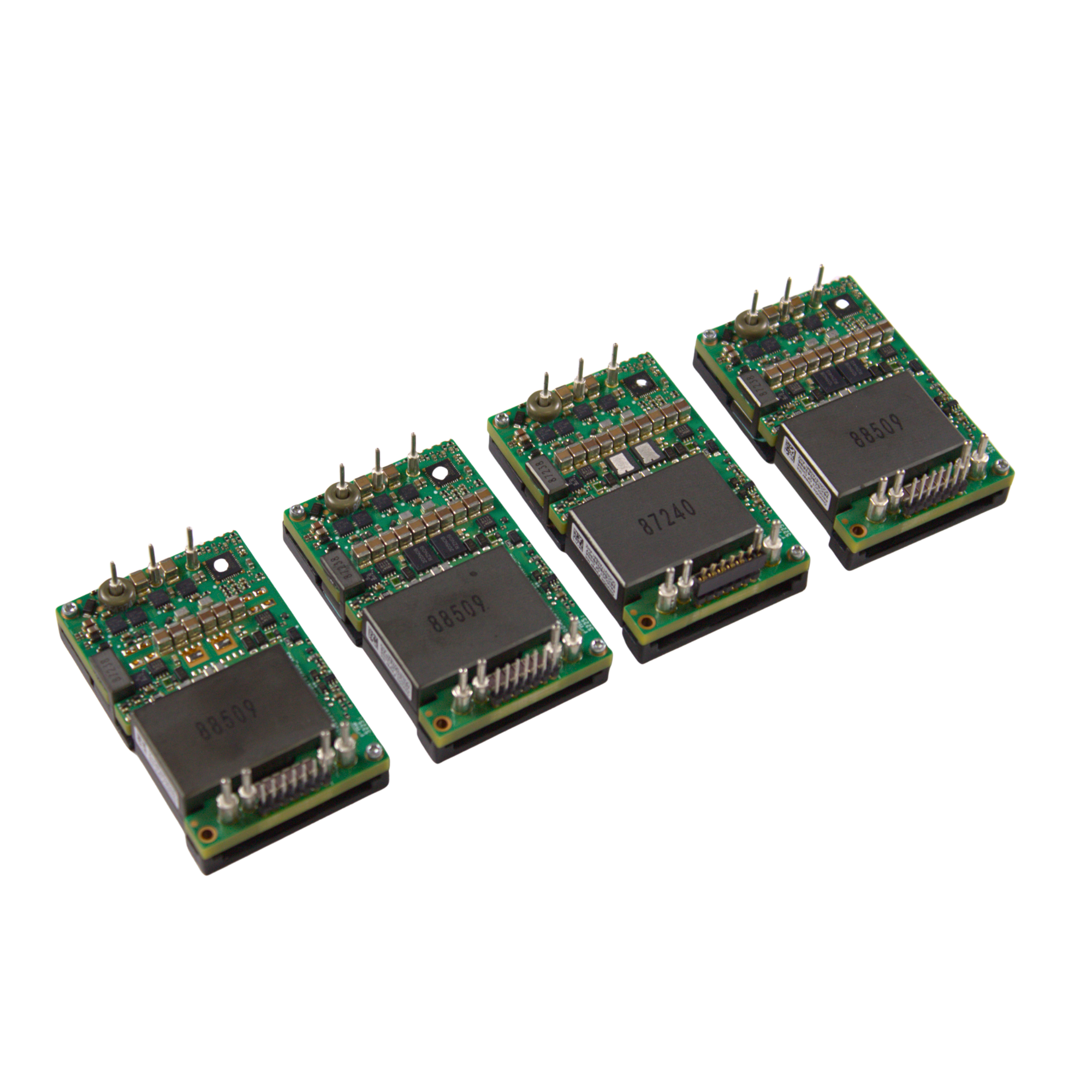
IN Brief:
- The qMicroModule IBC converts an 800V DC rack supply directly to approximately 6V for downstream processor regulation.
- Two stacked modules share the input voltage and deliver roughly 5kW using established 650V GaN devices.
- QPT combines high-frequency transformer, energy-recovery, and cycle-level control technologies to pursue multi-MHz operation.
QPT has unveiled an intermediate bus converter architecture for 800V AI data-centre racks that uses stacked gallium nitride power stages and high-frequency hard switching to convert the rack supply directly to approximately 6V for downstream processor regulators. The Cambridge company is offering the qMicroModule IBC through licensing and lead design partnerships, with a two-module stack intended to deliver roughly 5kW while occupying substantially less space than current 800V conversion stages.
The electrical arrangement places two converter modules in series across the high-voltage input so that each handles approximately 400V, allowing the first implementation to use established 650V GaN transistors rather than depending on a new high-voltage device generation before the architecture can be commercialised. Their low-voltage outputs are combined after conversion, while QPT says the same topology can later accommodate higher-voltage devices, including 1,200V GaN, as those technologies mature.
Higher input voltage reduces distribution current for a given rack power level, which is why 800V architectures are attracting attention as AI systems move towards much higher power densities, although stepping that bus down close to processor voltage creates a difficult conversion ratio. Existing resonant converters can operate efficiently around the megahertz range, but QPT argues that transformer and switching behaviour make further frequency increases progressively less useful when designers try to extract more power from the same physical volume.
The qMicroModule takes a different route by retaining hard switching at frequencies intended to move well into the multi-MHz range while combining several proprietary technologies to control the resulting losses. QPT’s ZEST transformer is designed for efficient operation at very high frequency, an energy-harvesting network recovers part of the energy that would otherwise be lost during switching, and the control system adjusts converter behaviour on every switching cycle.
Rob Gwynne, co-founder and CTO of QPT, said the architecture is intended to keep increasing power density as switching frequency rises, with the transformer and switching-loss problems addressed together rather than treated as separate limits. That claim will eventually have to be supported across efficiency, thermal performance, electromagnetic compatibility, insulation, and reliability, because reducing magnetic volume only improves the complete converter when the recovered board area is not consumed elsewhere by cooling, filtering, or device packaging.
QPT has already applied related high-frequency GaN techniques in its MicroDyno motor drive, which operates at 1MHz, giving the company practical experience with fast switching and cycle-level control even though the electrical conditions differ substantially from a multi-kilowatt intermediate bus converter. Moving from a motor drive to an 800V rack supply changes the conversion ratio, load profile, packaging constraints, fault energy, and thermal environment, so the earlier platform establishes a technology lineage rather than proving the data-centre design by itself.
The control system is also intended to react to a sudden load change within a single switching cycle, which QPT says can reduce the bulk capacitance normally used to support rapid power transients from processors and accelerators. AI workloads can move sharply between operating states, making local energy storage valuable when upstream converters cannot respond quickly enough, although the amount of capacitance that can actually be removed will depend on distribution impedance, downstream voltage regulators, protection strategy, and the complete rack power architecture.
The same response speed is being used for fault protection, with the converter designed to shut down within one switching cycle when an abnormal condition is detected. That becomes increasingly important as several kilowatts are concentrated into a small module because a fault can release substantial energy into semiconductor dies, conductors, and nearby components before a slower supervisory controller has time to intervene.
Thermal packaging forms another part of QPT’s development strategy through its qAttach die-attach technology, which the company says improves heat extraction from power semiconductor dies and creates headroom for later converter generations. Previous IN Electronics coverage of QPT’s qDesign platform examined the same packaging approach at module level, where die-attach geometry is treated as an engineering variable rather than a fixed manufacturing layer.
The qMicroModule brings those elements into a rack-power architecture where transformer design, transistor switching, heat removal, control timing, and mechanical integration all have to scale together. Increasing switching frequency can make magnetics smaller and transient response faster, but it also raises the penalty for parasitic inductance, device capacitance, layout error, and electromagnetic noise, leaving little value in a compact transformer if the rest of the converter grows around it to compensate.
An Industrial News report on the same announcement placed QPT’s approach within the wider move towards 800V rack distribution, while the electronics engineering question centres on whether the converter can retain efficiency and manageable EMI as its switching frequency moves beyond conventional intermediate bus designs. QPT is opening a limited number of lead partnerships with semiconductor and power-system companies working on racks intended for 2027 and beyond, leaving the qMicroModule at the licensable-architecture stage rather than as a catalogue converter with independent efficiency maps and qualification data.
Partner hardware will therefore provide the next significant evidence, particularly around full-load efficiency, thermal behaviour, transient response, electromagnetic emissions, and manufacturability across production tolerances. The architecture presents a credible route to shrinking part of the 800V conversion chain, but the claimed density advantage will only survive if transformer, GaN devices, cooling, filtering, protection, and control can all operate at several kilowatts without moving the lost volume into another part of the rack.