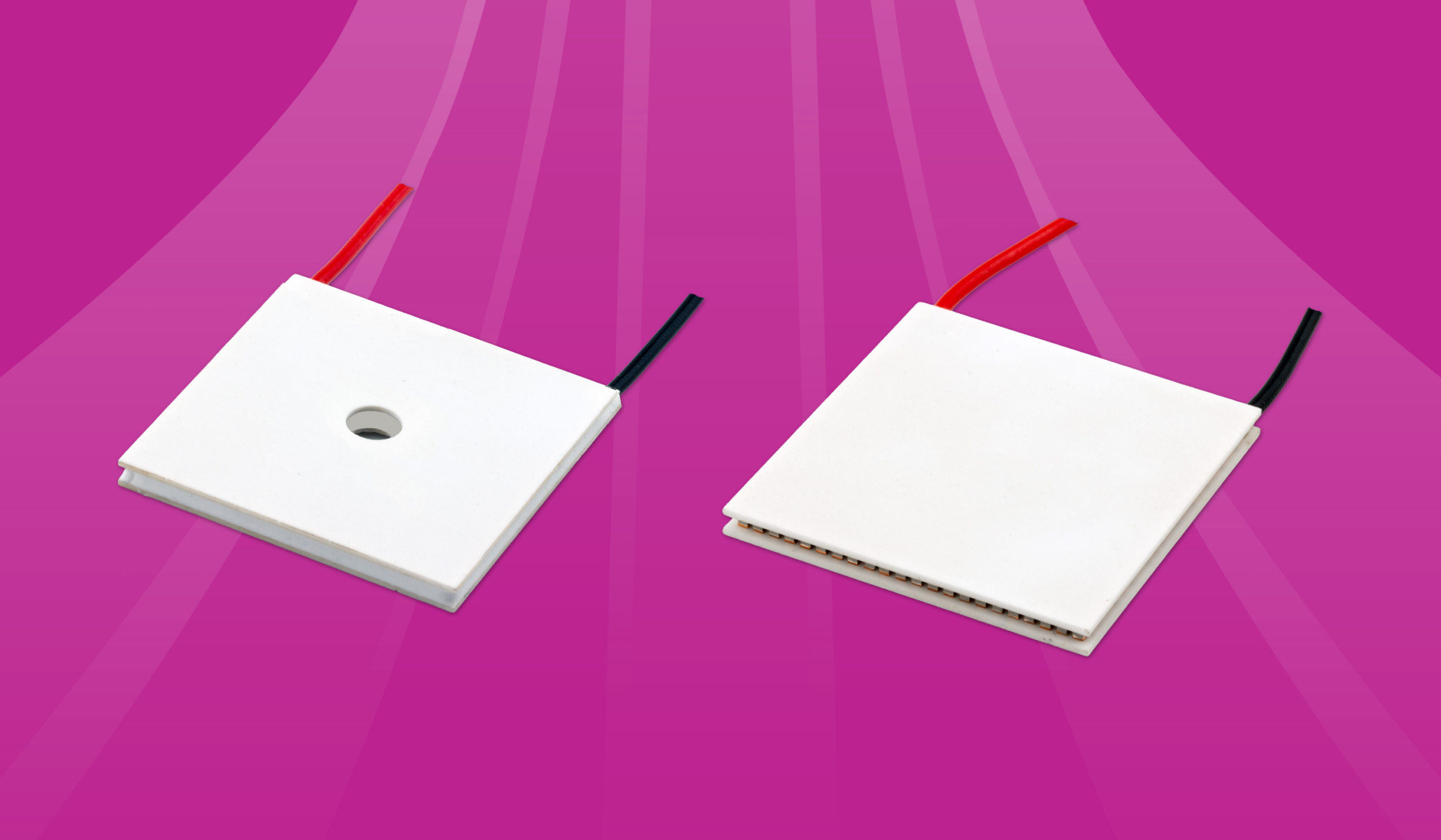
IN Brief:
- Same Sky has added 86 single-stage Peltier cooling modules using its established arcTEC structure.
- The new models span 25mm to 62mm square packages and 18W to 730W maximum heat pumping ratings under specified conditions.
- Resin interfaces, higher-temperature solder and larger thermoelectric elements are intended to limit fatigue during thermal cycling.
Same Sky has added 86 single-stage Peltier cooling modules to its thermal management range. The additions cover new package dimensions and electrical ratings while retaining the manufacturer’s existing arcTEC construction, developed to address fatigue from repeated heating and cooling. The components are intended for medical diagnostic equipment, laboratory instruments and industrial systems requiring compact temperature control.
The modules range from 25mm × 25mm to 62mm × 62mm, with some versions measuring 3.0mm thick. Same Sky lists maximum heat pumping ratings between 18W and 730W, maximum currents of 1.6A to 40A and maximum voltages from 9.3V to 34.6V. The published ranges cover different models. No individual part is specified to deliver all of those electrical and thermal extremes at once.
Thermoelectric cooling relies on the Peltier effect: electrical current through junctions of dissimilar materials transfers heat from one face of a module to the other. Reversing the current reverses the direction of heat transfer in an appropriate assembly. Cooling therefore depends on heat removal from the hot face, which must dissipate both the heat pumped from the cold side and the electrical input converted into heat.
The headline heat pumping figures are measured under specified conditions, including a hot-side temperature of 50°C. Heat transfer changes with the temperature difference across the module and the drive current. Same Sky also quotes maximum temperature differences from 79°C to 83°C, but the maximum temperature difference and the maximum heat pumping rating occur at different operating points. They cannot be combined into an assumed performance figure for a completed instrument.
Repeated temperature changes subject a thermoelectric module to mechanical stress because ceramics, metal connections and semiconductor elements expand at different rates. Cracking or joint fatigue can interrupt current flow and reduce thermal contact. Same Sky’s arcTEC arrangement addresses those interfaces through material and construction choices. The design predates the current expansion; the new development is a broader choice of modules built using it.
A thermally conductive resin between an electrical interconnect and the cold-side ceramic is intended to accommodate expansion and contraction. The manufacturer also uses higher-temperature antimony-tin solder rather than bismuth-tin solder and larger P-type and N-type elements. These features are presented as ways to improve resistance to cycling damage. The release does not provide a comparative, independently validated cycle-life figure for the new models.
Same Sky specifies cold-side operation down to −60°C and hot-side operation up to 195°C across the range. Those are component ratings requiring checks against an individual datasheet; they are not a claim that a module can simultaneously maintain a 255°C temperature difference. Surrounding electronics, sealing materials and condensation risks may impose narrower limits on the completed assembly.
The expanded range includes silicone-sealed units and models with annular cut-outs. Sealing may reduce exposure of the module to moisture or contamination, while an opening through the module can support an optical or mechanical arrangement that requires a central passage. Both features have to be considered alongside the contact area, clamping method and the route through which heat is rejected.
Medical analysers may require precise control of a sample or detector temperature, while laboratory instruments can be sensitive to thermal drift during measurement. Industrial imaging and optical systems may face both internal heat generation and changing ambient conditions. In each case, selection involves matching the module’s performance curve to the thermal load and available heat removal, not simply choosing the part with the highest quoted Qmax. Temperature sensors, a current driver and control software are also needed if the application requires closed-loop temperature regulation.
Prices begin at $12.82 per unit in quantities of 25, with delivery described as ranging from stocked parts to ten weeks, depending on the model. An equipment designer must therefore select from individual datasheets rather than the headline power rating alone. The 86 additions provide a wider set of dimensions, current ratings and environmental options for designs using Same Sky’s existing arcTEC thermoelectric architecture.