IN Brief:
- The RML 83 uses Intel Atom Amston Lake processors on a modular SMARC architecture for rolling stock applications.
- Connectivity includes 5G, three Gigabit Ethernet ports, CAN, serial interfaces, and RTK positioning with dead reckoning.
- Fanless operation below 20W is combined with railway environmental, fire, vibration, and EMC compliance.
Syslogic has introduced the RML 83, an EN 50155 certified railway computer built around a SMARC processor module for passenger information, networking, logging, communications, and other rolling stock functions.
The fanless platform is available with Intel Atom x7433RE quad-core or x7835RE octa-core processors from the Amston Lake family. Syslogic combines the processor module with its own carrier board and enclosure, using the modular SMARC architecture to separate the compute module from much of the application specific I/O.
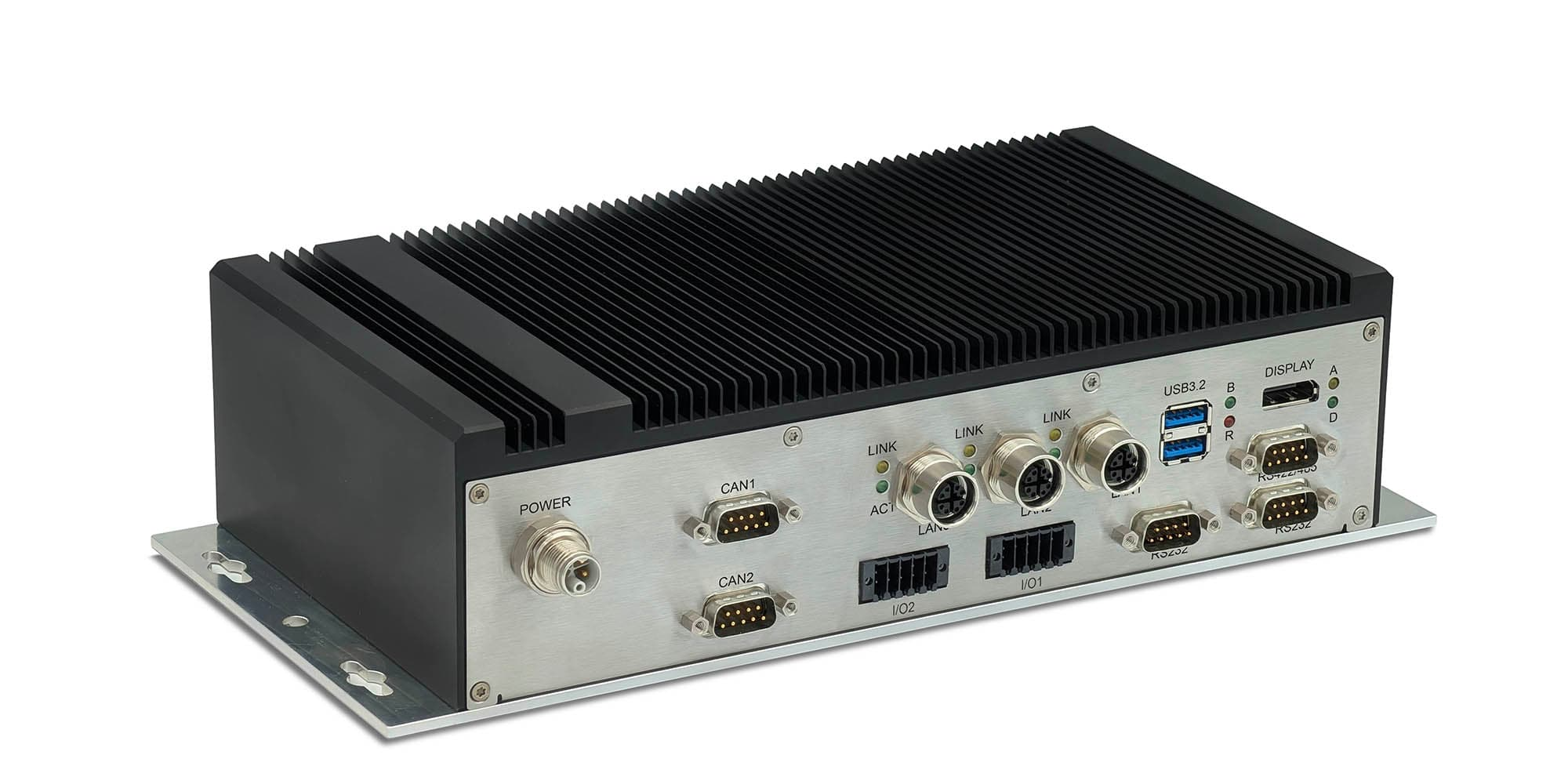
Standard interfaces include three Gigabit Ethernet ports, two CAN channels, two digital I/O interfaces, two USB ports, two RS-232 connections, one RS-422/RS-485 interface, and DisplayPort. The system also provides 5G connectivity for vehicle-to-control-centre and cloud communications, giving operators a route for diagnostic, operational, and passenger information without relying solely on depot connections.
Positioning is handled through a u-blox ZED-F9R module with RTK and dead reckoning. Syslogic says the arrangement can maintain centimetre-level positioning through temporary interruptions in satellite reception, a useful property in tunnels, cuttings, stations, and dense urban areas where GNSS signals can be obstructed. Satellite data is combined with inertial and vehicle movement information to estimate position until a reliable fix returns.
The RML 83 accepts 24VDC to 110VDC input, covering common onboard railway power systems. Its enclosure is rated IP40 and uses integrated cooling fins rather than a fan, with an operating temperature range from -40°C to +70°C. Power consumption is specified below 20W, reducing the heat load inside cabinets with limited airflow.
Certification is central to the design. The computer complies with EN 50155 for railway electronic equipment, EN 50125 environmental requirements, EN 45545-2 HL3 fire protection, EN 61373 shock and vibration requirements, and EN 50121 electromagnetic compatibility. Those standards address the electrical, mechanical, thermal, and EMC conditions encountered in rolling stock rather than general industrial installations.
The modular compute architecture also gives Syslogic a way to manage processor obsolescence over long vehicle lifetimes. Railway fleets can remain in service for decades while mainstream processor roadmaps move far faster. A SMARC based design does not remove the qualification work needed for future processor changes, but it can limit the number of mechanical and I/O elements that need to change during a compute refresh.
Syslogic offers the RML 83 with Debian Linux or Windows 11 IoT Enterprise LTSC preconfigured, with drivers available for common Linux distributions. Integrators can therefore choose between a long-life Windows environment and Linux based deployments according to application software, maintenance policy, and control over the operating system image.
The hardware is aimed at persistent onboard infrastructure rather than GPU heavy edge AI. Its sub-20W power consumption, conventional industrial interfaces, 5G communications, and resilient positioning suit systems that need to remain active for long periods without adding a large cooling requirement.
The available I/O mix also reflects the need to connect new compute functions with established railway subsystems. CAN and serial links remain common around vehicle control and monitoring, while Gigabit Ethernet supports newer IP-based networks. Keeping both interface generations on one platform can reduce the number of gateway devices needed inside a carriage or locomotive and simplify integration where legacy equipment remains in service.
Removing the cooling fan also eliminates a moving component that would otherwise become a maintenance item. The extended temperature range, railway-qualified mechanical design, and broad DC input range address deployment conditions where service access is limited and hardware replacement can carry disproportionate operational cost.
Production suitability will depend on how efficiently the modular platform can be adapted to project specific I/O, software, and certification requirements. The RML 83 is designed to provide a stable railway-qualified base while leaving the processor and selected interfaces flexible enough for different rolling stock programmes.