
IN Brief:
- Electrical steel below 0.1mm can reduce eddy-current losses at elevated operating frequencies.
- Grain-oriented and non-oriented grades are being supplied for motors, transformers, reactors, and compressors.
- Production performance depends on slitting quality, insulation integrity, stacking factor, joining, and material cost.
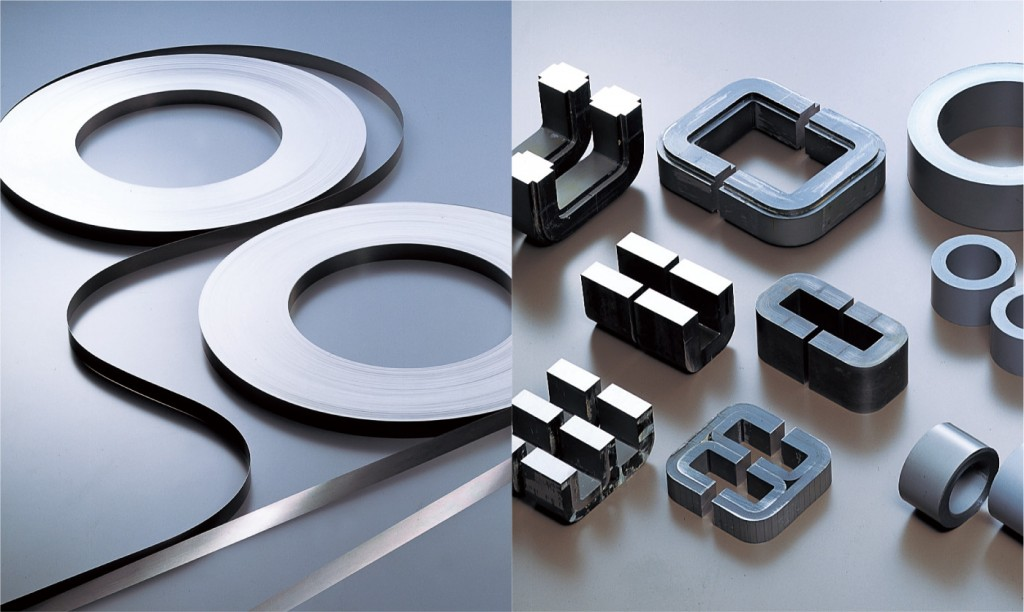
Nippon Kinzoku is expanding its range of ultra-thin electrical steels for high-frequency motors, transformers, reactors, electric compressors, drones, and medical equipment.
The Japanese manufacturer produces grain-oriented and non-oriented silicon-steel strip at thicknesses below 0.1mm, using Fe-3% Si material supplied by Nippon Steel. The products are intended for magnetic components operating across frequencies from approximately 400Hz to 40kHz.
As switching or rotational frequency rises, circulating eddy currents within a magnetic core contribute more heavily to iron loss, heat generation, and declining efficiency. Thinner laminations restrict those current paths, reducing the energy dissipated through the conductive material.
At a flux density of 1.0T and frequency of 20kHz, reducing grain-oriented material from 0.23mm to 0.05mm cuts iron loss by approximately 75%, while reducing non-oriented material from 0.15mm to 0.05mm produces a reduction of around 40% under the same conditions.
The strip is available with an insulation coating designed to remain stable at temperatures reaching 850°C. Electrical separation between adjacent laminations prevents the assembled stack from behaving as one solid conductor and preserves the loss reduction created by the thinner material.
Grain-oriented steel suits magnetic circuits in which flux follows a defined direction, including transformers and selected high-speed machine topologies. Non-oriented material provides more uniform magnetic behaviour in different directions and remains common in rotating electrical machines.
Motor and converter designers are increasing switching frequencies to shrink passive components, raise control bandwidth, and improve power density. High-speed motors also expose their cores to higher fundamental frequencies and richer harmonic content, increasing the proportion of loss generated in the magnetic material.
Ferrites and high-silicon materials already serve applications where high-frequency loss dominates, although their lower saturation flux density can require a larger magnetic cross-section. Ultra-thin electrical steel can retain higher usable flux density, offering a compact alternative where conventional laminations would overheat and ferrite would become physically larger.
Fabrication becomes more demanding as strip thickness falls. Slitting, stamping, handling, stacking, and joining must avoid burrs, deformation, residual stress, and damage to the insulating layer, since a small conductive bridge between laminations can create a local current path and erode the expected efficiency gain.
Stacking factor also changes because coating and microscopic gaps occupy a larger proportion of a structure built from thinner material. Less active magnetic steel fits within a given volume, so lower eddy-current loss has to be balanced against flux density, mechanical strength, production yield, and the number of laminations requiring assembly.
Joining methods introduce further compromises. Welding can create conductive paths and heat-affected regions, while adhesives, interlocking features, or mechanical compression influence dimensional tolerance, production speed, and thermal behaviour. High-speed rotors add centrifugal loading that may require sleeves or specialist retention structures.
Motor architecture is evolving alongside the material set. Mercedes-Benz is preparing axial-flux motor production, where compact magnetic circuits, thermal control, and repeatable high-volume assembly are central to achieving the expected power-density advantage.
Ultra-thin steel also applies to aerospace actuators, electric turbochargers, compressors, robotics, compact medical equipment, and high-frequency transformers. The optimum gauge varies with flux waveform, switching frequency, duty cycle, cooling arrangement, mechanical load, and production volume rather than following a single efficiency target.
Faster semiconductor switches bring the magnetic design into closer contact with the power-electronic architecture. Silicon-carbide and gallium-nitride devices can reduce switching loss and permit smaller converters, yet their steeper edges and higher operating frequencies may transfer more loss into motors, transformers, and reactors unless the core and winding are redesigned.
Accurate material models are therefore needed beyond traditional 50Hz or 60Hz data. Designers require loss curves across frequency, flux density, temperature, and harmonic waveform, while manufacturing teams need to understand how punching, stress relief, coating damage, and assembly alter the values measured on ideal samples.
Nippon Kinzoku’s sub-0.1mm strip broadens the options available between conventional electrical steel and lower-saturation high-frequency materials. Commercial adoption will depend on whether smaller, cooler magnetic components can offset the added difficulty of processing, inspecting, and assembling substantially thinner laminations at production scale.

