
IN Brief:
- The VOMHA43A provides 1MBd isolated signalling in a narrow 3.6mm SOP-5 package.
- Minimum common-mode transient immunity reaches 40kV/µs, with 707V peak repetitive isolation.
- The device targets isolated interfaces, intelligent power modules, industrial controls, and vehicle power electronics.
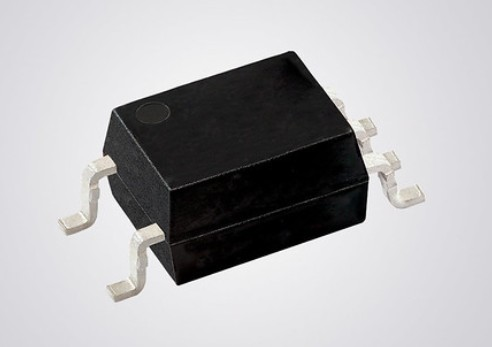
Vishay has introduced the VOMHA43A, a 1MBd automotive optocoupler in a 3.6mm-wide SOP-5 package for isolated communications and control within high-voltage power systems.
The device combines a gallium-aluminium-arsenide infrared emitter with a photodetector, open-collector output transistor, and internal Faraday shield. Galvanic separation allows low-voltage control electronics to exchange signals with circuits exposed to higher voltages and disruptive switching transients.
Minimum common-mode transient immunity reaches 40kV/µs, while repetitive peak isolation voltage is specified at 707V. The package has a comparative tracking index of 400 and operates across temperatures from -40°C to +125°C.
Qualification to AEC-Q102 supports use in vehicle electronics, with intended applications including isolated CAN, LIN, I2C, and SPI interfaces, intelligent power-module control, industrial automation, building systems, telecommunications equipment, and power converters.
At 3.6mm wide, the package is narrower than the 4.4mm body used by many conventional SOP-5 optocouplers. Vishay has retained a pin arrangement compatible with established alternatives, allowing board area to be reduced without forcing a complete interface redesign.
Isolation components are being exposed to steeper electrical transitions as converters move towards higher DC-link voltages and faster switching. Electric vehicles, energy-storage systems, solar inverters, chargers, motor drives, and industrial supplies increasingly operate around 400V or 800V architectures.
Silicon-carbide and gallium-nitride transistors intensify the challenge because rapid changes in voltage can drive displacement current through parasitic capacitance across an isolation barrier. If the receiver interprets that current as a valid transition, a power stage may switch incorrectly or a communications link may corrupt data.
Common-mode transient immunity describes the optocoupler’s ability to preserve its output state while the potential between its isolated sides changes rapidly. The specified value needs margin above the expected switching-node slew rate, including variation from temperature, production spread, layout, and operating condition.
The internal Faraday shield reduces capacitive coupling into the detector circuitry, although board structure remains part of the isolation system. Creepage paths, return-current geometry, nearby switching nodes, and electric-field concentration can weaken performance even when the component itself meets its data-sheet limits.
Vishay has also developed an optocoupler for 800V electric-vehicle architectures, reflecting the growing requirement for devices that combine higher working-voltage margins with immunity to fast common-mode events.
Optical isolation remains familiar and provides a clear galvanic barrier, but the light-emitting element ages and transfer characteristics vary with temperature, drive current, and operating time. Capacitive and magnetic digital isolators offer different combinations of speed, lifetime, emissions, and integration.
Selection therefore extends beyond headline data rate. Propagation delay, pulse-width distortion, output logic, supply current, fail-safe state, electromagnetic behaviour, insulation lifetime, and operation during partial power conditions all influence whether a device suits a particular control loop or communications channel.
With a 1MBd rating, the VOMHA43A is aimed at control and serial communications rather than the highest-speed isolated interfaces. Its open-collector output can simplify level adaptation and wired logic, although the pull-up network adds its own compromise between switching speed, current consumption, and noise immunity.
The narrower body does not remove creepage and clearance requirements around the package. Pollution degree, material group, working voltage, transient overvoltage, board finish, and the relevant equipment standard still determine spacing between conductive regions.
Pin compatibility can strengthen supply resilience for products with long manufacturing lives, but footprint alone is insufficient for substitution. Timing, drive current, insulation certification, transient response, temperature behaviour, and ageing must be compared before an alternative enters an approved bill of materials.
The VOMHA43A brings automotive qualification, optical isolation, and strong transient immunity into a smaller package. Reliable use in a fast-switching power system will depend on the margins, layout, and insulation structure surrounding it as much as the headline figures attached to the component.

