IN Brief:
- PLATON uses a light-field camera, microlens array, and SwissSPAD2 sensor to reconstruct particle interactions in three dimensions.
- Laboratory tests tracked electrons inside an unsegmented plastic scintillator using signals down to five detected photons.
- Future versions could support larger physics detectors and higher-resolution positron-emission tomography systems.
ETH Zurich and EPFL researchers have developed a particle detector that combines plenoptic imaging, single-photon avalanche-diode sensing, and computational reconstruction to track events inside an unsegmented block of scintillating material.
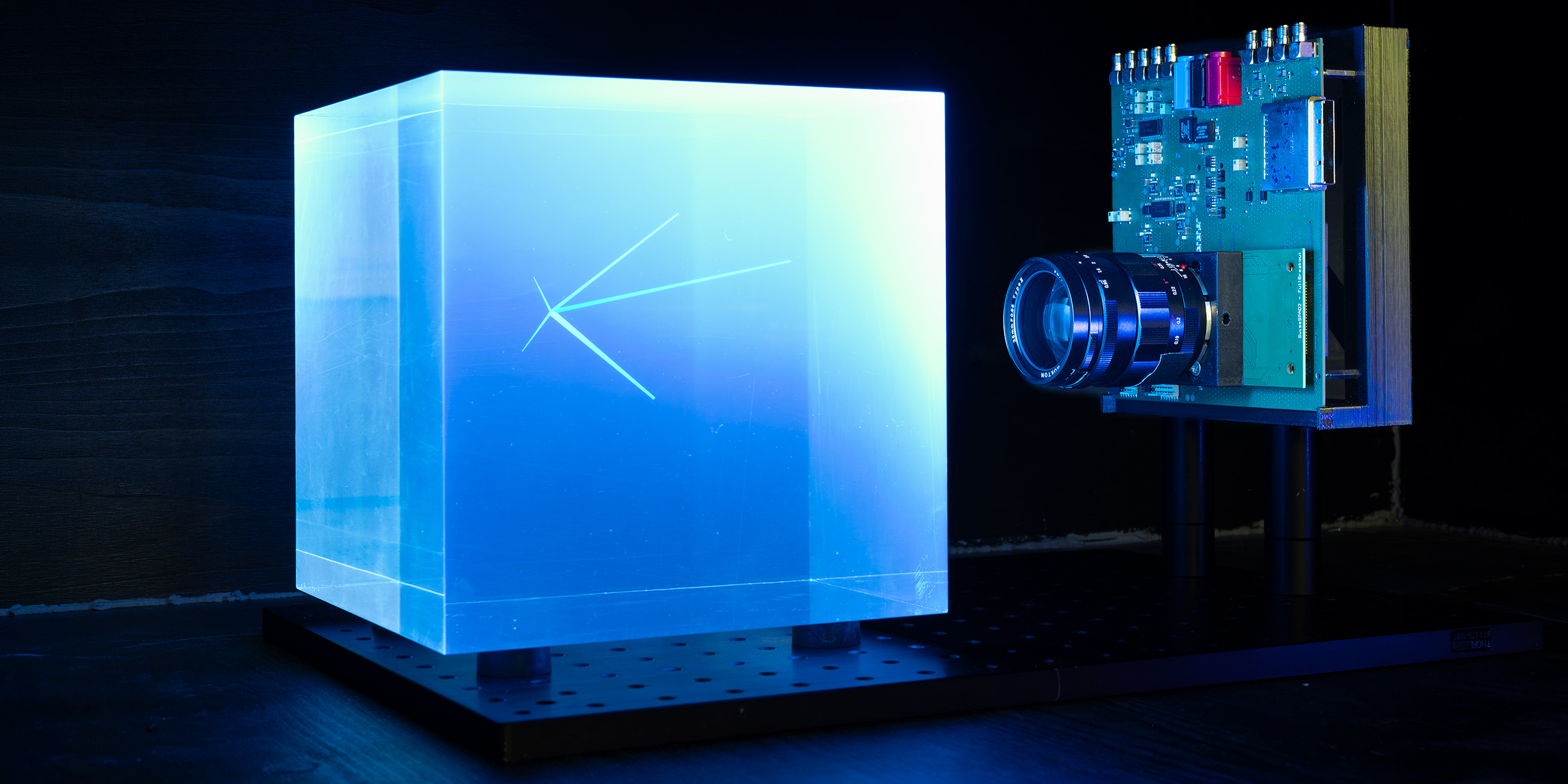
Named PLATON, the prototype replaces the conventional arrangement of numerous small scintillator elements, optical fibres, and individual photon detectors with a larger active volume viewed by a light-field camera. By recording information about both the position and direction of arriving light, the system can estimate where a particle interaction occurred in three dimensions.
The imaging assembly combines a microlens array with SwissSPAD2, a single-photon avalanche-diode sensor developed at EPFL. Each avalanche diode can register extremely weak optical signals, while controlled temporal gates help separate scintillation photons from dark counts and other background events.
Laboratory trials used a plastic scintillator and a strontium-90 source, allowing the researchers to reconstruct electron trajectories through the material. Measurements were compared with simulations across signals ranging from several hundred photons down to only five detected photons, with the experimental and modelled results showing close agreement under the tested conditions.
A neural network based on a transformer architecture analyses the spatial and temporal relationships between detected photons. Rather than treating the detector as a conventional two-dimensional camera, the reconstruction process infers the path that most plausibly produced the recorded light field inside the scintillator.
Development is now moving towards a SPAD array with higher photon-detection efficiency and sub-nanosecond timing. More precise time stamps would add another constraint to each photon measurement, improving the system’s ability to distinguish overlapping events and reject light that does not belong to the particle track being reconstructed.
The plenoptic camera is also being redesigned to widen its field of view and collect more light. Optical efficiency remains critical because photons can be lost at the scintillator boundary, within the lens system, across the microlens array, and at the sensor itself, reducing the information available to the reconstruction algorithm.
Simulations of an upgraded 10cm × 10cm × 10cm detector indicate that spatial resolution below one millimetre may be achievable, while a simplified one-cubic-metre model retained resolution of a few millimetres. Scaling from laboratory hardware to a large detector will nevertheless introduce alignment, calibration, data-rate, thermal, and mechanical challenges that are not represented fully by spatial simulation alone.
High-resolution particle detectors usually obtain precision through physical segmentation. The T2K neutrino experiment, for example, uses roughly two million scintillator cubes and 60,000 optical fibres in part of its detector system, while other instruments rely on dense arrays of thin scintillating fibres.
Segmentation supplies a direct indication of where an interaction occurred, yet every additional element introduces material, optical coupling, assembly work, routing, calibration, and another potential failure point. PLATON transfers much of that complexity into optics, photon sensing, and computation, simplifying the active volume while increasing the demands placed on calibration and reconstruction.
Any large implementation would need stable optical models across the full detector, compensation for component variation, and a repeatable method of checking the neural network against known particle sources. Changes in scintillator ageing, sensor response, temperature, mechanical alignment, or optical transmission could otherwise alter the reconstructed position without producing an obvious hardware fault.
Comparable design pressures are appearing in compact optical ranging. STMicroelectronics’ integrated 3D LiDAR module combines single-photon detection, timing, local processing, and calibration within a small edge-sensing platform, although PLATON applies those principles to light generated inside a detector volume rather than reflected from an external scene.
Positron-emission tomography offers a possible medical application because PET scanners reconstruct the location of photons created by positron annihilation events. Improved spatial and timing resolution could sharpen images or reduce the tracer activity needed to obtain clinically useful data, provided the architecture can be adapted to medical detector materials, geometries, and count rates.
Clinical deployment would add requirements around sensor reliability, thermal stability, electromagnetic compatibility, patient safety, manufacturing repeatability, and validated reconstruction performance. A network trained on laboratory data would also need evidence that its output remains dependable across different patients, scanner configurations, and operating conditions.
PLATON remains a research prototype, but it establishes a credible alternative to pursuing detector resolution through ever-finer physical segmentation. The architecture replaces millions of repeated components with a smaller number of sophisticated optical and electronic elements, shifting the engineering burden from assembly density towards precision sensing, timing, calibration, and computation.