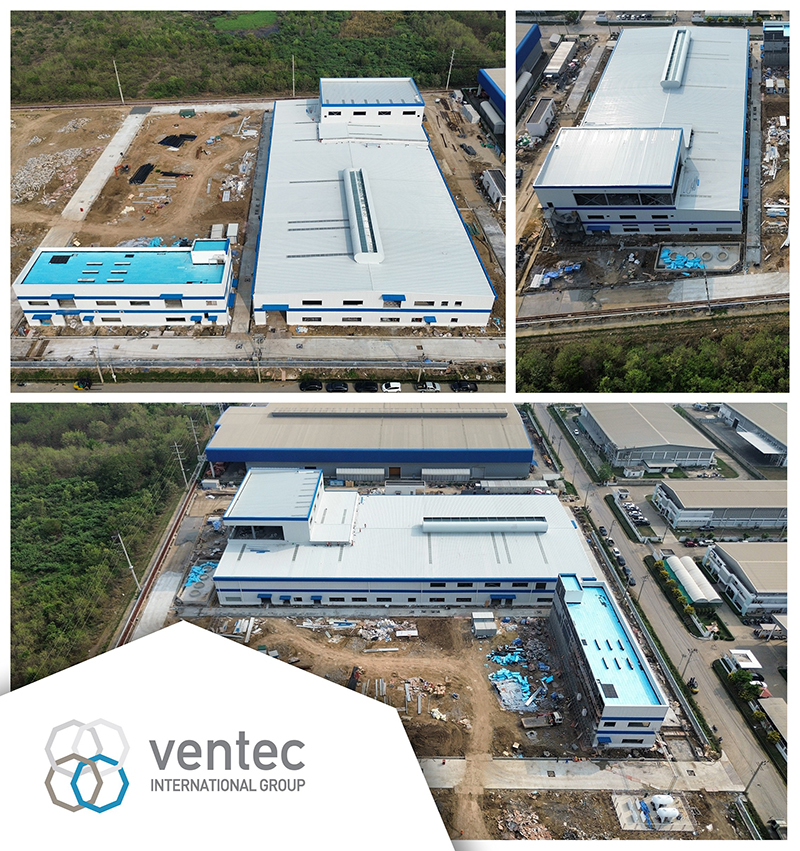
IN Brief:
- Ventec has opened its first Southeast Asian manufacturing facility in Thailand for PCB insulating and bonding materials.
- Earlier plans target 3.0 million square metres of monthly prepreg capacity and 80,000 square metres of bond-ply at full ramp-up.
- A separate US$50 million investment will expand its existing Kunshan operations in China.
Ventec International Group has opened its first manufacturing facility in Southeast Asia, adding a Thai production base for materials used in high-reliability printed circuit boards. The opening expands the company’s manufacturing footprint beyond existing operations in China and Taiwan.
Ventec is also investing US$50 million to expand its existing operation at Kunshan in eastern China. The projects serve different purposes: the Thai factory adds another manufacturing location, while the Kunshan investment increases capabilities at an established site.
The Thailand facility is intended to manufacture prepreg, bond-ply and laminate products for printed circuit boards used in aerospace, defence, industrial and medical electronics. These materials contribute to the electrical insulation and mechanical structure of multilayer boards, making consistency important in applications with demanding reliability requirements.
Ventec plans to increase the Thai operation’s capacity progressively through 2028. The planned equipment includes up to eight vertical treaters and two horizontal treaters for prepreg, alongside presses intended for high-mix, mid-volume laminate production.
At full ramp-up the company targets approximately three million square metres of monthly prepreg capacity and 80,000 square metres of bond-ply capacity. These figures describe planned manufacturing capability, not the volume produced when the factory opened in October.
Prepreg is reinforcing material impregnated with a resin system that has been partially cured. Sheets are placed between conductive and insulating layers in a multilayer PCB before heat and pressure are applied to complete the bonding process.
During lamination the resin flows and cures, producing a consolidated structure. Its composition, thickness and distribution influence electrical insulation and the spacing between copper features, while processing conditions affect the board’s mechanical integrity.
High-speed signals are affected by the properties of the dielectric material surrounding a trace. Changes in dielectric constant, loss or layer thickness can alter impedance and attenuation, potentially reducing the agreement between a circuit’s designed and manufactured electrical behaviour.
Bond-ply materials provide joining functions for selected structures, including boards using specialised substrates. Their behaviour must be compatible with the other layers and with the temperature and pressure conditions applied during PCB manufacture.
Copper-clad laminates supply conductive copper bonded to an insulating base. Material selection affects dimensional stability, dielectric properties and thermal expansion. The board must also tolerate soldering temperatures when components are subsequently attached.
Repeated heating and cooling can place mechanical stress on plated holes and layer interfaces when constituent materials expand at different rates. In high-reliability applications, manufacturers therefore need to consider thermal cycling, moisture behaviour and long-term performance alongside electrical specifications.
The Thai factory is planned to support a range of specialised products rather than a single high-volume material grade. Differences in resin systems and reinforcement materials can require different production settings, cleaning procedures and qualification tests, affecting how readily capacity can move between products.
Material manufactured at a new location may also require customer approval even when its published specification matches an existing grade. PCB producers can require comparative checks on thickness, dielectric behaviour, resin content, traceability and processing response before changing an approved supply source.
A new manufacturing site creates alternative sourcing options, but does not automatically make all materials from the Thai and Chinese factories interchangeable. Customer qualification, available product grades and production scheduling will determine when particular supplies can be substituted.
Ventec has identified a more fragmented PCB materials market, with some larger suppliers directing capacity towards AI computing and IC substrate applications. It sees an opportunity to support manufacturers handling a wider variety of high-reliability orders that may not fit the production priorities of larger-volume suppliers.
Ventec also targets an increase in global lamination capacity to around 1.8 million square metres per month by 2028. That is a network-wide future target and must not be added to, or mistaken for, the Thailand factory’s separately stated prepreg and bond-ply figures.
Expanding across manufacturing regions can reduce dependence on one location, but raw materials, production equipment and freight may still be sourced internationally. Operational resilience depends on which material grades are qualified at each plant and on how the wider supply chain is organised.
Ventec has not provided confirmed output or utilisation figures for the newly opened facility. Commercial supply will depend on the commissioning of individual production processes, qualification of material grades and completion of customer approvals.
The Thailand opening establishes the additional site, while the scheduled capacity ramp-up and Kunshan investment remain separate operational programmes. Further reporting will determine when the projected material output becomes available to PCB manufacturers.