IN Brief:
- Photronics recorded Q3 revenue of $216.0 million, up 2.7% year on year and 2.9% sequentially.
- IC photomask revenue rose 5% to $154.7 million, with high-end products reaching a record 44% of IC sales.
- US and Korean manufacturing investments remain on schedule as customers continue migrating towards more advanced process geometries.
Photronics has reported a recovery in semiconductor photomask demand as previously delayed integrated-circuit designs returned to production, with high-end masks reaching a record share of its IC business. Fiscal third-quarter revenue was $216.0 million, an increase of 2.7% year on year and 2.9% from the preceding quarter.
IC photomask revenue reached $154.7 million, increasing 5% both year on year and sequentially. High-end products accounted for 44% of IC revenue during the quarter, the highest proportion reported by Photronics. The company defines its high-end IC business as photomasks supporting 28 nm and smaller design nodes.
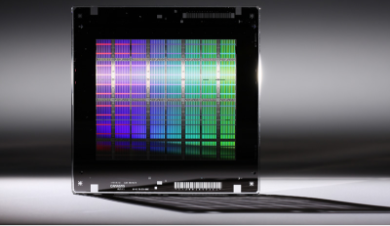
Photomasks sit between circuit design and semiconductor fabrication. Each mask contains the pattern used during a lithography stage to transfer circuit features onto a wafer, with a modern integrated circuit requiring a sequence of masks corresponding to the different layers created during manufacturing.
As dimensions shrink, mask production becomes increasingly demanding. Registration between successive layers has to remain tightly controlled, while mask writing, inspection, defect repair, and process correction all become more sensitive to dimensional errors. A new semiconductor design can also require a complete set of masks before volume wafer production begins.
That makes photomask demand dependent on design activity as well as fab utilisation. A production line can operate at high capacity using an existing mask set without creating substantial new demand for masks, while the release of a new device, a process migration, or a major design revision generates fresh tooling requirements.
Photronics said some semiconductor design releases had been temporarily delayed during its second fiscal quarter, citing high fab utilisation, tight memory supply, and wider macroeconomic factors. The third-quarter figures indicate that some of those projects progressed back into production during the latest period.
The high-end product mix also reflects continuing node migration. Moving a design from an older geometry to 28 nm, 22 nm, or smaller processes increases the accuracy required from the mask set and can increase its value. Photronics has previously identified 22 nm and 28 nm migration in Asian markets as an important part of its high-end business.
The company continues to invest in manufacturing capacity in the United States and South Korea and said both programmes remain on track. Photomask supply has acquired greater strategic attention as semiconductor manufacturing becomes more geographically distributed, because regional wafer-fab investment creates a corresponding requirement for qualified mask capacity.
Photomasks cannot simply be moved between suppliers or production sites without qualification. Semiconductor manufacturers typically correlate a mask supplier’s process and equipment against their own lithography requirements before approving it for volume use. That places importance on inspection capability, process repeatability, defect control, and matching between manufacturing locations as capacity expands.
Photronics operates 11 manufacturing facilities across Asia, Europe, and North America. A wider footprint gives it options for supporting customers in different regions, although equipment capability and qualification still determine which facilities can manufacture a particular high-end mask.
Flat-panel-display photomasks accounted for the remainder of third-quarter revenue. FPD sales were $61.4 million, down 2% both sequentially and year on year, leaving IC masks as the principal source of growth during the period.
The company ended the quarter with $672.8 million in cash, cash equivalents, and short-term investments, of which $503.5 million was associated with joint ventures. Capital expenditure during the quarter was $37.0 million.
For the fiscal fourth quarter, Photronics expects revenue between $207 million and $227 million and an operating margin between 19% and 24%. The range does not imply a uniform acceleration across the semiconductor market, but the third-quarter product mix provides a clearer manufacturing signal: more of the company’s IC activity is being generated by mask sets for advanced geometries as previously delayed designs return to production.