IN Brief:
- The 41-621 PXI and 43-621 PXIe generators provide two or four independently programmable output channels in a single 3U slot.
- Each channel supports 16-bit conversion at up to 250 MSa/s, 128 million waveform samples, and sine-wave generation up to 40 MHz.
- Cross-channel synchronisation, modulation functions, and software interfaces support automated testing, avionics simulation, and legacy test-system upgrades.
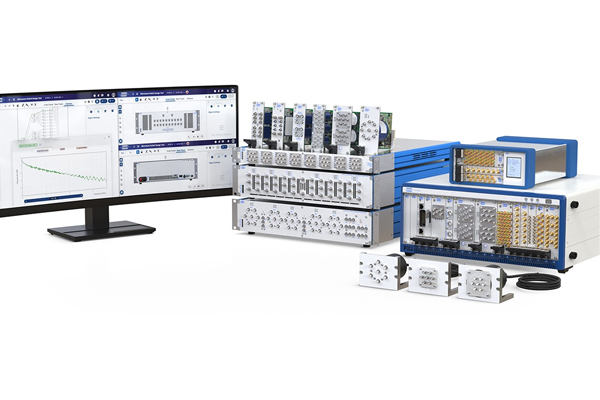
Pickering Interfaces has introduced the 41-621 PXI and 43-621 PXIe arbitrary waveform generator families, providing up to four independently programmable signal outputs within a single 3U chassis slot. The instruments are designed for automated functional testing, multi-channel sensor simulation, avionics verification, and the modernisation of established electronic test systems.
The new generators are offered with two or four output channels, each incorporating a 16-bit digital-to-analogue converter operating at up to 250 million samples per second. Every channel provides 128 million samples of waveform memory and can generate sine waves at frequencies reaching 40 MHz, with output amplitudes up to 20 V peak-to-peak into a high-impedance load.
Pickering identifies the four-channel configuration as a way to reduce the chassis space required for complex test arrangements. Compared with two-channel modules occupying equivalent slots, the higher channel density allows more independent signals to be generated from a given rack configuration.
The company estimates a cost-per-channel advantage of approximately 40% over selected competing instruments. That figure is a manufacturer comparison rather than an independently established saving across the wider test equipment market, where pricing also depends on channel specifications, software, chassis requirements, and support arrangements.
Arbitrary waveform generators reproduce electrical signals from stored sequences of digital amplitude values. A digital-to-analogue converter transforms those values into an analogue output, allowing the instrument to generate waveforms that are more complex than conventional sine, square, or triangular signals.
Sampling rate determines how frequently the stored values can be converted into an output. The 250 MSa/s capability therefore describes the maximum update rate of the converter, while the achievable frequency content is constrained by the instrument’s analogue output characteristics and the waveform being generated.
The 16-bit converter provides 65,536 nominal amplitude codes. Resolution influences the precision with which output levels can be represented digitally, but actual signal fidelity also depends on noise, distortion, calibration, output circuitry, and the operating frequency.
Pickering’s 40 MHz sine-wave specification is consequently distinct from the 250 MSa/s converter rate. Both characteristics must be considered when assessing whether the module can reproduce the bandwidth and waveform shape required by a particular device under test.
Independent channel memory allows different waveforms to be stored and reproduced simultaneously. This arrangement is useful when a system receives several related electrical inputs that must change according to a defined operating sequence.
A flight-control electronics assembly, for example, may receive signals representing several sensor measurements while its response is monitored by an automated tester. Reproducing those inputs consistently is necessary when comparing results across repeated tests or investigating a particular operating condition.
Pickering identifies full authority digital engine control systems among the intended applications. Such equipment processes multiple sensor inputs to manage engine operation, so test arrangements can require several coordinated signals rather than one standalone source.
The new modules support synchronisation and phase alignment within a module and across multiple modules. A shared timing relationship allows channels to reproduce signals whose relative timing is part of the test condition.
Without appropriate synchronisation, differences between signal sources can introduce uncertainty into a measurement. In a multi-channel simulation, even when each waveform is individually accurate, the device under test may respond differently if the relative phase or sequence timing changes.
Available generation functions include amplitude and frequency modulation, chirps, frequency-shift and phase-shift keying, pulse-width modulation, and programmable frequency sweeps. These modes allow changing electrical conditions and communication-related signals to be reproduced without creating every sample sequence externally.
Frequency sweeps can be used to assess circuit response across a specified range, while chirp signals provide controlled changes in frequency over time. Their usefulness depends on whether the resulting analogue output remains within the instrument’s amplitude, frequency, and distortion specifications.
The PXI and PXIe configurations provide alternative integration routes. The 41-621 uses the PXI platform and can also operate in Pickering’s modular LXI and LXI/USB chassis, supporting Ethernet- or USB-controlled systems. The 43-621 is intended for PXIe installations.
Software support includes LabVIEW, Python, and C#, alongside a software front panel for configuring standard waveforms, importing custom sequences, and defining sweeps. The interfaces enable the modules to operate as part of automated test programmes rather than requiring continuous manual adjustment.
Long-term maintenance is another consideration in test-system design. Aerospace and defence electronics programmes can remain in operation for many years, with their test infrastructure required for development, production, servicing, and component replacement.
Pickering provides a standard three-year warranty and describes product support periods typically extending for 15–20 years or longer. The company’s existing switching, simulation, and connectivity portfolio provides complementary modules for test configurations requiring additional signal routing or system integration.
The 41-621 and 43-621 families extend Pickering’s modular instrumentation range with higher channel density and coordinated arbitrary signal generation, supporting systems where signal complexity, rack space, and long-term maintainability must be assessed together.