IN Brief:
- MicroVision has begun commercial production and customer shipments of MOVIA Pro at its Orlando facility.
- The solid-state sensor provides 180° horizontal coverage, onboard perception processing and a 10Hz frame rate.
- MicroVision specifies under 9W power consumption, IP6K9K protection and CAN and Ethernet interfaces.
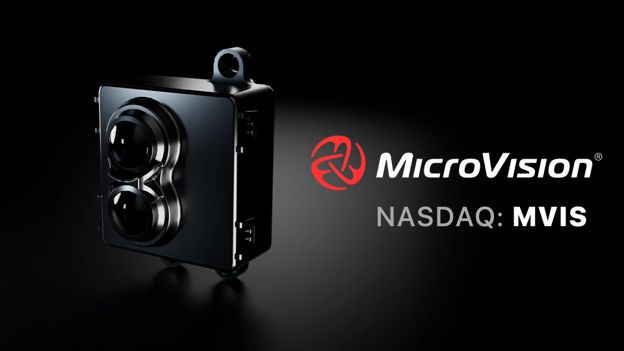
MicroVision has begun commercial production and customer shipments of its MOVIA Pro short-range lidar sensor at the company’s Orlando manufacturing facility. The solid-state device combines optical ranging with onboard processing, allowing selected perception applications to operate directly on the sensor instead of requiring every point cloud to be interpreted by a separate computer.
MOVIA Pro is the production development of MicroVision’s earlier MOVIA S platform. The new model includes an open, Linux-based software framework through which customers can develop, install and update their own perception applications. The company is targeting warehouse automation, intelligent transport infrastructure, unmanned systems and other equipment that needs environmental sensing within a compact package.
The sensor provides a 180° horizontal field of view and 132° vertically, with a stated angular resolution of no more than 0.86° horizontally and 0.80° vertically. It operates at 10 frames per second. Together, these specifications describe angular coverage and sampling frequency; they do not establish that every object within the observed region can be detected or classified under all operating conditions.
Detection range depends on how strongly a target reflects the laser light, the surrounding illumination and the probability threshold used to describe a successful measurement. For a target with 10% Lambertian reflectivity under 100 kilolux sunlight, MicroVision specifies a range of 15.1 metres at a detection probability above 90%. The company’s product information also gives 19.8 metres at a 50% detection probability under the same conditions.
Those range figures are not interchangeable. A greater quoted distance obtained at a lower detection probability does not mean that the sensor can meet the stricter threshold at that distance. System developers must also consider object geometry, partial obstruction and the requirements of the downstream control function when determining whether the stated ranging characteristics provide adequate sensing coverage.
MOVIA Pro uses a solid-state optical arrangement without moving scanning parts. It is specified as a Class 1 laser product, measures approximately 77 by 76.6 by 56.2 millimetres and weighs less than 400 grams. Stated power consumption is below 9W. These characteristics support integration into equipment with constrained space and electrical budgets, although the finished installation still requires suitable mounting, wiring and thermal conditions.
The enclosure carries an IP6K9K protection rating, indicating defined resistance to dust ingress and high-pressure, high-temperature water jets under the applicable test conditions. Such a rating does not independently qualify every cable assembly, connector or host enclosure used with the device. Its suitability for washdown areas or exposed machinery needs to be assessed across the complete installation.
Conventional lidar equipment produces a set of spatial measurements that can be converted into a point cloud representing nearby surfaces. External processors then analyse that information to identify obstacles, estimate movement or supply data to navigation software. MicroVision has added processing capability within MOVIA Pro so that selected interpretations can occur locally and object-level information can be sent to connected equipment.
Moving processing onto the sensor may reduce the computing work required elsewhere and the amount of raw measurement data transmitted across an interface. The benefit depends on the selected application, the algorithm and the capabilities available on the embedded hardware. Complex perception or autonomy functions may still need substantial external computing capacity, while software updates and configuration remain important to maintaining consistent results.
The product also supports multi-echo measurement, recording more than one return from a transmitted lidar pulse where reflections arise from different surfaces. Multiple returns can provide additional information in partially obstructed scenes, although whether they improve object detection depends on surface reflectivity, scene geometry and the software used to interpret the returns.
Interfaces include CAN, Gigabit Ethernet and 100Mbit Ethernet, allowing the device to communicate with industrial controllers, vehicles and supporting computers. The appropriate connection depends on the content being transferred: raw sensing data can place different demands on bandwidth from processed obstacle information or equipment status messages. MicroVision says its framework allows customers to develop and update applications on the device.
Warehouse robots and automated guided vehicles are among the intended uses. Their sensors must account for moving people, stored goods and changing travel routes, while the overall control system determines when to stop or change direction. Wide angular sensing can assist environmental coverage, but vehicle geometry can create blind spots and the safety of a complete machine cannot be inferred from the lidar device’s specifications alone.
MicroVision also identifies intelligent intersections, traffic monitoring, infrastructure surveillance and unmanned aerial and ground systems as prospective applications. It says anonymised sensing may support deployments where privacy is important, but data protection obligations will depend on the actual processing and retention arrangements. The company has not announced a universal certified safety function covering those different uses.
Chief executive Glen DeVos said the company’s Orlando operation was manufacturing MOVIA Pro to meet customer demand. The 22 October announcement confirms that shipments have begun and the device is available for orders, but does not disclose production volumes, named buyers or revenues attributable to this launch. Those figures remain separate from the published optical and electrical specifications.