IN Brief:
- The AHC1724Q and AHC1725Q measure AC and DC currents over selectable ranges extending to ±50 A, with galvanic isolation between the primary conductor and sensing electronics.
- Both devices integrate a 1.2 mΩ conductor, differential Hall sensing and 120 kHz analogue bandwidth, with typical response time of 4 µs.
- The sensors are AEC-Q100 qualified, operate from −40°C to +150°C and provide separate 5 V and 3.3 V supply options.
Diodes Incorporated has introduced two automotive-qualified Hall-effect current sensors that combine galvanically isolated measurement with a low-resistance internal conductor. The AHC1724Q and AHC1725Q are designed for AC and DC current monitoring in electric vehicle chargers, onboard power converters and other systems where current must be measured without directly connecting the monitoring electronics to the primary electrical circuit.
Both devices incorporate a copper conductor with typical resistance of 1.2 mΩ and provide measurement options extending to ±50 A. Their analogue outputs have a bandwidth of 120 kHz, with a typical response time of 4 µs and typical propagation delay of 2 µs.
Diodes offers two supply-voltage arrangements. The AHC1724Q operates from 4.5 V to 5.5 V and supports measurement ranges from ±2.5 A to ±50 A. The AHC1725Q operates from 3.0 V to 3.6 V, with available ranges from ±5 A to ±50 A.
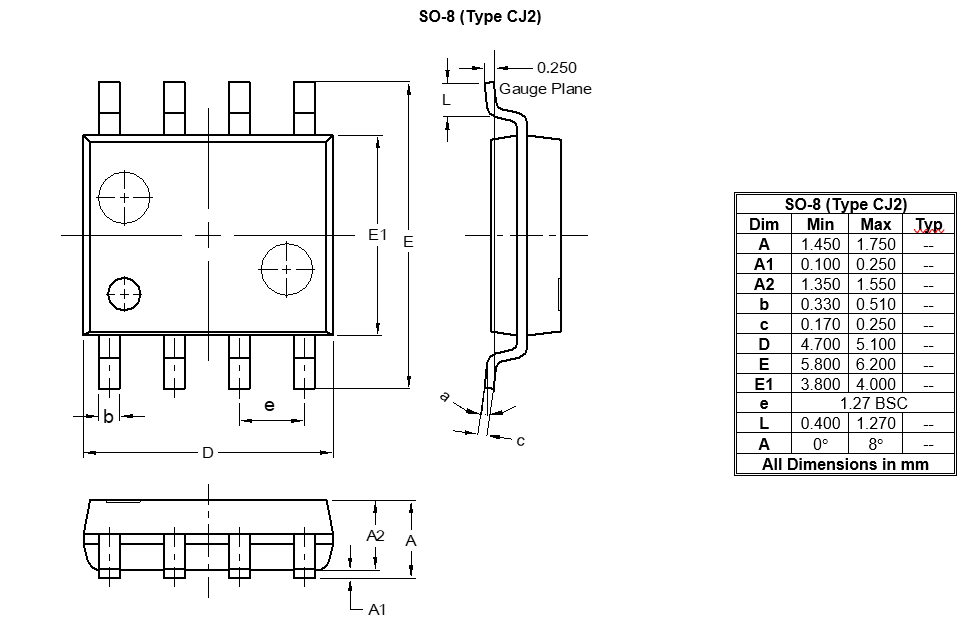
Both sensors are housed in low-profile SO-8 Type CJ2 surface-mount packages and are rated for operating temperatures from −40°C to +150°C. Unidirectional and bidirectional measurement options allow the output configuration to be selected according to the expected direction of current flow.
The devices use the Hall effect to measure the magnetic field generated by current passing through a conductor. Within the package, a copper conduction path is positioned close to the sensing circuit, establishing a defined relationship between the current and the magnetic field detected by the semiconductor.
The sensing circuit converts that magnetic field into a proportional analogue output. Unlike a conventional shunt measurement arrangement, the low-voltage signal connections do not need to share a direct electrical path with the conductor carrying the measured current.
This separation allows current to be monitored in higher-voltage circuitry while maintaining galvanic isolation between the primary conductor and the sensing electronics. Diodes specifies a maximum working voltage of 420 V DC for basic isolation according to UL 62368-1.
The isolation rating must be interpreted within the conditions established by the relevant standard and device documentation. Suitability for a finished charger or converter still depends on its insulation architecture, protective measures, electrical clearances and applicable equipment requirements.
Current measurement introduces a trade-off between electrical loss, measurement accuracy and circuit complexity. A shunt resistor produces a voltage proportional to current, but the resistor dissipates power and may require additional signal conditioning or isolation when used on a high-voltage rail.
Hall-effect sensing uses the magnetic field associated with the current instead. The conductor still has resistance, however, so electrical losses remain and must be included in the thermal design.
At a current of 25 A, a typical resistance of 1.2 mΩ corresponds to approximately 0.75 W of resistive dissipation. At 50 A, the corresponding instantaneous loss rises to approximately 3 W, illustrating the effect of the square-law relationship between current and conduction loss.
Those calculations use the nominal resistance and do not establish the permitted continuous operating current under every installation condition. Conductor temperature, current waveform, PCB thermal design and the package’s operating limits must also be considered.
Diodes employs differential Hall sensing to reduce interference from external magnetic fields. The sensing arrangement detects the field associated with its primary conductor while rejecting some common-mode field components that may be present around neighbouring power electronics.
Magnetic interference is relevant to converters containing inductors, transformers, busbars and other current-carrying conductors. Their fields can influence measurements if the sensor cannot adequately distinguish the intended current path from surrounding electrical activity.
Differential sensing improves rejection of some unwanted fields, but the result still depends on sensor placement and the magnetic environment. Mechanical positioning and routing of nearby high-current conductors therefore remain part of the measurement design.
The devices also use chopper-stabilised analogue circuitry to reduce offset-related errors. Calibration after packaging compensates for characteristics of the assembled component, supporting a proportional output over its specified operating conditions.
Both sensors produce ratiometric analogue outputs, meaning the output voltage varies in relation to the device’s supply voltage. When the receiving analogue-to-digital converter uses an appropriately related reference, this characteristic can reduce sensitivity to certain supply variations.
Measurement accuracy nevertheless depends on more than ratiometric behaviour. Supply noise, reference stability, analogue filtering, temperature drift, sensor tolerance and the characteristics of the receiving converter all influence the resulting current measurement.
The 120 kHz output bandwidth allows changes in current to be observed at frequencies substantially above those required for simple load monitoring. This is relevant to power converters where current changes rapidly during switching operation or following a load disturbance.
Response time and propagation delay describe different aspects of sensor behaviour. The former concerns how quickly the output responds to a changing current, while the latter describes the delay between the input event and its representation in the output signal.
Where current measurement contributes to fault detection, the complete protection response also depends on subsequent filtering, analogue-to-digital conversion, controller software and the method used to interrupt the current. The sensor’s response figures therefore do not establish the fault-clearing time of the finished equipment.
Automotive versions of the sensors are AEC-Q100 qualified and manufactured in facilities certified to IATF 16949, with production part approval documentation supported. These arrangements address component qualification and manufacturing controls rather than certifying the safety of an entire charging system.
Diodes also offers the AHC1724 and AHC1725 without the automotive-specific designation. The company identifies industrial power supplies, HVAC equipment, load management and overcurrent monitoring as potential applications for those versions.
The AHC1724Q is priced at $1.30 and the AHC1725Q at $2.20 in quantities of 4,000 units. Both automotive devices are available, adding compact isolated current measurement options for power electronics where conductor losses, sensing accuracy and available PCB area must be considered together.