IN Brief:
- Renesas has integrated Xplore Developer Hub into its Renesas 365 development platform.
- The environment combines RA microcontroller boards priced from approximately $12 with expansion hardware and more than 100 application-focused software building blocks.
- Xplore is available to RA users now, with additional processor families and AI-guided development features planned.
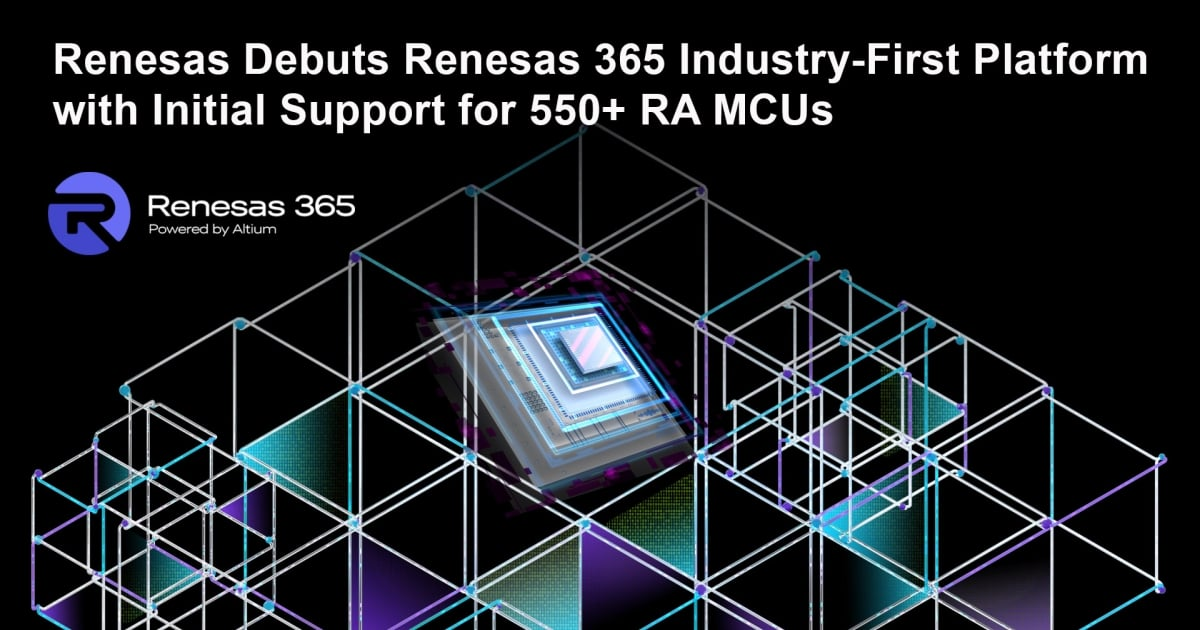
Renesas Electronics has integrated Xplore Developer Hub into its Renesas 365 development platform, bringing low-cost RA microcontroller boards, modular expansion hardware, reusable software, and development tools into a connected engineering environment. The service provides more than 100 application-focused software building blocks and access to development boards priced from approximately US$12.
The new hub combines hardware selection, software resources, tutorials, and application demonstrations within Renesas 365, powered by Altium. It is available to new and existing Renesas RA users and is being demonstrated at electronica 2026 in Munich. Support for further microcontroller and microprocessor families is planned, alongside additional expansion modules and AI-guided development capabilities.
Embedded product development commonly begins with the selection of a processor and the hardware required to support its intended functions. A connected monitoring device, for example, might require a microcontroller, environmental sensors, wireless communication, power management, and firmware capable of coordinating those components. Evaluating the complete arrangement can involve several development tools and hardware platforms.
Individual microcontroller peripherals also require configuration before the application can use them. Communication interfaces, timers, analogue inputs, and digital outputs must be assigned appropriate operating parameters and connected to the correct external circuitry. Although device libraries and code-generation tools can automate part of this work, an application still requires software that performs useful functions using those interfaces.
Renesas is addressing that second layer through software building blocks associated with defined application requirements. Rather than concentrating exclusively on register settings or peripheral drivers, the blocks incorporate reusable functions designed for activities such as connectivity, sensing, and control. The company says the modules have been validated for supported Renesas hardware and peripherals.
More than 100 blocks are available within the hub. Renesas identifies near-field communication and Bluetooth Low Energy as examples of functionality that can be reused across products such as asset trackers, smart locks, and domestic appliances. The common software may provide a starting point for different applications, although each product still requires integration with its particular hardware and operating requirements.
The Xplore catalogue also includes application examples covering Bluetooth sensor transmission, NFC-controlled access, and event detection using sensor data. These examples combine several hardware and software functions rather than demonstrating an isolated peripheral. A wireless sensor application, for instance, must acquire measurements, prepare the resulting information, and pass it to a communication interface using the relevant protocol.
Developers can begin with a Renesas RA microcontroller evaluation board and add compatible analogue, power, or connectivity expansion modules. This allows a proposed combination of components to be tested before a dedicated printed circuit board is designed. Existing development hardware can support early investigation of software behaviour and interface requirements, particularly when the final circuit architecture has not yet been established.
Modular prototyping does not eliminate the engineering work required for production hardware. A custom board must still provide suitable electrical connections, power distribution, component placement, and signal routing. Software may also need revision when pin assignments, peripheral availability, memory resources, or external devices differ from the original evaluation configuration.
The integration with Renesas 365 places these activities within a cloud-connected development environment. Users can access software resources, development tools, documentation, and project information through a web browser, while the platform supports collaboration between engineering participants. It provides a common location for evaluating hardware and software combinations instead of requiring every resource to be managed through an unrelated interface.
Collaboration is particularly relevant when hardware design and embedded software development proceed in parallel. Changes to a selected microcontroller or external component can affect the firmware configuration, while software requirements may reveal that additional processing resources or different interfaces are needed. Sharing project information can make those dependencies visible earlier in development.
Renesas has organised the hub around application-led workflows, allowing users to start with a desired function and examine suitable hardware and software building blocks. This reverses part of the conventional approach in which a processor is selected first and the application is subsequently constructed around its peripherals. The resulting design must nevertheless be evaluated against performance, cost, power consumption, and other product constraints.
The company's examples cover industrial equipment, smart home systems, connected devices, and other embedded applications. These products can impose different requirements despite using related microcontroller families. A sensor node designed for occasional wireless transmission may prioritise low energy consumption, while an industrial control application may require tighter timing and a different set of communication interfaces.
Software reuse also has limits. A validated building block provides functionality under the conditions for which it was developed, but the complete application must still be tested with the selected components and operating environment. Security, response time, memory use, error handling, and reliability depend on interactions between the reusable code and the surrounding system.
Renesas intends to extend the hub to additional MCU and MPU families, broadening the hardware available for application-led development. The company has also identified AI-guided workflows as a future addition, although it has not specified their release date or detailed capabilities. These planned features are separate from the software and hardware resources available at launch.
Xplore Developer Hub is available now within Renesas 365 for RA users. The company's immediate offering combines low-cost evaluation boards with a reusable software library and connected development tools, while later updates are expected to expand its supported hardware and development functions. Renesas has not published independent comparisons establishing a particular reduction in prototype development time across customer projects.